

Pakistan amends rules on purchasing forex as rupee breaches psychological barrier against greenback 

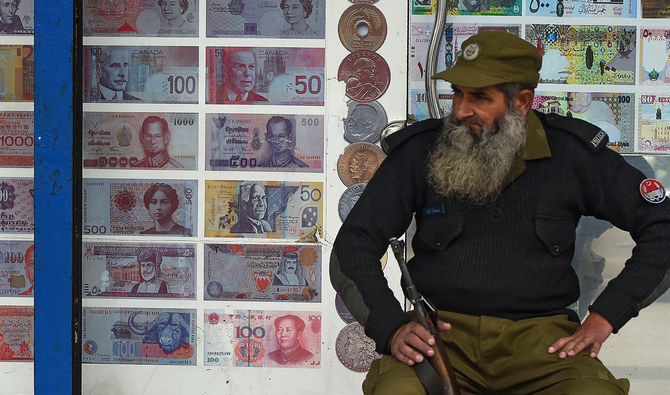
In this file photo, a Pakistani security guard sits outside the currency exchange shop in Lahore on Jan. 3, 2018. (AFP)
Short Url
Updated 20 December 2021
Follow

Pakistan amends rules on purchasing forex as rupee breaches psychological barrier against greenback 

  • Exchange companies must ensure no individual can buy foreign exchange of over $10,000 per day, $100,000 per calendar year
  • On Friday rupee crossed psychological barrier of Rs178 in the interbank market, closed at Rs178.04 against greenback

KARACHI: The State Bank of Pakistan (SBP) has amended its rules on the purchase of foreign currency, binding all exchange companies to ensure that no individual can buy foreign exchange of more than $10,000 per day and $100,000 per calendar year. 

The new rules have been announced as the greenback continues to climb against the rupee and the central bank struggles to stop the flow of foreign currency out of Pakistan and enhance transparency in transactions by exchange companies.

On Friday the rupee crossed the psychological barrier of Rs178 in the interbank market, losing its value by 0.03 percent to close at Rs178.04 against the greenback.

“In order to enhance documentation and transparency and to further strengthen the foreign exchange regulatory regime, the State Bank of Pakistan has amended the regulations governing sale of foreign exchange to individuals by exchange companies,” the central bank said on Sunday.

“This step, which is in continuation of other measures being taken by SBP, is primarily to discourage speculative buying and selling of foreign exchange from the exchange companies without affecting the ability of the market to serve the genuine needs of the public.”

Listing the new rules, the bank said exchange companies were now bound to ” ensure that any individual shall not purchase foreign exchange from all exchange companies in excess of USD 10,000 per day and USD 100,000 (or equivalent in other currencies) per calendar year, in the form of cash or outward remittances.”

Additionally, the statement said, individuals could remit educational and medical expenses abroad up to $70,000 per calendar year and $50,000 per invoice respectively, from banks as per existing regulations.

“For remittance of any amount in excess of these limits, or for any other purposes, individuals can approach Foreign Exchange Operations Department of SBP-BSC, through their bank. Further, there is no change in regulations with respect to foreign currency accounts of the individuals,” the statement said. 

Under new rules for exchange companies announced in October, people traveling to Afghanistan were allowed to carry only $1,000 per person per visit, with a maximum annual limit of $6,000. Exchange companies were required to conduct biometric verification for all foreign currency sale transactions equivalent to $500 and above and outward remittances, effective from October 22, 2021.

Exchange companies were also asked to sell foreign currency in cash and make outward remittances equivalent to $10,000 and above against receipt of funds through cheque or banking channels only.


Pakistan, ADB sign $730 loan agreements to boost SOE reforms, energy infrastructure

Updated 25 December 2025
Follow

Pakistan, ADB sign $730 loan agreements to boost SOE reforms, energy infrastructure

  • Both sign $330 million Power Transmission Strengthening Project and $400 million SOE Transformation Program loan agreements
  • Economic Affairs Division official says Transmission Project will secure Pakistan’s energy future by strengthening national grid’s backbone

KARACHI: Pakistan and the Asian Development Bank (ADB) on Thursday signed two loan agreements totaling $730 million to boost reforms in state-owned enterprises (SOEs) and energy infrastructure in the country, the bank said.

The first of the two agreements pertains to the SOE Transformation Program worth $400 million while the second loan, worth $330 million, is for a Power Transmission Strengthening Project, the lender said. 

The agreements were signed by ADB Country Director for Pakistan Emma Fan and Pakistan’s Secretary of Economic Affairs Division Humair Karim. 

“The agreements demonstrate ADB’s enduring commitment to supporting sustainable and inclusive economic growth in Pakistan,” the ADB said. 

Pakistan’s SOEs have incurred losses worth billions of dollars over the years due to financial mismanagement and corruption. These entities, including the country’s national airline Pakistan International Airlines, which was sold to a private group this week, have relied on subsequent government bailouts over the years to operate.

The ADB approved the $400 million loan for SOE reforms on Dec. 12. It said the program seeks to improve governance and optimize the performance of Pakistan’s commercial SOEs. 

Karim highlighted that the Power Transmission Strengthening Project will enable reliable evacuation of 2,300 MW from Pakistan’s upcoming hydropower projects, relieve overloading of existing transmission lines and enhance resilience under contingency conditions, the Press Information Department (PID) said. 

“The Secretary emphasized that both initiatives are transformative in nature as the Transmission Project will secure Pakistan’s energy future by strengthening the backbone of the national grid whereas the SOE Program will enhance transparency, efficiency and sustainability of state-owned enterprises nationwide,” the PID said. 

The ADB has supported reforms by Pakistan to strengthen its public finance and social protection systems. It has also undertaken programs in the country to help with post-flood reconstruction, improve food security and social and human capital. 

To date, ADB says it has committed 764 public sector loans, grants and technical assistance totaling $43.4 billion to Pakistan.