


DUBAI: The Gulf Cooperation Council is pressing ahead with plans for an economic union between its six members in just four years’ time, despite a “very challenging” timetable, the secretary-general of the GCC told Arab News.
Nayef Al-Hajjraf, who took over the organization’s top job in 2020, said that the verdict of last week’s GCC summit was conclusive. “The directions or the decisions made by the supreme council are very clear — it has been set as a deadline 2025. There is a lot of work ongoing. We are working on the customs union, we are working on the common market, and also lifting the barriers that might be in between.”
He added: “I know 2025 is around the corner. There is a lot of work that needs to be done for the next four years. We have to emphasize that we are not starting from scratch, there is huge work that we conducted and completed actually over the last 20 years since the custom union was announced in 2003.”
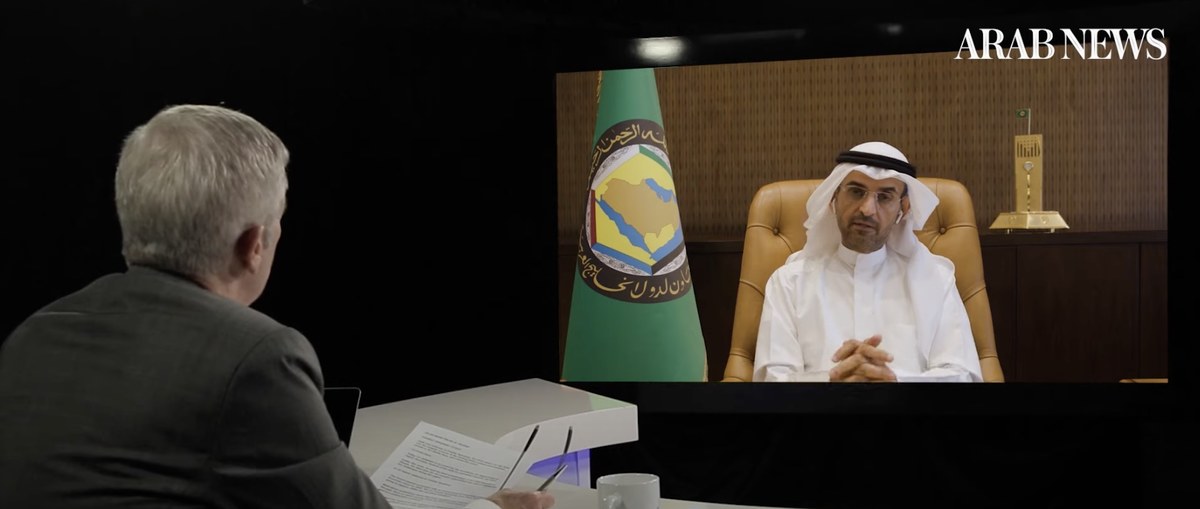
Al-Hajjraf underlined the GCC’s commitment to union on “Frankly Speaking,” the series of video interviews with leading regional and global policymakers. He was speaking after the 42nd summit of GCC leaders in Riyadh last week.
In the course of a wide-ranging interview, he also talked of the possibility of further political integration in the GCC, the need for a unified rate of value-added tax across the organization, the desirability of a special “business visa” to aid commerce, and the GCC’s commitment to mutual defense security.
He also pledged the GCC to work toward a fully fledged economic and political union, an ambition set out by the late King Abdullah of Saudi Arabia and reinforced by King Salman in 2015. “We are fully dedicated to implement what was adopted by King Salman’s vision in 2015,” Al-Hajjraf said.
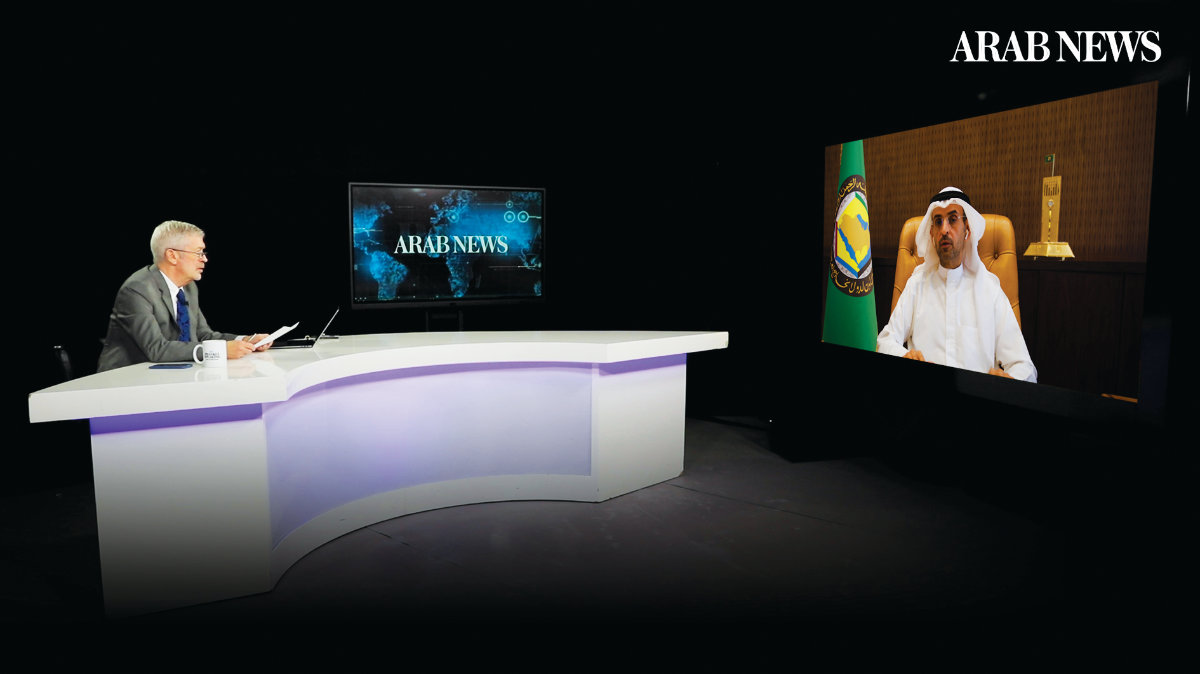
Al-Hajjraf, formerly the minister of finance of Kuwait, praised the “fundamental achievements, the milestones” of GCC unity, and said that issues that had been contentious in the past, such as the location of a GCC central bank and a common currency, were “technical issues” that could be resolved because “the political will is there and the direction is very clear.”
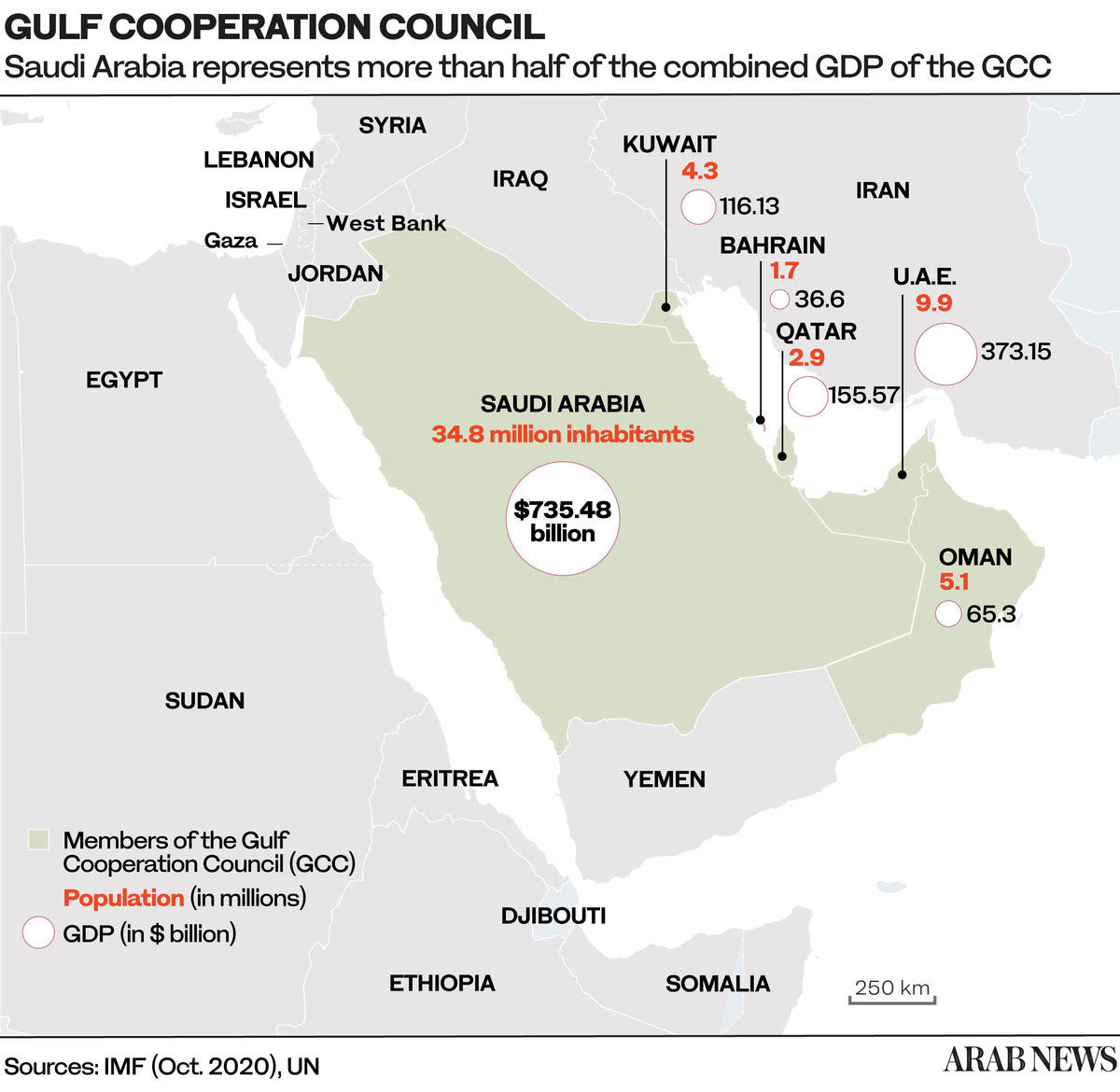
He said that VAT rates, which at the moment vary from zero to 15 percent across different GCC countries, could eventually be unified. The global pandemic had a “significant impact” on VAT policy, he said.
“That was the reason some countries raised their VAT to 15 percent — that’s in Saudi Arabia, for example — and to 10 recently in Bahrain, while in Oman and UAE they maintain the 5 percent, and in Qatar they have 5 percent for excise tax but no VAT. In Kuwait, they still work with the National Assembly to get the approval for both VAT and excise taxes,” he said.
“I think within a time frame this should be unified. This will be discussed for the coming period and we hope that we’ll reach the unified percentage,” he added.
Al-Hajjraf also held out the prospect of the introduction of a special visa for business travelers in the GCC in order to facilitate cross-border trade.
“That’s a great idea. It is on our agenda. It has been discussed last year at several meetings and we hope that soon we will conclude this.”
He added: “You know that this requires a lot of approvals from different governmental agencies within the six member states. It has been discussed and, hopefully, we’ll be able to conclude it and then we will announce it when it is finalized.”
On the possibility of GCC enlargement, Al-Hajjraf said the plan was to “intensify” relations with non-GCC countries such as Jordan and Morocco, both mentioned as potential full members previously by King Abdullah.
“For the time being this kind of strategic relation is very important for the GCC, as well as for Jordan and Morocco, and we are intending to intensify this kind of relation because we strongly believe that we have a role to stabilize not only the region, but to be the voice of wisdom across the Arab world as well,” he said.
Egypt, too, will play an increasingly influential role in regional affairs and in relations with the GCC, he said. “Egypt is at the heart of the Arab world and has a historical role. The GCC at the same time is also a stabilizer, and is fulfilling its objective to civilize and maintain the peace and security in the region. So getting together is just something we are doing all the time. We need to see that this relation is taking an institutionalized way.”
The summit reiterated its support for UN resolutions recognizing Morocco’s right to the Western Sahara, and the country’s need for “security, stability and territorial integrity,” even at the risk of alienating neighboring Algeria. “That was our view and our belief from day one,” he said.
The 42nd summit also restated its long-standing support for the Palestinians and their rights to a two-state solution within the 1967 borders, although two members of the GCC, the UAE and Bahrain, have normalized relations with Israel.
“Even though two countries have signed a peace agreement with Israel according to the Abraham Accord — which were sovereign decisions we respect very much — the two-state solution is our view how to solve this long-lasting conflict, a conflict that helps no one. I don’t think the Palestinians or the Israelis are benefiting from continuing the status quo,” he said.
The GCC was waiting for a response from the Israelis on the two-state proposals, but Al-Hajjraf said the 1967 borders and East Jerusalem as the Palestinian capital were essential features of any peace initiative.
The GCC’s joint defense treaty, which specifies that a military attack on one member is an attack on all, was also underlined at the recent summit. Al-Hajjraf said that it will continue be a “binding” agreement, as it had been when Iraq attacked Kuwait in 1990.
He condemned continuing military support from Iran to the Houthi militia in Yemen, which he said was making matters worse on the ground and causing needles civilian casualties , and added that the GCC was fully supporting the peace-seeking efforts of the US and UN special envoys on Yemen, as well as the role of Oman.
The position of the Emirati islands in the Gulf that have been occupied by Iran for the past 50 years should be resolved by dialogue, negotiation and through the international courts, he said.
The GCC should be more involved in negotiations in Vienna over Iran’s nuclear plans, he said, adding that the forum should be widened to include talks about Tehran’s aggressive expansionist policies in the region.
“This should be a one package. The Vienna talks should not be limited to resuming the JCPOA at all, but it should take the whole package all at once. We have also expressed our demand to be there at the negotiation table because we strongly believe that the Iranian nuclear program will not affect Washington, which is 10,000 miles from the area, but it will affect us — we are only 100 miles from their nuclear capabilities or facilities,” he said.
Al-Hajjraf reiterated the GCC’s support for the people of Lebanon, but criticized the influence of Hezbollah and Iran in the country’s internal affairs, and the negligence displayed by the country’s political elites. “They need to start thinking how to help themselves first and then seek the help from outside,” he said.
The AlUla summit in January 2021 marked the end of rifts and differences within the GCC, he said, and a “new beginning” for the organization, cemented by the regional tour of Crown Prince Mohammed Bin Salman before last week’s summit.
“These are very important milestones and we are very satisfied that this has been put behind us and we are looking to move forward,” he said.


