Cyprus, Jordan sign bilateral agreements

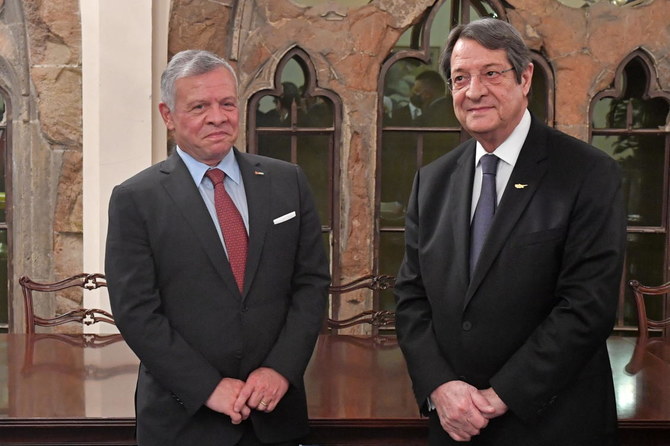
Cypriot President Nicos Anastasiades receives Jordan’s King Abdullah II at the presidential palace in Nicosia on Friday. (Reuters)
Short Url
Updated 17 December 2021
Follow

Cyprus, Jordan sign bilateral agreements

  • The agreements covered issues including double taxation and the extradition of fugitives
  • The two leaders discussed bilateral relations and regional developments

NICOSIA: Jordan’s King Abdullah II paid an official visit to Cyprus on Friday for talks with President Nicos Anastasiades, during which several bilateral accords were signed, officials said.
The agreements covered issues including double taxation and the extradition of fugitives.
Following a military guard of honor, Anastasiades and Abdullah held a private meeting and exchanged gifts.
“President Anastasiades bestowed upon the king of Jordan the highest honor of the Republic of Cyprus... and King Abdullah II bestowed upon the president the highest honor of Jordan,” the presidency said.
The two leaders discussed bilateral relations and regional developments, as well as climate change and efforts to combat Covid-19.
Abdullah was also briefed on efforts to resume United Nations-backed Cyprus reunification talks and Turkish warnings against Nicosia over oil and gas exploration in the region.
Jordan has joined a burgeoning regional alliance that includes Egypt, Greece and Israel, based on shared energy interests.


Trump demands role in choosing next Iran leader, Khamenei's son ‘unacceptable’

Updated 16 sec ago
Follow

Trump demands role in choosing next Iran leader, Khamenei's son ‘unacceptable’

  • US president tells Axios US would likely return to war within five years without a favorable leader in Iran
  • Draws parallel with Venezuela where interim president Delcy Rodriguez has cooperated under threat of violence
WASHINGTON: US President Donald Trump on Thursday insisted he should have a role in picking Iran’s next supreme leader after the killing of Ayatollah Ali Khamenei, whose son he said he found unacceptable.
“Khamenei’s son is a lightweight. I have to be involved in the appointment, like with Delcy,” Trump told Axios in an interview, drawing a comparison to Venezuela, where interim president Delcy Rodriguez has cooperated with him under threat of violence after the United States ousted her boss, Nicolas Maduro.
Trump told the news outlet that the United States would likely return to war within five years without a favorable leader in Iran.
“Khamenei’s son is unacceptable to me. We want someone that will bring harmony and peace to Iran,” Trump was quoted saying by the news outlet.
It was unclear in what way Trump would be able to take a role in the Islamic republic’s selection of a new supreme leader, a decision made by an assembly of senior Shiite Muslim clerics mostly staunchly opposed to the United States. Trump was raised a Presbyterian.
But his remarks imply a willingness to work with someone from within the Islamic republic rather than seek to topple the government, which has been a sworn enemy of the United States since the 1979 Islamic revolution toppled the pro-Western shah.
The late shah’s son, Reza Pahlavi, has proposed that he return as a transitional figure before Iran drafts a new constitution as a secular democracy. Pahlavi earlier Thursday said that any new supreme leader within the Islamic republic would be illegitimate.
Ali Khamenei, who ruled Iran since 1989 with hard-line policies that included repression at home and confrontation with neighboring countries, was killed Saturday in an Israeli strike as Israel and the United States opened war.
His son, Mojtaba Khamenei, is considered one of the contenders to succeed his father, who was only the second supreme leader after revolutionary leader Ayatollah Ruhollah Khomeini.
In Venezuela, Trump ordered a deadly January 3 attack in which US forces snatched Maduro, a longtime US nemesis.
Rather than backing the opposition long championed by the United States, Trump has said he has been pleased by Rodriguez, who was Maduro’s vice president but has cooperated on key US demands, notably on benefiting oil companies.
She is doing so under Trump’s threat of violence if she does not do what he wants, particularly on access to natural resources.