

EU hopes fresh talks, not sanctions, will avert Ukraine war

1 / 2
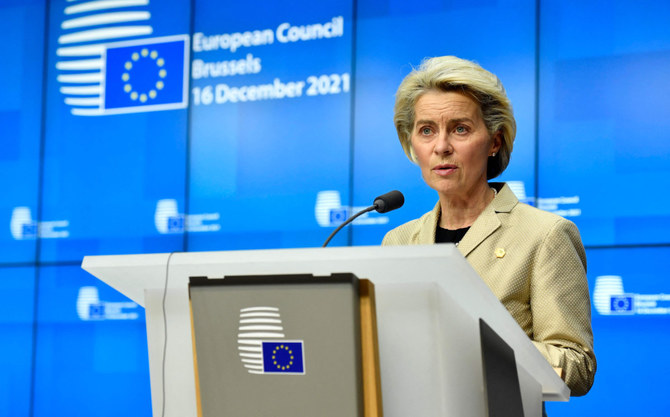
European Commission President Ursula von der Leyen holds a press conference after an European Union Summit in Brussels,early on Dec. 17, 2021. (AFP/Pool)
2 / 2
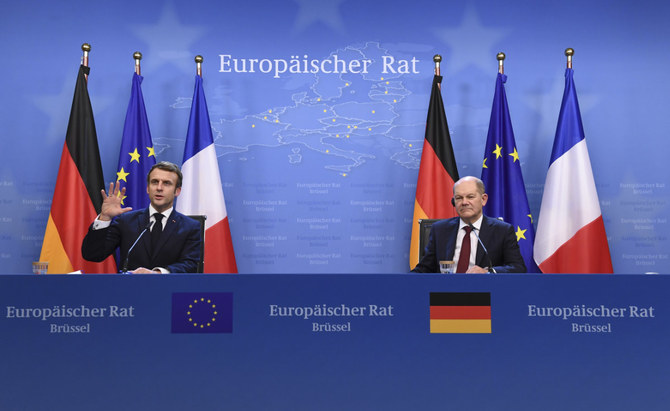
German Chancellor Olaf Scholz, right, and French President Emmanuel Macron address a media conference at the conclusion of an EU Summit in Brussels on Dec. 17, 2021. (John Thys, Pool Photo via AP)
Short Url
Updated 17 December 2021
Follow

EU hopes fresh talks, not sanctions, will avert Ukraine war

  • Leaders reiterate warning of sanctions with ‘massive cost’ if Russia invades Ukraine
  • Countries on the EU’s eastern flank closer to Russia believe sanctions would work best as a deterrent and should be imposed immediately

BRUSSELS: European Union leaders on Thursday pressed Russia to return to peace talks with Ukraine and renewed their threat to impose unprecedented sanctions on Moscow in tandem with the United States and Britain should Russian armed forces cross the border.

“Let there be no doubt. If Russia were to move against Ukraine, the Union will be in a position to take sanctions that could extract a massive cost. We have done our work in that respect,” European Commission president Ursula von der Leyen  told a news conference following a summit of EU leaders in Brussels.
The EU’s call for a return to the negotiating table came as Russia said it had submitted draft documents to the United States outlining security arrangements that it wants to negotiate with Washington and its allies in the NATO military alliance. NATO is suggesting it might be willing to discuss them.
US intelligence officials say Russia has moved 70,000 troops and is preparing for a possible invasion early next year. Moscow denies it has any plans to attack, as it did in 2014 when it annexed the Crimean Peninsula, but says it wants guarantees that Ukraine will never join NATO.
In a statement in Brussels, the EU leaders underlined “the urgent need for Russia to de-escalate tensions caused by the military buildup along its border with Ukraine and aggressive rhetoric.” They pledged their “full support for Ukraine’s sovereignty and territorial integrity.”
They said the EU “encourages diplomatic efforts and supports the Normandy format in achieving the full implementation of the Minsk Agreements,” in reference to French and German brokered talks between the two sides aimed at enforcing a 2015 peace deal.
The leaders repeated a message sent from the US, Britain and the Group of Seven industrial nations in recent weeks that “any further military aggression against Ukraine will have massive consequences and severe cost in response, including restrictive measures coordinated with partners.”
The EU is divided over when to hit Moscow with sanctions. France and Germany want to hold fire, expressing concern that such action could bring on an attack and believing that a diplomatic solution can be found.
Both countries’ leaders underlined Thursday the importance of reviving the Normandy talks, which have made little headway this year.
“We have a very good format, the Normandy format, that we want to reactivate, re-energize,” German Chancellor Olaf Scholz told reporters. “It won’t be easy, we should not be naïve, and we should be very clear when it comes to the integrity of borders.”
France and Germany’s peace efforts in 2015 helped end large-scale hostilities in eastern Ukraine, where Ukrainian forces have been fighting Russia-backed separatists since 2014. But the conflict, which has left 14,000 dead, has simmered.
In contrast, countries on the EU’s eastern flank closer to Russia believe sanctions would work best as a deterrent and should be imposed immediately. Ukraine’s president wants more sanctions to be imposed before — instead of after — any possible incursion, but his plea has fallen on deaf ears.
Lithuanian President Gitanas Nauseda, whose country borders Russia, said the EU should not underestimate the threat the troop buildup poses. He warned that Moscow’s actions are creating one of the worst security situations since the collapse of the Soviet Union.
“I’m talking not only about Ukraine,” Nauseda said, stressing that the entire Baltic region and Poland should be concerned.
EU lawmakers said in a resolution that “any new sanctions package should include the Russian officer corps and flag officers involved in the planning of a possible invasion, as well as the immediate circle and oligarchs ‘in the orbit of the Russian President and their families.’”
They said it should involve “the freezing of financial and physical assets in the EU, travel bans, the exclusion of Russia from the SWIFT payment system” for international financial transfers, target key economic sectors and disrupt the financing of the intelligence services and the armed forces.
The lawmakers have no decision-making powers on sanctions, but their experts often have detailed knowledge of what member countries are thinking on joint foreign policy initiatives.
Meanwhile, the Kremlin again prodded Western leaders to provide legally binding guarantees that Ukraine would never join NATO or that its members weapons would ever be deployed there, calling such moves a “red line” for Moscow.
The US and its allies have refused to make such a pledge, but Putin and US President Joe Biden agreed last week on further talks to discuss Russian concerns.



Mystery of CIA’s lost nuclear device haunts Himalayan villagers 60 years on

Updated 20 December 2025
Follow

Mystery of CIA’s lost nuclear device haunts Himalayan villagers 60 years on

  • Plutonium-fueled spy system was meant to monitor China’s nuclear activity after 1964 atomic tests
  • Porter who took part in Nanda Devi mission warned family of ‘danger buried in snow’

NEW DELHI: Porters who helped American intelligence officers carry a nuclear spy system up the precarious slopes of Nanda Devi, India’s second-highest peak, returned home with stories that sent shockwaves through nearby villages, leaving many in fear that still holds six decades later.

A CIA team, working with India’s Intelligence Bureau, planned to install the device in the remote part of the Himalayas to monitor China, but a blizzard forced them to abandon the system before reaching the summit.

When they returned, the device was gone.

The spy system contained a large quantity of highly radioactive plutonium-238 — roughly a third of the amount used in the atomic bomb dropped by the US on the Japanese city of Nagasaki in the closing stages of the Second World War.

“The workers and porters who went with the CIA team in 1965 would tell the story of the nuclear device, and the villagers have been living in fear ever since,” said Narendra Rana from the Lata village near Nanda Devi’s peak.

His father, Dhan Singh Rana, was one of the porters who carried the device during the CIA’s mission in 1965.

“He told me there was a danger buried in the snow,” Rana said. “The villagers fear that as long as the device is buried in the snow, they are safe, but if it bursts, it will contaminate the air and water, and no one will be safe after that.”

During the Sino-Indian tensions in the 1960s, India cooperated with the US in surveillance after China conducted its first nuclear tests in 1964. The Nanda Devi mission was part of this cooperation and was classified for years. It only came under public scrutiny in 1978, when the story was broken by Outsider magazine.

The article caused an uproar in India, with lawmakers demanding the location of the nuclear device be revealed and calling for political accountability. The same year, then Prime Minister Morarji Desai set up a committee to assess whether nuclear material in the area near Nanda Devi could pollute the Ganges River, which originates there.

The Ganges is one of the world’s most crucial freshwater sources, with about 655 million people in India, Nepal, and Bangladesh depending on it for their essential needs.

The committee, chaired by prominent scientists, submitted its report a few months later, dismissing any cause for concerns, and establishing that even in the worst-case scenario of the device’s rupture, the river’s water would not be contaminated.

But for the villagers, the fear that the shell containing radioactive plutonium could break apart never goes away, and peace may only come once it is found.

Many believe the device, trapped within the glacier’s shifting ice, may have moved downhill over time.

Rana’s father told him that the device felt hot when it was carried, and he believed it might have melted its way into the glacier, remaining buried deep inside.

An imposing mass of rock and ice, Nanda Devi at 7,816 m is the second-highest mountain in India after Kangchenjunga. 

When a glacier near the mountain burst in 2021, claiming over 200 lives, scientists explained that the disaster was due to global warming, but in nearby villages the incident was initially blamed on a nuclear explosion.

“They feared the device had burst. Those rescuing people were afraid they might die from radiation,” Rana said. “If any noise is heard, if any smoke appears in the sky, we start fearing a leak from the nuclear device.”

The latent fear surfaces whenever natural disasters strike or media coverage puts the missing device back in the spotlight. Most recently, a New York Times article on the CIA mission’s 60th anniversary reignited the unease.

“The apprehensions are genuine. After 1965, Americans came twice to search for the device. The villagers accompanied them, but it could not be found, which remains a concern for the local community,” said Atul Soti, an environmentalist in Joshimath, Uttarakhand, about 50 km from Nanda Devi.

“People are worried. They have repeatedly sought answers from the government, but no clear response has been provided so far. Periodically, the villagers voice their concerns, and they need a definitive government statement on this issue.”

Despite repeated queries whenever media attention arises, Indian officials have not released detailed updates since the Desai-appointed committee submitted its findings.

“The government should issue a white paper to address people’s concerns. The white paper will make it clear about the status of the device, and whether leakage from the device could pollute the Ganges River,” Soti told Arab News.

“The government should be clear. If the government is not reacting, then it further reinforces the fear.”