France to ban non-essential UK travel over omicron surge

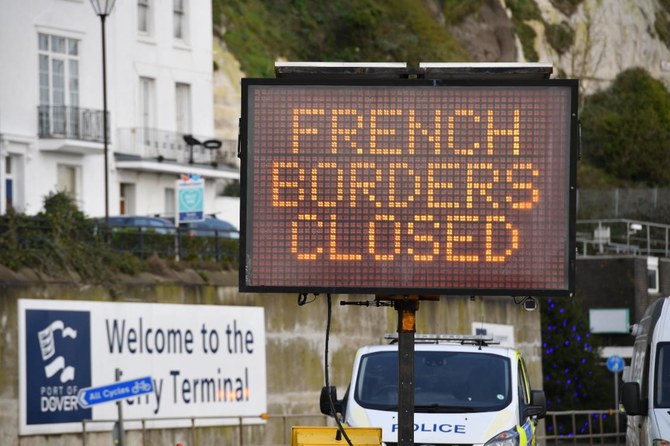
A sign informs drivers that the French border crossing is closed at the cordoned entrance to the ferry terminal at the Port of Dover in Kent, south east England. (File/AFP)
Short Url
Updated 16 December 2021
Follow

France to ban non-essential UK travel over omicron surge

  • French citizens and EU nationals could still return to France from the UK
  • Britain on Wednesday recorded a record 78,610 laboratory-confirmed COVID-19 cases

PARIS: France will ban non-essential travel to and from Britain from the weekend to slow the spread of the omicron Covid-19 variant that is causing record numbers of cases on the other side of the Channel, the government said Thursday.
From midnight Saturday (2300 GMT Friday) there will be a “requirement to have an essential reason to travel to, or come from, the UK, both for the unvaccinated and vaccinated... People cannot travel for touristic or professional reasons,” the government said in a statement.
“Faced with the extremely rapid spread of the omicron variant in the UK, the government has chosen to reinstate the need for an essential reason for travel from and to the UK,” the statement said.
It added that French citizens and EU nationals could still return to France from the UK.
“We will put in place a system of controls drastically tighter than the one we have already,” government spokesman Gabriel Attal told BFMTV channel.
Attal said the policy was aimed at “tightening the net” to slow down the arrival of omicron cases in France and give time for the French vaccination booster campaign to make more ground.
“Our strategy is to delay as much as we can the development of omicron in our country and take advantage to push ahead with the booster drive,” he said.
In addition, returning travelers will need a negative test less than 24 hours old, and a blanket quarantine would be enforced on return to France.
“People (coming back) will have to register on an app and will have to self-isolate in a place of their choosing for seven days — controlled by the security forces — but this can be shortened to 48 hours if a negative test is carried out in France,” he said.
Britain on Wednesday recorded a record 78,610 laboratory-confirmed Covid cases, with scientists predicting even higher rates as omicron is believed to spread much faster than the currently dominant Delta variant.
The tight travel restrictions are also being imposed during what analysts see as a breakdown of trust between the British and French governments in the wake of Brexit over a host of issues from migrants to fishing.
French President Emmanuel Macron last week accused UK Prime Minister Boris Johnson’s government of failing to keep its word on Brexit, saying “the problem with the British government is that it does not do what it says.”


Rwanda-back M23 rebels say they will withdraw from seized city in eastern Congo

Updated 6 sec ago
Follow

Rwanda-back M23 rebels say they will withdraw from seized city in eastern Congo

  • The statement also called for the demilitarization of Uvira
  • Uvira residents said Tuesday that the rebels are still in the town

DAKAR: Rwanda-backed M23 rebels said Tuesday they will withdraw from Uvira, the strategic city in eastern Congo seized last week, as fighting in the region escalated despite a US mediated peace deal.
Corneille Nangaa, leader of the Congo River Alliance, which includes M23, said the withdrawal was requested by the US and is a “unilateral trust-building measure” to facilitate the peace process.
The statement also called for the demilitarization of Uvira, the protection of its population and infrastructure, and the monitoring of the ceasefire through the deployment of a neutral force. It did not say whether M23’s withdrawal is contingent on implementing these measures.
Uvira residents said Tuesday that the rebels are still in the town.
M23 took control of the city last week following a rapid offensive launched at the start of the month. Along with the more than 400 people killed, about 200,000 have been displaced, regional officials say.
The rebels’ latest offensive comes despite a US-mediated peace agreement signed earlier this month by the Congolese and Rwandan presidents in Washington.
The US last week accused Rwanda of violating the agreement by backing a deadly new rebel offensive in the mineral-rich eastern Congo, and warned that the Trump administration will take action against “spoilers” of the deal.
The accord didn’t include the rebel group, which is negotiating separately with Congo and agreed earlier this year to a ceasefire that both sides accuse the other of violating. However, it obliges Rwanda to halt support for armed groups like M23 and work to end hostilities.
The rebels’ advance pushed the conflict to the doorstep of neighboring Burundi, which has maintained troops in eastern Congo for years, heightening fears of a broader regional spillover.
At least 30,000 Congolese have crossed the nearby border into Burundi since Dec.8, according to the Burundian Ministry of Foreign Affairs. There have also been reports of shells falling in the town of Rugombo, on the Burundian side of the border.
Congo, the US and UN experts accuse Rwanda of backing M23, which has grown from hundreds of members in 2021 to around 6,500 fighters, according to the UN
More than 100 armed groups are vying for a foothold in mineral-rich eastern Congo, near the border with Rwanda, most prominently M23. The conflict has created one of the world’s most significant humanitarian crises, with more than 7 million people displaced, according to the UN agency for refugees.