

UK charities launch winter crisis appeal for Afghanistan

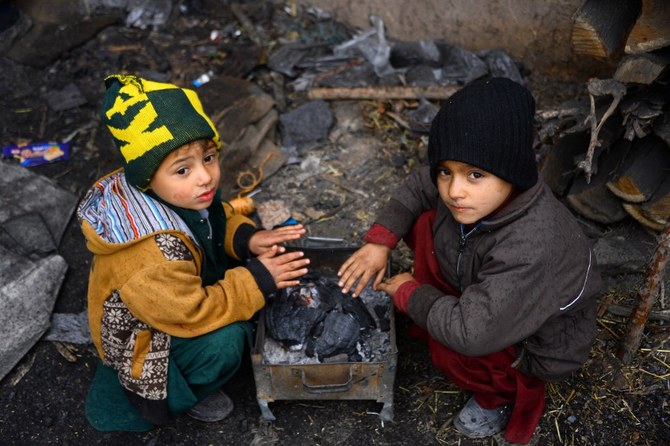
Public donations would be used for supply winter kits to help families stay warm, among others. Above, children warm up themselves around a charcoal fire in Herat on Nov. 22, 2020. (AFP)
Short Url
Updated 15 December 2021
Follow

UK charities launch winter crisis appeal for Afghanistan

  • One million children could die of hunger in next 3 months
  • ‘This is no longer about making things better, this is about saving lives:’ British Red Cross official

LONDON: More than a dozen of the UK’s most prominent aid agencies have joined forces to launch an emergency appeal for public donations in a bid to avert a deadly famine for millions of people in Afghanistan.

According to the UK’s Disasters Emergency Committee, which is coordinating the efforts, 1 million children are at risk of dying from malnutrition in the next three months, and more than 22 million will go hungry.

Oxfam, the British Red Cross, and another 13 charities, are together launching the appeal for money to help avoid the disaster and the British government has promised to match pound-for-pound the first £10 million ($13.25 million) raised by the public.

The coronavirus disease (COVID-19) pandemic, conflict, and drought in Afghanistan have brought the country to a “tipping point,” the DEC warned, leaving 8 million people at risk of starvation.

And while the Taliban takeover of the country had been a contributing factor to the crisis, Afghanistan was also in the grip of its worst drought in more than a quarter of a century. Much of the nation’s wheat crop has been ruined, and prices have soared as a result.

In a statement, the committee said: “The situation will only get worse as the freezing weather sets in. We must act now to save lives. DEC charities are already on the ground providing lifesaving aid, scaling up their operations, and reaching those most in need.”

Saleh Saeed, the DEC’s chief executive officer, said the situation was already “beyond horrific.” He added: “We can’t just sit back and watch. We can’t just let this happen.”

Public donations would be used to deliver emergency food and cash to hungry families, provide nutrition for young children and mothers, support healthcare facilities in treating malnutrition, and supply winter kits to help families stay warm.

Maryann Horne, of the British Red Cross, told the BBC that people were living “hand to mouth, not knowing where their next meal will come from” and “asking for the most basic help to feed their children.”

She said people in Afghanistan were traditionally resilient but now had a “sense of desperation” with “no light at the end of the tunnel.”

She added: “We are sounding the alarm bell. This is no longer about making things better, this is about saving lives, and reaching people before it’s too late.”


WHO appeals for $1 bn for world’s worst health crises in 2026

Updated 58 min 6 sec ago
Follow

WHO appeals for $1 bn for world’s worst health crises in 2026

  • The UN health agency estimated 239 million people would need urgent humanitarian assistance this year and the money would keep essential health services going

GENEVA: The World Health Organization on Tuesday appealed for $1 billion to tackle health crises this year across the world’s 36 most severe emergencies, including in Gaza, Sudan, Haiti and the Democratic Republic of Congo.
The UN health agency estimated 239 million people would need urgent humanitarian assistance this year and the money would keep essential health services going.
WHO health emergencies chief Chikwe Ihekweazu told reporters in Geneva: “A quarter of a billion people are living through humanitarian crises that strip away the most basic protections: safety, shelter and access to health care.
“In these settings, health needs are surging, whether due to injuries, disease outbreaks, malnutrition or untreated chronic diseases,” he warned.
“Yet access to care is shrinking.”
The agency’s emergency request was significantly lower than in recent years, given the global funding crunch for aid operations.
Washington, traditionally the UN health agency’s biggest donor, has slashed foreign aid spending under President Donald Trump, who on his first day back in office in January 2025 handed the WHO his country’s one-year withdrawal notice.
Last year, WHO had appealed for $1.5 billion but Ihekweazu said that only $900 million was ultimately made available.
Unfortunately, he said, the agency had been “recognizing ... that the appetite for resource mobilization is much smaller than it was in previous years.”
“That’s one of the reasons that we’ve calibrated our ask a little bit more toward what is available realistically, understanding the situation around the world, the constraints that many countries have,” he said.
The WHO said in 2026 it was “hyper-prioritising the highest-impact services and scaling back lower?impact activities to maximize lives saved.”
Last year, global funding cuts forced 6,700 health facilities across 22 humanitarian settings to either close or reduce services, “cutting 53 million people off from health care.” Ihekweazu said.
“Families living on the edge face impossible decisions, such as whether to buy food or medicine,” he added, stressing that “people should never have to make these choices.”
“This is why today we are appealing to the better sense of countries, and of people, and asking them to invest in a healthier, safer world.”