

Saudi FM to arrive in Islamabad on Dec. 18 for OIC meeting on Afghanistan

Pakistani foreign minister Shah Mehmood Qureshi receives Saudi Arabian Foreign Minister Prince Faisal bin Farhan Al-Saud at the Foreign Office in Islamabad on December 26, 2019. (Photo courtesy: Pakistan Foreign Office/File)
Short Url
Updated 16 December 2021
Follow

Saudi FM to arrive in Islamabad on Dec. 18 for OIC meeting on Afghanistan

  • Bahrain, Kuwait, Qatar, Indonesia, Malaysia and other countries have confirmed participation, PM’s aide says
  • Secretary level meeting to take place on Saturday to chalk out agenda items, foreign ministers to meet on Sunday

ISLAMABAD: Saudi foreign minister Prince Faisal bin Farhan Al Saud will arrive in Islamabad with a large delegation on Saturday, December 18, to participate in a special session of the Organization of Islamic Cooperation (OIC) to discuss a growing humanitarian crisis in Afghanistan, the Pakistani prime minister’s aide on the Middle East said on Wednesday.

The 17th Extraordinary Session of the OIC’s Council of Foreign Ministers was called by Saudi Arabia and will be hosted by Islamabad on December 19. The meeting’s focus is on the humanitarian situation in Afghanistan where the United Nations is warning nearly 23 million people – about 55 percent of the population – can face extreme levels of hunger, with nearly 9 million at risk of famine as winter takes hold in the impoverished, landlocked country.

The United States and other donors cut off financial aid on which Afghanistan became dependent during 20 years of war and more than $9 billion of the country’s hard currency assets were frozen.

“Saudi foreign minister will arrive in Islamabad with a big delegation on December 18 to participate in the OIC meeting on Afghanistan,” Tahir Mahmood Ashrafi told Arab News. “Today I met with Saudi ambassador to Pakistan Nawaf bin Said Al-Makli and discussed the upcoming OIC foreign ministers meeting on Afghanistan.”

He said all Islamic countries were participating in the meeting and a majority would be represented by their foreign ministers.

“Bahrain, Kuwait, Qatar, Indonesia, Malaysia and other important countries’ foreign ministers have already confirmed their participation,” Ashrafi said, adding that P-5 countries and European Union delegations had also confirmed participation.

The P5+1 refers to the UN Security Council’s five permanent members (the P5); namely China, France, Russia, the United Kingdom, and the United States; plus Germany. The P5+1 is often referred to as the E3+3 by European countries.

Talking about the agenda of the conference, Ashrafi said an official secretary level meeting would take place on Saturday to chalk out details and agenda items, while the foreign ministers would meet on Sunday.

“Pakistan and Saudi Arabia are presenting this opportunity to all the countries to share their reservations,” Ashrafi said, “and find solutions so that the Afghan people should not suffer.”

Pakistani foreign minister Shah Mahmood Qureshi also chaired a meeting of high officials later in the day to review the preparations and arrangements for the OIC conference.

According to an official statement, a detailed briefing on the OIC meeting was given to Qureshi by the managing committees constituted under the chairmanship of the foreign secretary.

“Special Teams [have been] formed to warmly welcome the Foreign Ministers and other distinguished guests attending the extraordinary meeting of the OIC Council of Foreign Ministers on Afghanistan,” the statement said.

“Fool-proof security arrangements [have also been] made in Islamabad on the occasion of OIC meeting,” foreign office added.
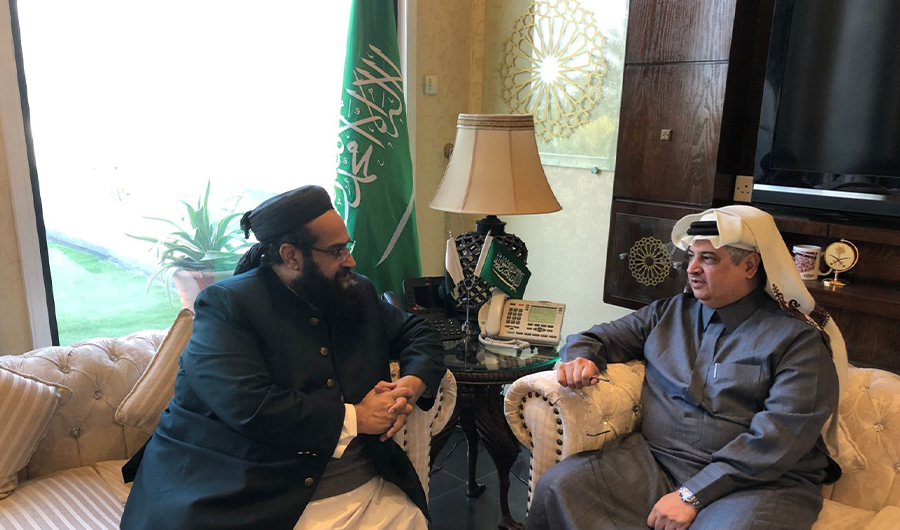


Prime Minister Imran Khan’s special representative for the Middle East Tahir Mahmood Ashrafi (L) meets with the Saudi envoy to Pakistan Nawaf bin Said Al-Makli (R) in Islamabad, Pakistan, on Dec 15, 2021. (Courtesy: Tahir Mahmood Ashrafi)

“Bahrain, Kuwait, Qatar, Indonesia, Malaysia and other important countries’ foreign ministers have already confirmed their participation,” Ashrafi said, adding that P-5 countries and European Union delegations had also confirmed participation.

The P5+1 refers to the UN Security Council’s five permanent members (the P5); namely China, France, Russia, the United Kingdom, and the United States; plus Germany. The P5+1 is often referred to as the E3+3 by European countries.

Talking about the agenda of the conference, Ashrafi said an official secretary level meeting would take place on Saturday to chalk out details and agenda items, while the foreign ministers would meet on Sunday.

“Pakistan and Saudi Arabia are presenting this opportunity to all the countries to share their reservations,” Ashrafi said, “and find solutions so that the Afghan people should not suffer.”

Pakistani foreign minister Shah Mahmood Qureshi also chaired a meeting of high officials later in the day to review the preparations and arrangements for the OIC conference.

According to an official statement, a detailed briefing on the OIC meeting was given to Qureshi by the managing committees constituted under the chairmanship of the foreign secretary.

“Special Teams [have been] formed to warmly welcome the Foreign Ministers and other distinguished guests attending the extraordinary meeting of the OIC Council of Foreign Ministers on Afghanistan,” the statement said.

“Fool-proof security arrangements [have also been] made in Islamabad on the occasion of OIC meeting,” foreign office added.


Pakistan, ADB inch toward $2 billion financing agreement for railway upgrade venture

Updated 5 sec ago
Follow

Pakistan, ADB inch toward $2 billion financing agreement for railway upgrade venture

  • The 480-kilometer Karachi-Rohri railway section is part of the $7 billion Main Line-1 project
  • ADB official confirms talks, says any potential assistance will be subject to due diligence

KARACHI: Talks between Pakistan and the Asian Development Bank (ADB) over a $2 billion loan agreement to complete the first phase of a multibillion-dollar railway upgradation project have reached an “advanced level,” officials privy to the matter said on Wednesday.

The 480-kilometer Karachi-Rohri railway section is part of the $7 billion Main Line-1 (ML-1) project, which Islamabad has long sought to implement under the China-Pakistan Economic Corridor (CPEC) project. 

The ML-1 upgrade is the largest infrastructure scheme under the over $60 billion CPEC project, with Beijing originally pledging $6.67 billion for it in 2016. However, financing has stalled for nearly a decade.

The ML-1 project aims to modernize Pakistan’s 1,250-kilometer strategic railway corridor stretching from Kotri city in Sindh to the eastern city of Attock in Punjab. It will feature over 90 operational stations and a dedicated freight track.

“The talks with ADB have reached an advanced level for securing financing to complete the Karachi-Rohri project,” said a Pakistan Railways official, who was privy to the negotiations, on condition of anonymity.

“The project is expected to cost about $2 billion.” 

Pakistan and China formed a consortium of bilateral and multilateral partners, which includes the ADB and the Asian Infrastructure Investment Bank (AIIB) in September 2025, to finance the ML-1 project.

Pakistan Railways Chief Executive Officer Amir Ali Baloch said the government has placed the ML-1 upgradation at the top of its infrastructure agenda.

“The government has prioritized the upgradation of ML-1,” Baloch told Arab News. 

The ML-1 project’s first phase will be executed under the proposed $2 billion financing arrangement through the military-run National Logistics Corporation (NLC), Baloch disclosed without elaborating further about the NLC’s role. 

“Phase-1 (Karachi-Rohri) of the $6.7 billion ML-1 project is expected to break ground in July with financing support from ADB,” he said. 

Pakistan has recently moved to revive long-delayed railway modernization plans and is lining up financing timelines for work on the country’s most critical train corridors.

The push comes as the government seeks to expand freight capacity, boost regional trade and upgrade decades-old infrastructure to ensure economic growth. 

The modernization of Pakistan’s mainline tracks, particularly ML-1, ML-2 and ML-3, has remained stalled for years due to financing delays and shifting priorities.

The latest timelines provided by officials indicate Islamabad is now trying to fast-track the process by combining multilateral support with domestic financing arrangements.

If executed, the projects would mark the largest overhaul of Pakistan’s railway system in its history.

“Additionally, rehabilitation of the 1,000-kilometer ML-3 is likely to commence in April,” Baloch said.

ML-3 corridor stretches from Rohri to Taftan in Pakistan’s southwestern Balochistan province via the Sibbi and Quetta cities. The track’s rehabilitation would enhance Pakistan’s regional freight connectivity toward Turkiye via Iran, the Pakistan Railways CEO added. 

The latest timelines provided by railway officials indicate Islamabad is now trying to fast-track the process by combining multilateral support with domestic financing arrangements. If executed, the projects would mark the largest overhaul of Pakistan’s railway system.

An ADB spokesperson confirmed that “regular” dialogue had taken place between the government and the bank. However, he stressed that no final commitments have been made.

“The Government of Pakistan and ADB have regular discussions on railway sector development, including the ML-1 project,” the spokesperson said.

Any potential ADB assistance would be subject to “comprehensive due diligence and consideration” under the bank’s policies and procedures before any commitment is made, he added.