All for one, one for all: Gulf leaders stress unity at Riyadh summit

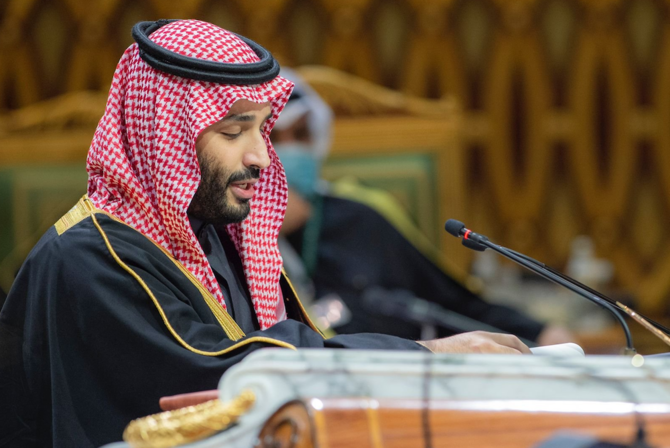
Crown Prince Mohammed bin Salman speaking at the conclusion of the 42nd GCC Summit. (SPA)
Short Url
Updated 15 December 2021
Follow

All for one, one for all: Gulf leaders stress unity at Riyadh summit

  • Security is key issue on agenda, with challenges from Iran to Yemen

RIYADH: Gulf state leaders called on Tuesday for greater regional economic and defense integration as the annual GCC summit in Riyadh came to a close.

Saudi Crown Prince Mohammed bin Salman, who chaired the meeting, stressed the importance of Gulf unity in the face of security challenges. “We continue to make all efforts to enhance security in the region,” he said.

“We laud the commitment and solidarity that led to the success of the outputs of the AlUla declaration. We look forward to building a prosperous economy that depends on diversifying sources of income and keeping pace with developments in all fields.”

The GCC had achieved a great deal since it was established in 1981, the crown prince said. “We look forward to achieving more.”

Regional security was a key item on the summit agenda, including Iran’s nuclear ambitions, and challenges in Iraq, Yemen, Lebanon, Palestine, Sudan, and Libya. “Saudi Arabia stresses the importance of dealing seriously with the Iranian nuclear issue. We stress the importance of Iraq’s stability, and the importance of reaching a political solution in Yemen,” the crown prince said.

After the meeting, Saudi Foreign Minister Prince Faisal bin Farhan said the Kingdom was closely following the progress of talks in Vienna on Iran’s nuclear program. “Iran's tough stance in Vienna is worrying,” he said. “The Gulf states face the biggest threat from Iran’s nuclear program. We want a long and comprehensive nuclear deal with Iran. We want to have a normal relationship with Iran, and that depends on them.”

In a final communique, GCC Secretary-General Dr. Nayef Al-Hajraf called for teamwork to face regional challenges, and stressed the importance of strengthening the role of women and young people.

“The leaders agreed on principles and policies to develop strategic cooperation and economic and development integration among the GCC states,” Al-Hajraf said.

The communique emphasized the issue of joint defense, pointing out that for GCC member states, “any attack on any of them is an attack on all, and any danger that threatens one of them is a threat to all.”

Leaders discussed the implementation of King Salman’s vision for Gulf integration. “The leaders emphasized the importance of accurate, complete and continuous implementation of King Salman’s vision, completing the elements of economic unity and joint defense and security systems, coordinating their positions in a way that enhances the solidarity and stability of the GCC states, preserves their interests, and avoids regional and international conflicts,” Al-Hajraf said.

The communique emphasized the issue of joint defense, pointing out that for GCC member states, “any attack on any of them is an attack on all, and any danger that threatens one of them is a threat to all.”

The leaders also stressed the importance of coordinating and integrating the foreign policies of member states “to crystallize a unified and effective foreign policy that serves the aspirations of the people of the Gulf states and preserves their interests and gains.”

Al-Hajraf said the leaders also confirmed the importance of coordinating plans to achieve sustainability, deal with climate change and its effects, and applying the circular carbon economy approach launched by the Kingdom during its presidency of the G20.

“The leaders stressed the importance of following up on the achievement of the economic vision of the GCC to achieve economic diversification and benefit from economic potential,” he said.

They also stressed the need to curb Hezbollah’s terrorist activities, and urged Lebanon to implement political reforms and extend its sovereignty over its institutions.

Visiting national delegations at the summit were led by King Hamad of Bahrain, Qatar’s Emir Sheikh Tamim Al-Thani, Sheikh Fahd Al-Said of Oman, Kuwait’s Crown Prince Sheikh Mishal Al-Jaber Al-Sabah, and UAE Prime Minister Sheikh Mohammed bin Rashid Al-Maktoum.


Israel’s Barak ‘regrets’ knowing Epstein after documents detail friendship

Updated 8 sec ago
Follow

Israel’s Barak ‘regrets’ knowing Epstein after documents detail friendship

  • Former Israeli prime minister apologizes for his years-long friendship with convicted sex offender Jeffrey Epstein
  • Barak is among several political elites found to have maintained long relationships with Epstein, even after his 2008 conviction
TEL AVIV, Israel: Former Israeli Prime Minister Ehud Barak has apologized for his years-long friendship with convicted sex offender Jeffrey Epstein that included regular correspondence, multiple visits to the disgraced financier’s Manhattan apartment and one to his private island.
The former Israeli leader has not been implicated in Epstein’s sexual abuse of underage girls and faces no accusations of wrongdoing. In an exclusive interview with Israel’s Channel 12 on Thursday, he said he regretted having ever known Epstein and apologized to all those “who feel deeply uncomfortable.”
“I am responsible for all my actions and decisions, and there is definitely room to ask if there wasn’t room for more in-depth judgment on my part and a more thorough examination of what the details really are, what exactly happened there,” he said.
Barak is among several political, business and cultural elites found to have maintained long relationships with Epstein, even after his 2008 guilty plea for soliciting prostitution from an underage girl in Florida. Epstein died by suicide in detention in 2019 while awaiting trial on federal allegations of sexually abusing and trafficking dozens of girls.
Barak, who has previously distanced himself from Epstein, gave the latest interview after millions of pages of documents were released by the US Justice Department in connection with its investigations of Epstein.
Barak and his wife, Nili, have turned up frequently in the documents, showing they stayed in regular contact with Epstein for years, including after he cut a deal with prosecutors in 2008 that resulted in an 18-month prison sentence.
Barak has acknowledged visiting Epstein numerous times, flying on his private plane and staying at his New York apartment when he was out of public office. Barak said he and his wife and some security guards paid a three-hour visit to Epstein’s home in the US Virgin Islands, but saw only Epstein and some maintenance workers there.
Barak said he never observed or took part in any inappropriate behavior. He said he was aware of the earlier Epstein case but assumed he had paid his debt to society.
“Only in 2019, when a reinvestigation of the whole story begins, does the breadth and depth of the man’s heinous crimes become apparent and I cut off relations with him, and everyone cuts off relations with him,” Barak said.

A Netanyahu rival

Barak served as prime minister from 1999 to 2001, when Israel and the Palestinians held high-level peace talks before the process collapsed and a Palestinian uprising broke out. He later served as defense minister.
His ties to Epstein came to light seven years ago after Barak announced a political comeback in an unsuccessful bid to topple Israeli Prime Minister Benjamin Netanyahu.
At the time, US tax records showed Barak received some $2 million in grants for unspecified “research” the previous decade from the Wexner Foundation — a philanthropic organization that supports Jewish causes. At the time, Epstein was a trustee of the foundation.
Barak downplayed those ties when they surfaced, saying Epstein “didn’t support me or pay me.”
The new batch of released documents show regular correspondence among Barak, his wife and Epstein.
Some detail plans for a 2017 stay at Epstein’s New York residence, while others discuss mundane logistics for other visits, meetings and phone calls. In June 2019, Barak’s wife, Nili, emailed Epstein saying they delayed their flight to New York by roughly a week. In 2013, Epstein’s assistant, Lesley Groff, emailed Epstein about dinner with Barak, his wife and several business people and celebrities, including Woody Allen.
In 2019 — about a week before Epstein was arrested — an exchange about Barak between Epstein and an unknown person shows Epstein saying he was ”dealing with Ehud in Israel. Making me crazy.”
The documents show that Epstein connected Barak with US President Donald Trump’s former adviser, Steve Bannon, who was seeking to become more involved in Israeli politics. Emails from Epstein to his staff and others in 2018 discussed setting up dinners or meetings between Barak and Bannon.
Bannon has not been implicated in any wrongdoing related to Epstein.
In Thursday’s interview, Barak said it’s likely more information will emerge from the documents in the weeks ahead, but he maintained that he had done nothing illegal or improper.
“I promise you that nothing will be discovered, because there is nothing,” he said.