

Saudi Arabia’s 2022 budget to see first surplus since 2013 at $24bn

Saudi Finance Minister Mohammed Al-Jadaan. (SPA/File)
Short Url
Updated 13 December 2021
Follow

Saudi Arabia’s 2022 budget to see first surplus since 2013 at $24bn

  • Kingdom’s economy forecast to grow by 7.5 percent amid plans to diversify income activity

RIYADH: Saudi Arabia expects a 2022 budget surplus of SR90 billion ($24 billion), the Saudi Press Agency reported, citing a Cabinet statement.

If achieved, this will be the first fiscal surplus since 2013. Total revenues for 2022 are estimated at SR1.05 trillion, while spending is estimated at SR955 billion — the lowest level since 2017.

The Kingdom’s economy is expected to grow by 7.5 percent. Revenues grew by 12.4 percent compared with estimated revenues in the 2021 fiscal year, while expenditures narrowed by 5.9 percent, the statement said, following a meeting chaired by King Salman.

The Kingdom’s budget surplus is projected to be 2.5 percent of gross domestic product in 2022.
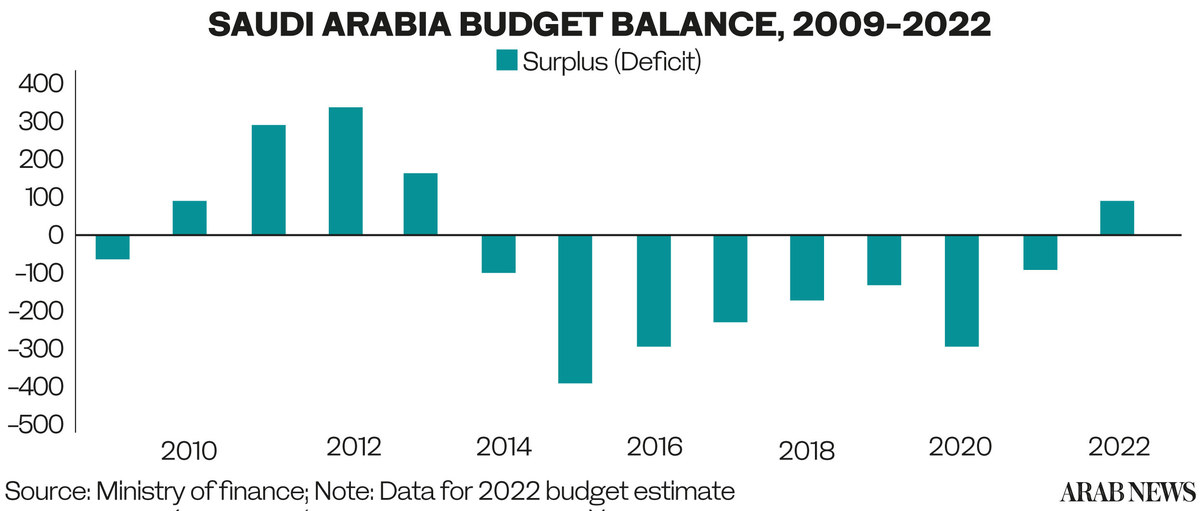
In the pre-budget statement published in September, a SR52 billion deficit was predicted for 2022. The Ministry of Finance had then expected the deficit to be 1.6 percent of the GDP. Yesterday, the ministry of finance expected this to be a surplus.

As for 2021, total revenues are projected at SR930 billion while expendtures are set to be higher than next year, standing at SR1.02 trillion. The ministry kept its deficit estimates for 2021 unchanged from its pre-budget statement in September at SR85 billion.

The ministry had predicted a lower SR849 billion of revenues in last year’s budget statement while expenditures were also forecast at SR990 billion — less than this year’s estimated figure of SR1.02 trillion.

Revenues experienced an upswing due to the weakening of the pandemic’s adverse effects, as well as government support for the private sector. In addition, several non-oil initiatives were adopted by the Kingdom, the report said. This led to an 18.2 percent growth in non-oil revenues compared to 2020, after excluding some profits from government investments last year.

Oil revenues also underwent a boost as higher global demand pushed oil prices up.

Meanwhile, COVID-19 related issues attributed to expenditures being higher than budgeted. Increasing vaccination rates among the Kingdom’s citizens meant that health workers received more overtime compensation while the purchase of vaccines also partly led to the jump in expenditures.

The rise in zakat revenues corresponded to larger social spending by the government, according to the ministry.

Deficit as a percentage of GDP fell notably from 11.2 percent in 2020 to an expected 2.7 percent in 2021.

While public debt increased in value from SR854 billion last year to an estimated SR938 billion this year, its share of GDP declined from 32.5 percent to 29.2 percent. The statement explained that output is set to expand at a higher rate when compared to debt growth, inducing the decline in the latter figure.


SAMI CEO: Advancing toward integrated, sovereign Saudi defense industry

Updated 5 sec ago
Follow

SAMI CEO: Advancing toward integrated, sovereign Saudi defense industry

RIYADH: Saudi Arabian Military Industries is accelerating its push to deliver its 2030 strategy, aiming to anchor a sustainable national defense base built on deeper localization, advanced technology transfer and development, and an integrated industrial ecosystem spanning Saudi Arabia’s defense and security sectors.

SAMI CEO Thamer Al-Muhid said the next phase marks a decisive shift in SAMI’s trajectory, from building capabilities to full industrial enablement, to strengthen self-sufficiency, readiness, and defense sovereignty in line with Saudi Vision 2030.

Speaking to Asharq Al-Awsat, Al-Muhid said the strategy translates into developing and supporting defense industries inside the Kingdom, boosting self-reliance and playing a central role in meeting the Vision 2030 goal of localizing 50 percent of defense spending. That target, he said, will directly boost the armed forces’ readiness and operational capacity.

On the sidelines of the recently concluded World Defense Show in Riyadh, he described the coming stage as a qualitative leap from foundation-building to broad-based defense industrial expansion, reinforcing the Kingdom’s long-term defense readiness and sovereignty.

Sources of strength

Al-Muhid said SAMI’s strength lies in its structure as an integrated national entity operating under a distinct business model that brings together specialized Saudi companies, qualified national talent, flexible domestic supply chains and strategic partnerships with major global firms.

That integration enables the group to convert national objectives into tangible industrial output and defense products manufactured in the Kingdom, supporting national security and the long-term sustainability of the military industries sector.

World Defense Show participation

Al-Muhid said SAMI’s presence at the World Defense Show underscores the maturity of its defense ecosystem, operating across specialized and complementary sectors including aerospace, land and naval systems, unmanned systems, advanced electronics, munitions and professional services.

The ecosystem covers the full value chain, from design and development to manufacturing, integration, support and sustainment.

The message from Riyadh to partners and international markets is clear, he said, adding that Saudi Arabia now has a sovereign industrial base, trusted national capabilities and expanding supply chains operating to global standards.

SAMI has become a strategic partner capable of delivering sustainable defense solutions that enhance national security and open new avenues for industrial cooperation with leading global defense companies, he stressed.

Local content

SAMI’s Local Content Program, known as Rukn, is designed to organize and expand the role of national suppliers within the defense industries ecosystem, he went on to say.

The program goes beyond raising localization ratios, focusing on building sustainable domestic supply chains that meet defense industry standards for quality, reliability and continuity, Al-Muhid explained.

It seeks to empower local suppliers, particularly small and medium-sized enterprises, through qualification, knowledge transfer and direct integration into SAMI projects and subsidiaries, he added.

The initiative also deepens domestic supply chains by localizing components, services and industrial processes inside the Kingdom and integrating suppliers across the full value cycle, raising local content and improving sector efficiency, he continued.

Al-Muhid said SAMI acts as a key enabler and driver of local content, expanding its base through projects and partnerships within an integrated national framework to lift localization rates across the sector, not just within the company.

Industrial enablement

Al-Muhid said SAMI has moved beyond technology transfer to full industrial enablement by building an integrated defense ecosystem led by specialized national companies, each with a defined sectoral role under a model that combines operational independence with group-wide integration.

Each subsidiary operates with flexibility and autonomy within a centralized governance framework and overarching strategy set by SAMI, ensuring alignment across the group.

He said SAMI Land Systems serves as a national arm in the design and manufacture of combat vehicles, artillery systems and armored platforms, as well as advanced protection solutions and integrated maintenance and logistics services.

SAMI Aerospace provides maintenance, repair and overhaul services for aerospace systems, focusing on support for the Royal Saudi Air Force, and has achieved 75 percent local content, revealed AlMuhid. It also signed an agreement with SKYFive Arabia to install air-to-ground connectivity systems on flynas aircraft, becoming the exclusive regional partner in this field.

SAMI Advanced Electronics designs and develops command and control systems, cybersecurity, electronic warfare and sensor technologies within an integrated framework to protect digital infrastructure.

SAMI Autonomous Systems specializes in autonomous systems and unmanned aerial, naval and land platforms.

In munitions, SAMI Munitions leads an industrial complex project that has surpassed 60 percent localization and created more than 1,200 jobs. It has also signed a contract with the Ministry of National Guard to sustain systems and weapons in support of higher local content.

Al-Muhid said SAMI’s international partnerships are structured to ensure technology transfer, localization of operations and national capacity building, backed by clear governance and performance indicators to secure a shift from assembly to full manufacturing.

Largest integrated facility

Al-Muhid said the SAMI Industrial Complex for Land Systems, operated in line with Fourth Industrial Revolution requirements, is the largest integrated facility of its kind in the Middle East and North Africa.

The 82,000 sq. meter plant sits within a 1 million sq. meter industrial zone and relies on automation, artificial intelligence, the Internet of Things and industrial robotics to raise production efficiency and enhance product quality to global standards.

The complex provides more than 1,000 specialized jobs for Saudis. Among its flagship outputs is the HEET project, which fully designs and manufactures armored vehicles inside the Kingdom, reflecting local control of the industrial value chain.

Challenges

Al-Muhid said complex defense technologies, tightly linked global supply chains and the need to accelerate the development of specialized talent remain key challenges.

SAMI has approached them as opportunities to reshape the defense industrial model by localizing integration and operations, developing local suppliers as qualified industrial partners and building national talent within projects to ensure sustained expertise.

Human capital is central to that effort, he said. By the end of 2025, SAMI employed more than 7,000 people, 73 percent of them Saudi nationals, with women accounting for 12 percent.

The group delivered more than 400,000 training hours to over 3,000 employees and hired more than 2,200 new staff under a structured pathway spanning early recruitment, specialized qualification, hands-on factory training and enabling Saudis to work in advanced industrial environments and transfer knowledge.

Industrial enablement at SAMI is no longer a future ambition but an operational reality, Al-Muhid said, strengthening the Kingdom’s defense sovereignty and boosting the competitiveness of its products regionally and internationally in line with Saudi Vision 2030.