

Pakistani president calls for new ‘morality-based international order’ led by Muslim states 

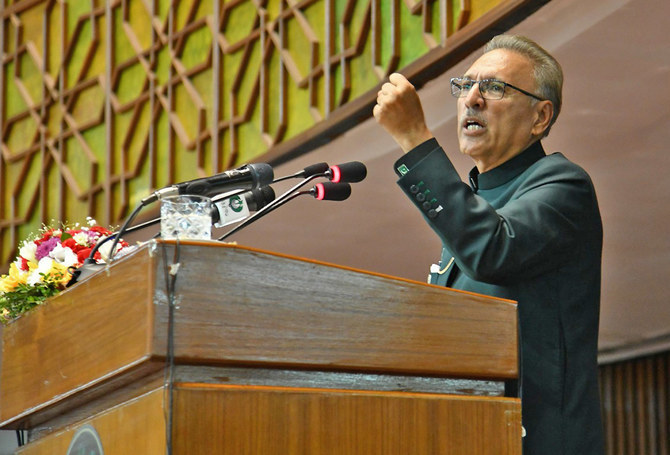
Pakistan's President Dr. Arif Alvi addresses joint parliamentary sitting at the Parliament House in Islamabad, Pakistan, on September 13, 2021. (Photo courtesy: @PresOfPakistan/Twitter)
Short Url
Updated 11 December 2021
Follow

Pakistani president calls for new ‘morality-based international order’ led by Muslim states 

  • Comments come as Islamabad declined to participate in democracy summit convened by United States this week 
  • China on Friday called Pakistan a “real iron brother” for declining to attend the US conference 

ISLAMABAD: Referring to tense ties between China and the United States, Pakistani President Dr. Arif Alvi said on Friday Islamabad would not become party to a ‘new Cold War’ and called for a new “morality-based” world order led my Muslim nations. 

The president’s comments come days after Islamabad declined to participate in a two-day democracy summit convened by the United States. 

Media has widely reported that Pakistan’s decision not to attend the ‘Summit on Democracy’ is in part due to President Joe Biden’s invitation to Taiwan, a move that has infuriated Islamabad’s longtime ally China, which views the democratically governed island as its territory. 

The first-of-its-kind gathering is a test of Biden’s assertion — announced in his first foreign policy address in office in February — that he would return the United States to global leadership to face down authoritarian forces led by China and Russia. 

There are 110 participants on the State Department’s invitation list for the virtual event on December 9 and 10, which aims to help stop democratic backsliding and the erosion of rights and freedoms worldwide. The list does not include China or Russia. 

“Currently, the world order in the world … is made on the basis of Western interests,” Alvi said in an interview with local SAMAA TV channel. 

“I understand that the position taken by Imran Khan is the best, that we won’t become a party in this new Cold War. We will act independently.” 

“This order is about to be changed,” he said, adding that Pakistan didn’t want to become a part of any bloc. 

The Pakistani president called for a “morality-based international order,” whose champion he said could be a leader like Prime Minister Imran Khan. 

“Morality-based order is a possibility and only Muslim countries further it and I understand Pakistan has a major position in that.” 

A spokesperson at the Pakistani foreign office on Friday denied that Islamabad had joined the Chinese bloc by declining to attend the US summit. 

“Let me tell you that we remain closely engaged with the US on a range of issues. We value our partnership with the US and we wish to expand it bilaterally as well as in terms of regional and international cooperation,” the spokesperson said during a weekly press briefing. 

“There have been exchanges recently as you are aware, that include the delegation led by House Foreign Affairs Committee Chair Congressman Meeks, and there is another delegation arriving tonight led by Senate Armed Services Committee Chair Senator King, all reflective of continuing, cooperative exchanges with the US.” 

China on Friday called Pakistan a “real iron brother” for declining to attend the US summit.


Pakistan army chief assumes role as first Chief of Defense Forces, signaling unified command

Updated 5 sec ago
Follow

Pakistan army chief assumes role as first Chief of Defense Forces, signaling unified command

  • New role is held simultaneously with Gen Asim Munir’s existing position as Chief of Army Staff
  • It is designed to centralize operational planning, war-fighting doctrine, modernization across services

ISLAMABAD: Pakistan’s most senior military officer, Field Marshal Syed Asim Munir, formally took charge as the country’s first Chief of Defense Forces (CDF) on Monday, marking a structural change in Pakistan’s defense command and placing the army, navy and air force under a single integrated leadership for the first time.

The new role, held simultaneously with Munir’s existing position as Chief of Army Staff, is designed to centralize operational planning, war-fighting doctrine and modernization across the services. It reflects a trend seen in several advanced militaries where a unified command oversees land, air, maritime, cyber and space domains, rather than service-level silos.

Pakistan has also established a Chief of Defense Forces Headquarters, which Munir described as a “historic” step toward joint command integration.

In remarks to officers from all three forces after receiving a tri-services Guard of Honor at the General Headquarters (GHQ) in Rawalpindi, Munir said the military must adapt to new theaters of conflict that extend far beyond traditional ground warfare.

He stressed the need for “a formalized arrangement for tri-services integration and synergy,” adding that future war will involve emerging technologies including cyber operations, the electromagnetic spectrum, outer-space platforms, information warfare, artificial intelligence and quantum computing.

“He termed the newly instituted CDF Headquarters as historic, which will afford requisite integration, coherence and coordination to meet the dynamics of future threat spectrum under a tri-services umbrella,” the military quoted Munir as saying in a statement. 

The ceremony also included gallantry awards for Pakistan Navy and Air Force personnel who fought in Marka-e-Haq, the brief May 2025 conflict between Pakistan and India, which Pakistan’s military calls a model for integrated land, air, maritime, cyber and electronic combat. During his speech, Munir paid tribute to the personnel who served in the conflict, calling their sacrifice central to Pakistan’s defense narrative.

The restructuring places Pakistan closer to command models used by the United States, United Kingdom and other nuclear-armed states where a unified chief directs inter-service readiness and long-range war planning. It also comes at a time when militaries worldwide are re-engineering doctrine to counter threats spanning satellites, data networks, information space and unmanned strike capabilities.