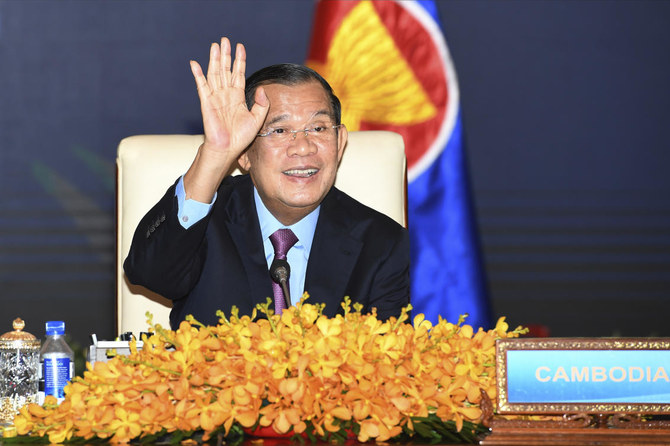
PHNOM PENH: Cambodian leader Hun Sen ordered the country’s military to destroy any US weaponry or dump it in warehouses on Friday, after Washington imposed an arms embargo over human rights concerns and Phnom Penh’s close ties with China.
The US on Wednesday imposed an arms embargo on Cambodia, citing concerns about human rights and corruption in the southeast Asian nation as well as China’s activities there.
The actions taken by the US State and Commerce departments aimed to restrict access to “defense articles and defense services” by Cambodia’s military and intelligence agencies, according to a statement.
But Cambodian Prime Minister Hun Sen downplayed the quality of US weapons and equipment on Friday.
“I order all army units to immediately review arms and military items that Cambodia currently has. (We) must recall all US arms and military items if there are any — put them in warehouses or destroy them accordingly,” he said in a Facebook post.
“(The US arms embargo) is a warning message to the next generation of Cambodians who lead the government that if they want an independent defense sector, please don’t use US weapons.”
“A lot of those who use US arms lost wars,” the Cambodian strongman said, citing Afghanistan.
In November, Washington sanctioned two Cambodian officials for corruption allegations linked to a US-funded naval base.
Cambodia’s longtime leader is one of China’s closest partners in Asia, and his government has been dismantling facilities at the Ream base that were built partly with American money and hosted to US exercises.
The Sihanoukville-base on the Gulf of Thailand has been a running sore in US-Cambodia relations in recent years, with Washington suspecting it is being converted for use by China.
Hun Sen has repeatedly denied his country would host the Chinese military at the base.
Beijing has been increasingly exerting territorial claims in the South China Sea and East China Sea, raising tensions with numerous Asian nations, but Cambodia has increasingly appeared to be an ally.


Cambodian PM orders US weapons destroyed after arms embargo
https://arab.news/cr5dr
Cambodian PM orders US weapons destroyed after arms embargo

- In November, Washington sanctioned two Cambodian officials for corruption allegations linked to a US-funded naval base
- Hun Sen has repeatedly denied his country would host the Chinese military at the base


South Korea calls for resuming dialogue with North
- President Lee Jae Myung has sought to mend ties with the nuclear-armed North since taking office in June
- North Korean leader Kim Jong Un last week dashed hopes of a diplomatic thaw with Seoul
SEOUL: South Korean President Lee Jae Myung called on Sunday for dialogue with North Korea to resume, after Pyongyang last week shunned the prospect of diplomacy with its neighbor.
Since taking office in June, a dovish Lee has sought to mend ties with the nuclear-armed North, which reaffirmed its anti-Seoul approach during a party meeting last week.
“As my administration has repeatedly made clear, we respect the North’s system and will neither engage in any type of hostile acts, nor pursue any form of unification by absorption,” Lee said in a speech marking the anniversary of a historical campaign against Japan’s colonial rule.
“We will also continue our efforts to resume dialogue with the North,” he said.
North Korean leader Kim Jong Un last week dashed hopes of a diplomatic thaw with Seoul, describing its overtures as “clumsy, deceptive farce and a poor work.”
Speaking at the party congress in Pyongyang, Kim said North Korea has “absolutely no business dealing with South Korea, its most hostile entity, and will permanently exclude South Korea from the category of compatriots.”
But he also said the North could “get along well” with the United States if Washington acknowledges its nuclear status.
Speculation has mounted over whether US President Donald Trump will seek a meeting with Kim during planned travels to China.
Last year, Trump said he was “100 percent” open to a meeting.
Previous Trump-Kim summits during the US president’s first term fell apart after the pair failed to agree over sanctions relief — and what nuclear concessions North Korea might make in return.


