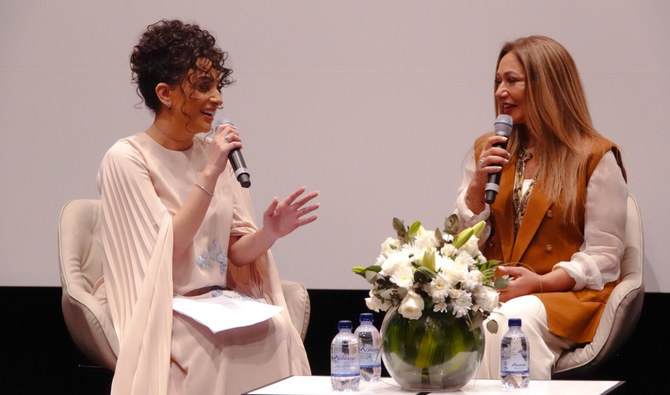

JEDDAH: Egyptian film and television stars have long been a source of inspiration for Saudis, but none more so than Laila Eloui, the award-winning actress who has made more than 70 movies in a career stretching back decades.
With her dramatic fashion sense, good looks and striking blonde curls, Eloui was a favorite among an emerging generation who rarely missed a chance to watch their idols on small box screens while growing up in the 1980s and 1990s.
After making her screen debut in the 1970s, the actress co-starred in films, comedies and dramas alongside some of the greatest names in Egyptian entertainment history, including Ahmed Zaki, Farooq Al-Fishawi, Adel Imam, Kamal Al-Shinawi, Hussain Fahmi, Laila Siddqi, Mervat Amin and Isaad Younis.
Eloui’s performances made her a household name, and brought a string of Egyptian and international festival awards.
Now, speaking on the fourth day of the Red Sea International Film Festival in Jeddah, Eloui has inspired a new generation of Saudi filmmakers to step up and take their turn in the limelight.
“Everyone can sense the change that’s happening here,” she said. “It’s a change for the better, it’s a change for more innovation, and I believe that there will be great things coming from the younger generation of directors, actors and actresses and more.”
She added: “You must grasp your opportunity because you will be the makers of change in the Arab and Saudi film industry.”
Eloui was speaking as part of a series of masterclass sessions featuring talks and question-and-answer discussions with film industry leaders.
The Egyptian actress took center stage on Thursday, and with an infectious smile told how proud and happy she was to see the Saudi community’s engagement with the festival, as well as the popularity of films, talks and workshops.
Eloui discussed the challenges she has faced throughout her career, and described acting as one of the most demanding professions “as it requires great skill to control one’s actions and reactions, and play a character different to your own.”
She offered insights into some of her most important film roles, and said that even after 40 years in the industry her love of acting remains strong.
Speaking of the challenges facing up-and-coming actors, especially when it comes to screenplays, Eloui said that reading a script differed from one decade to the next.
“I grew more knowledgeable, understood the scenarios better, and visualized the scenes clearly over time. It needs to be gained through patience and learning.”
When she first started, it was a struggle, “but I learned how to love each character. You learn to love each work that comes your way and you embrace the story and your role in it.”
Eloui added: “My role as an actress is to complete the film. Breaking into character will come easier if you understand your role, and therein lies the true magic of a writer and director. Once the message is clear, you won’t need to make any additions to it as an actress.”
She added that “it doesn’t hurt to improvise sometimes and add your two cents to the character you’re playing,” adding that “it works best if you have a good understanding of the story and a good relationship with the director.”
“It’s a working relationship and we complete each other. That’s how success is made.”
Eloui recalled her role in the 2001 television drama “Hadith Al-Sabah Wal Masaa” (“Morning and Evening Talk”) with Abla Kamel, Dalal Abdul Aziz and Khaled Al-Nabawi. The drama was based on a novel by Nobel prizewinner Naguib Mahfouz and followed the lives of an Egyptian family through generations.
The script was impeccably written, and is still widely appreciated by fans and industry professionals, she said.
“When a drama is written clearly and in the best form, you can’t help but ensure its perfection in every way. From the actors to production to the set, the lighting and costumes, all these components complete one another — it’s a full circle.”
Eloui stressed the importance of listening to a director. “Actors are actors and have their vision; but they must show their skills, and accept instructions and a director’s guidance,” she said.
“The more cooperation there is between artists in a film, the better the outcome.”