Pakistan hikes prices of petrol by Rs5, diesel by Rs7.32 per liter for next fortnight

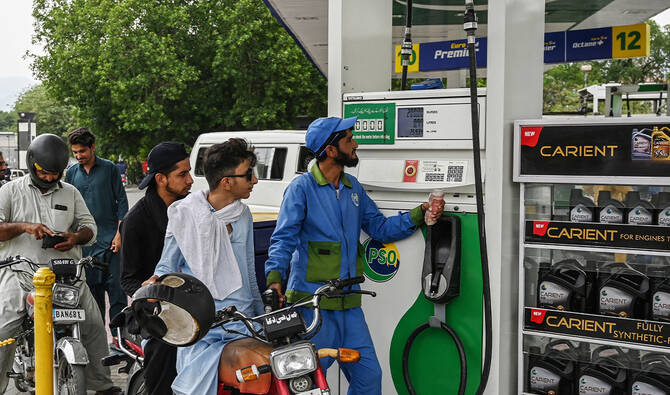
An employee fills the tank of a motorbike at a fuel station in Islamabad on June 16, 2025, after a hike in prices of petroleum products by the government. (AFP/File)
Short Url
Updated 16 February 2026
Follow

Pakistan hikes prices of petrol by Rs5, diesel by Rs7.32 per liter for next fortnight

  • After latest increase, new price of petrol is RsRs258.17 per liter while that of diesel is Rs275.70 per liter
  • Fuel prices in Pakistan are reviewed fortnightly, influenced by global oil prices, exchange rate movements, taxes

ISLAMABAD: Pakistan’s government has increased the price of petrol by Rs5 per liter and that of high-speed diesel (HSD) by Rs7.32 per liter, respectively, an official notification by the Ministry of Energy said on Sunday. 

After the fresh increase, the new price of petrol is Rs258.17 per liter from the previous Rs253.17 per liter. Meanwhile, the new price of HSD is Rs275.70 per liter, up from the previous Rs268.38 per liter. 

“The government has raised the prices of petroleum products based on recommendations of OGRA [Oil and Gas Regulatory Authority],” a notification by the Ministry of Energy said on Sunday. 

Fuel prices in Pakistan are reviewed fortnightly and are influenced by global oil prices, exchange rate movements and domestic taxes. The pricing mechanism passes changes in import costs on to consumers.

The government kept the price of petrol unchanged on Feb. 1, increasing that of HSD by Rs11.30 per lite. 

Petrol is mainly used in private transport, motorcycles and rickshaws, while diesel fuels heavy transport and agricultural machinery and is considered a key driver of inflation in the South Asian country.

Financial analysts warn constant increases in prices of petroleum products stoke inflation, inflicting a heavy burden on consumers. 


Pakistan highlights Gwadar transshipment role as shipping routes face disruption over regional tensions

Updated 7 sec ago
Follow

Pakistan highlights Gwadar transshipment role as shipping routes face disruption over regional tensions

  • Pakistani ports possess “untapped potential” to attract global shipping lines for transshipment operations, says minister
  • Pakistan eyes leveraging Gwadar as regional transshipment hub as Iran’s closure of Strait of Hormuz disrupts global maritime trade

KARACHI: Pakistan’s Maritime Affairs Minister Junaid Anwar Chaudhry on Thursday highlighted the importance of the port city of Gwadar’s transshipment role as major shipping routes, including the Strait of Hormuz, face disruption due to Iran’s ongoing conflict with the US and Israel in the Gulf. 

The meeting takes place as Iran has effectively closed the Strait of Hormuz, a strategic waterway that lies between it and Oman. It is one of the world’s most critical oil transit routes, with roughly 20 percent of global oil supplies passing through it. Iran has vowed it will attack any ship that enters the strait, causing energy prices to rise sharply on Monday amid disruptions to tanker traffic in the waterway.

Gwadar is a deep-sea port in Pakistan’s southwestern Balochistan province that lies close to the Strait of Hormuz. Pakistani officials have in the past highlighted Gwadar’s geostrategic position as the shortest trade route to the Gulf and Central Asia, stressing that it has the potential to become a regional transshipment hub.

Chaudhry chaired a high-level meeting of government officials to assess emerging logistical challenges facing Pakistan’s trade, particularly in the energy sector, amid tensions in the Gulf. 

“Special focus was placed on fully leveraging the potential of Gwadar Port as a regional transshipment hub and positioning it as an alternative of regional instability,” Pakistan’s maritime affairs ministry said in a statement. 

The minister said Pakistani ports possessed “significant untapped potential” to attract international shipping lines for transshipment operations, noting that it could also ensure long-term sustainability and growth of the country’s maritime sector.

Participants of the meeting discussed measures to strengthen Pakistan’s position as a viable alternative transit and transshipment destination, as key waterways are affected by the disruption. 

The committee also reviewed proposals to amend relevant rules and regulations to facilitate international transshipment operations through on-dock and off-dock terminals.

The chairmen of the Port Qasim Authority, Karachi Port Trust and Gwadar Port Authority attended the meeting, briefing committee members on the current operational readiness of their ports. They spoke about the available capacity for container transshipment, bulk cargo handling and refueling services at Pakistani ports. 

The port in Gwadar is a central part of the China-Pakistan Economic Corridor (CPEC), under which Beijing has funneled tens of billions of dollars into massive transport, energy and infrastructure projects in Pakistan.

Pakistan has long eyed the deep-sea port as a key asset that can help boost its trade with Central Asian states, the Gulf region and ensure the country earns valuable foreign exchange.