Enhanced agreement between US and Egypt to prevent antiquities trafficking

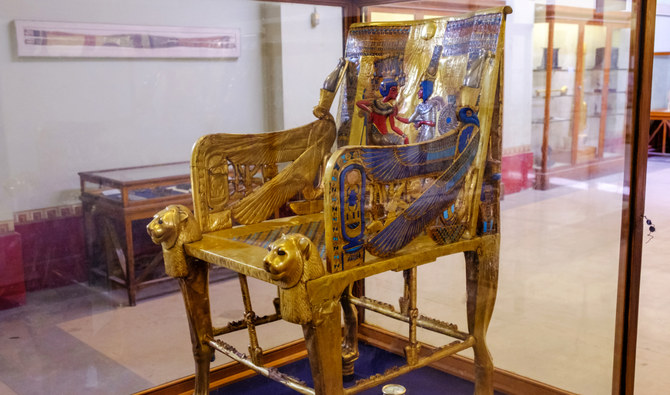
Artifacts taken from Egyptian antiquity sites are trafficked through Europe and the Gulf. (Shutterstock)
Short Url
Updated 09 December 2021
Follow

Enhanced agreement between US and Egypt to prevent antiquities trafficking

  • The new memorandum of understanding replaces and strengthens a 2016 deal that was the first of its kind in the region.

CHICAGO: US State Department officials said on Thursday they have signed a new and tougher Memorandum of Understanding with Egypt’s government to protect Egyptian cultural artifacts from looting, theft and trafficking.

During a briefing attended by Arab News, the officials said the MoU replaces and strengthens a 2016 agreement between the countries, which was the first of its kind in the region.

Artifacts taken from Egyptian antiquity sites are trafficked through Europe and the Gulf, and there was a surge in cases in the aftermath of protests during the Egyptian Revolution in 2011. The US is a major market for such stolen items, according to the State Department.

“For the looting, theft and trafficking of Egyptian cultural property it continues to be an issue,” a State Department official said in response to a question from Arab News. “We certainly saw a large uptick in 2011, when there were many disruptions in the country. Thankfully we see a lower level (now) than in 2011 but the problem remains.

“In terms of trafficking routes, they remain the same. We see a lot of movement through Europe and then on to the United States. The United States remains the largest art market, in general, in the world, so we continue to be a destination for this type of material. We also see trafficking through the Gulf States areas, which is also a concern.”

The officials said damage caused to archaeological sites, places of worship and museums around the time of the 2011 protests was extensive, and cultural-heritage artifacts were then under constant threat of plunder.

A number of valuable objects were subsequently recovered from museums and art collectors in the US. In 2019, for example, the Justice Department ordered the Metropolitan Museum of Art in New York, known as the Met, to return a prized item from its collection of Egyptian antiquities after confirming it had been stolen.

The looted item, a gilded coffin that once held the remains of a high-ranking priest named Nedjemankh, is estimated to be about 2,100 years old. It was returned to Egypt following a repatriation ceremony in New York attended by Egyptian Foreign Minister Sameh Hassan Shoukry.

The coffin, crafted in Egypt between 150 and 50 B.C. and valued at about $4 million, was stolen from Egypt’s Minya region after the 2011 protests and smuggled out of the country, according to a State Department announcement on Oct. 23, 2019.

The Met bought it in 2017. According to the State Department’s Bureau of Educational and Cultural Affairs, New York prosecutors said the dealer provided unsuspecting museum officials with forged documents that made the sale appear legitimate.

Once presented with evidence proving it had been stolen, the Met cooperated with the district attorney’s office and returned the coffin, which is now on public display in Egypt.

The new MoU expands the categories of protected objects and artifacts to including “ethnological materials.” The agreement will be policed by authorities that includes a crime task force staffed by agents from the Department of Homeland Security and the FBI, officials said. The US has similar agreements with 20 other countries including Libya, Algeria, Jordan and Morocco they added.

The new MoU also includes a legal process for Egyptian authorities to loan artifacts to US museums and special, temporary exhibitions.


US military visits contested area in northern Syria to defuse rising tensions

Updated 14 sec ago
Follow

US military visits contested area in northern Syria to defuse rising tensions

  • US has good relations with both sides and has urged calm

DEIR HAFER, Syria: A US military delegation arrived in a contested area of northern Syria on Friday following rising tensions between the Syrian government and a Kurdish-led force that controls much of the northeast.
The US has good relations with both sides and has urged calm. A spokesperson for the US military did not immediately respond to a request for comment.
Earlier in the day, scores of people carrying their belongings arrived in government-held areas in northern Syria ahead of a possible offensive by Syrian troops on territory held by Kurdish-led fighters east of the city of Aleppo.
Many of the civilians who fled were seen using side roads to reach government-held areas because the main highway was blocked by a checkpoint in the town of Deir Hafer normally controlled by the Kurdish-led and US-backed Syrian Democratic Forces, or SDF.
The Syrian army said late Wednesday that civilians would be able to evacuate through the “humanitarian corridor” from 9 a.m. to 5 p.m. Thursday and then extended the evacuation period another day. The announcement appeared to signal plans for an offensive against the SDF in the area.
There have been limited exchanges of fire between the two sides.
Men, women and children arrived in cars and pickup trucks that were packed with bags of clothes, mattresses and other belongings. They were met by local officials who directed them to shelters.
In other areas, people crossed canals on small boats and crossed a heavily damaged pedestrian bridge to reach the side held by government forces.
The SDF closed the main highway but more than 11,000 people were still able to reach government-held areas on other roads, Syrian state TV reported.
A US military convoy arrived in Deir Hafer in the early afternoon accompanied by SDF officials. Associated Press journalists saw SDF leaders and American officials enter one of the government buildings, where they met inside for more than an hour before departing the area.
Inside Deir Hafer, many shops were closed and people stayed home.
“When I saw people leaving I came here,” said Umm Talal, who arrived in the government-held area with her husband and children. She added that the road appeared safe and her husband plans to return to their home.
Abu Mohammed said he came from the town of Maskana after hearing the government had opened a safe corridor, “only to be surprised when we arrived at Deir Hafer and found it closed.”
SDF fighters were preventing people from crossing through Syria’s main east-west highway and forcing them to take a side road, he said.
Kortay Khalil, an SDF official at the Deir Hafer the checkpoint, said they had closed it because the government closed other crossings.
“This crossing was periodically closed even before these events, but people are leaving through other routes, and we are not preventing them,” he said. “If we wanted to prevent them, no one would be able to leave the area.”
The tensions in the Deir Hafer area come after several days of intense clashes last week in Aleppo, previously Syria’s largest city and commercial center, that ended with the evacuation of Kurdish fighters from three neighborhoods north of the city that were then taken over by government forces.
The fighting broke out as negotiations stalled between Damascus and the SDF over an agreement reached in March to integrate their forces and for the central government to take control of institutions including border crossings and oil fields in the northeast.
The US special envoy to Syria, Tom Barrack, posted on X on Friday that Washington remains in close contact with all parties in Syria, “working around the clock to lower the temperature, prevent escalation, and return to integration talks between the Syrian government and the SDF.”
The SDF for years has been the main US partner in Syria in fighting against the Daesh group, but Turkiye considers the SDF a terrorist organization because of its association with Kurdish separatist insurgents in Turkiye.