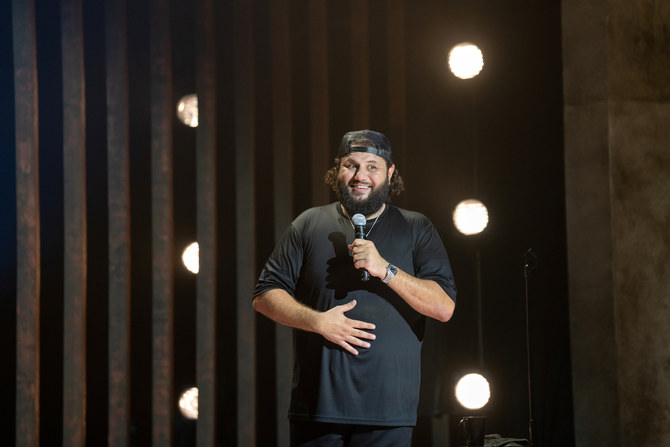

DUBAI: At the end of his latest Netflix special, after an hour of uproarious laughter, Palestinian comedian Mo Amer walked back on to the stage and decided to tell a very personal story.
“The crowd was going bananas, and I looked around at the design of the stage. On one side was the Banksy art of the Palestinian girl holding a balloon, on the other was the West Bank’s wall, and I thought I’d tell my first experience of going to Palestine — the first time I ever went to go visit my grandparent’s house,” Amer tells Arab News.
The trip occurred in 2009, before Amer’s star had ascended to the heights it has reached today, when he is not only a headline comedian across the world, but also a co-star in the Golden Globe-winning series “Ramy,” the star of the upcoming DC blockbuster film “Black Adam” opposite Dwayne ‘The Rock Johnson, and the co-creator, along with “Ramy” star Ramy Youssef, of his own upcoming scripted Netflix series, loosely based on his own experiences.
“Mo Amer: Mohammed in Texas,” streaming now on Netflix. (Supplied)
Amer, 40, moved to the US from Kuwait when he was 12 years old. His father died when he was 14, which sent him spiraling downwards, a hole he was only able to rise out of when he discovered comedy. Along with comedy, it has been his mother who has been the biggest support in his life. He paid tribute to her in his first Netflix special, 2018’s “Mo Amer: The Vagabond.”
On that trip to Burin and Nablus — the villages of his ancestors — after a delicious meal with his extended family, he looked out the window and saw a mosque that his cousin told him was hundreds of years old. Amer was intent on praying in it and set out from the house only to find a group of men who insisted that he perform the call to prayer for the village that evening.
After some hesitation, Amer accepted the men’s request. After he finished, a man came into the mosque to find out whose voice he had just heard bellowing out across the town. He knew everyone in the village, he said but he didn’t know Amer, and ask who his father was. When Amer told him, the man looked stunned.
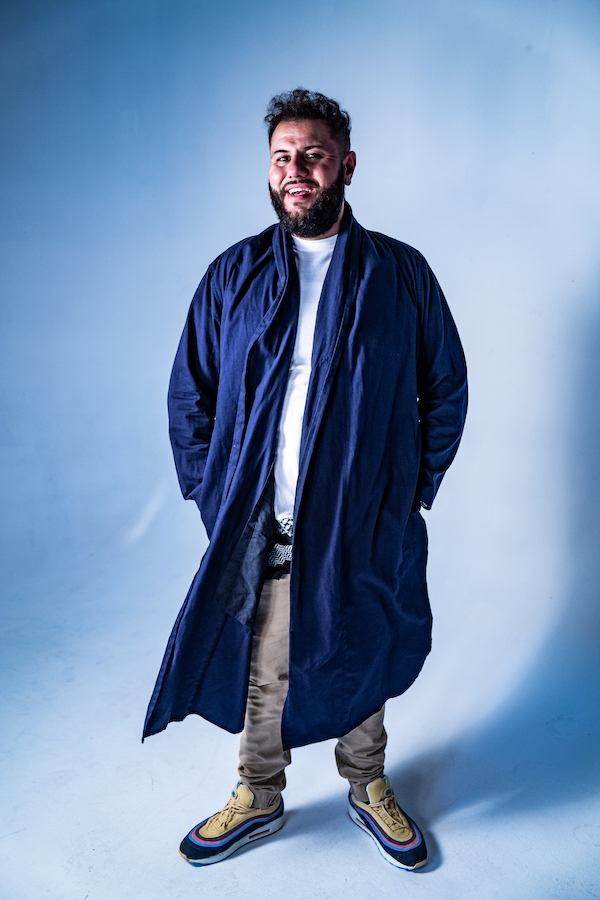
Amer, 40, moved to the US from Kuwait when he was 12 years old. (Supplied)
“Do you know who installed the sound system in this mosque? Your father did,” the man told Amer.
“It was just by coincidence that the special became about my father,” Amer says. “It was never scripted, and was not intended to go in that direction. I just knew then that this story would lend itself well to what I was talking about as an overall connective tissue.”
When Amer got home from shooting what would become “Mo Amer: Mohammed in Texas,” streaming now on Netflix, he remembered that he had the footage of that trip somewhere, and through “a miracle,” he managed to track it down on a friend’s old hard drive two days before they had to submit the final film to Netflix.

Sharing the experience of his parents, and of the Palestinian people, has always been a huge part of Amer’s comedy, and his own identity. (Supplied)
When they finished editing the special, the first person that he showed it to was his mother. On the screen, Amer recounted the story to the audience with tears in his eyes. When he looked up to see her reaction, Amer’s mother was sobbing, too.
“When she saw that, an encore memorializing my father, and then saw the special was dedicated to him, it was a really cool moment. She just lost it,” Amer says.
Sharing the experience of his parents, and of the Palestinian people, has always been a huge part of Amer’s comedy, and his own identity.
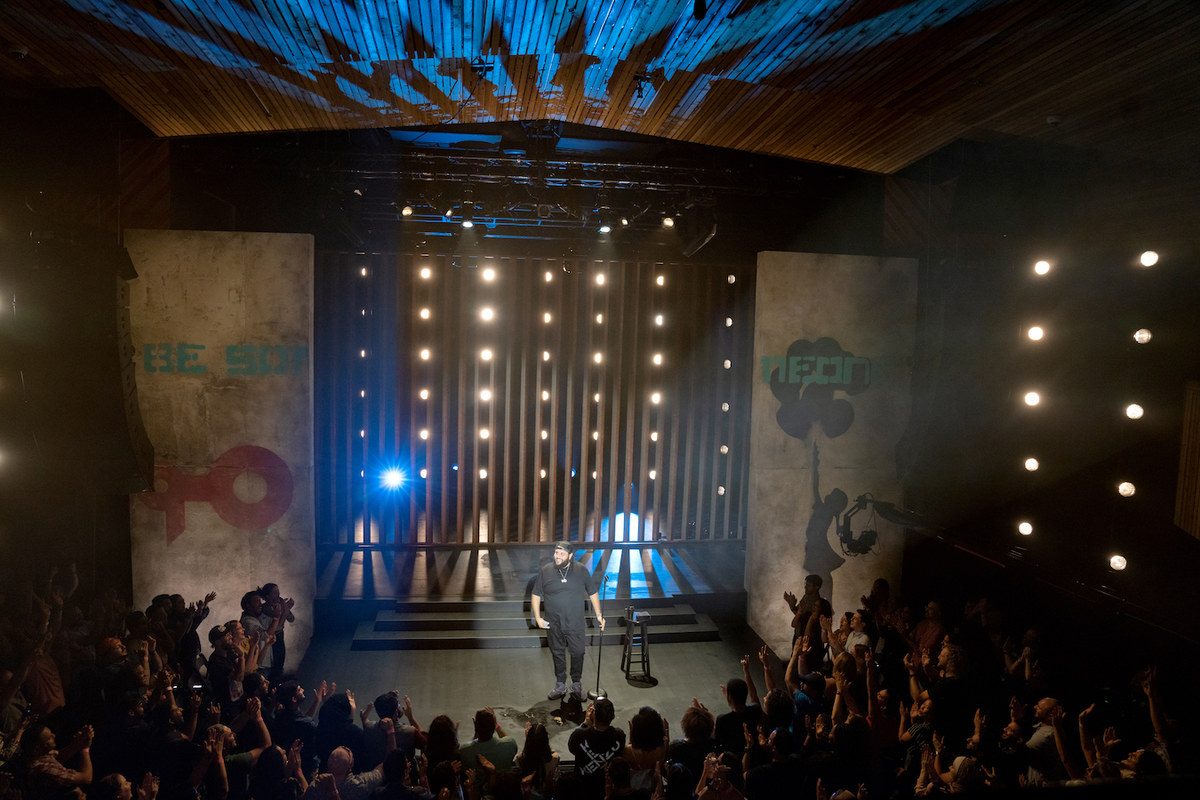
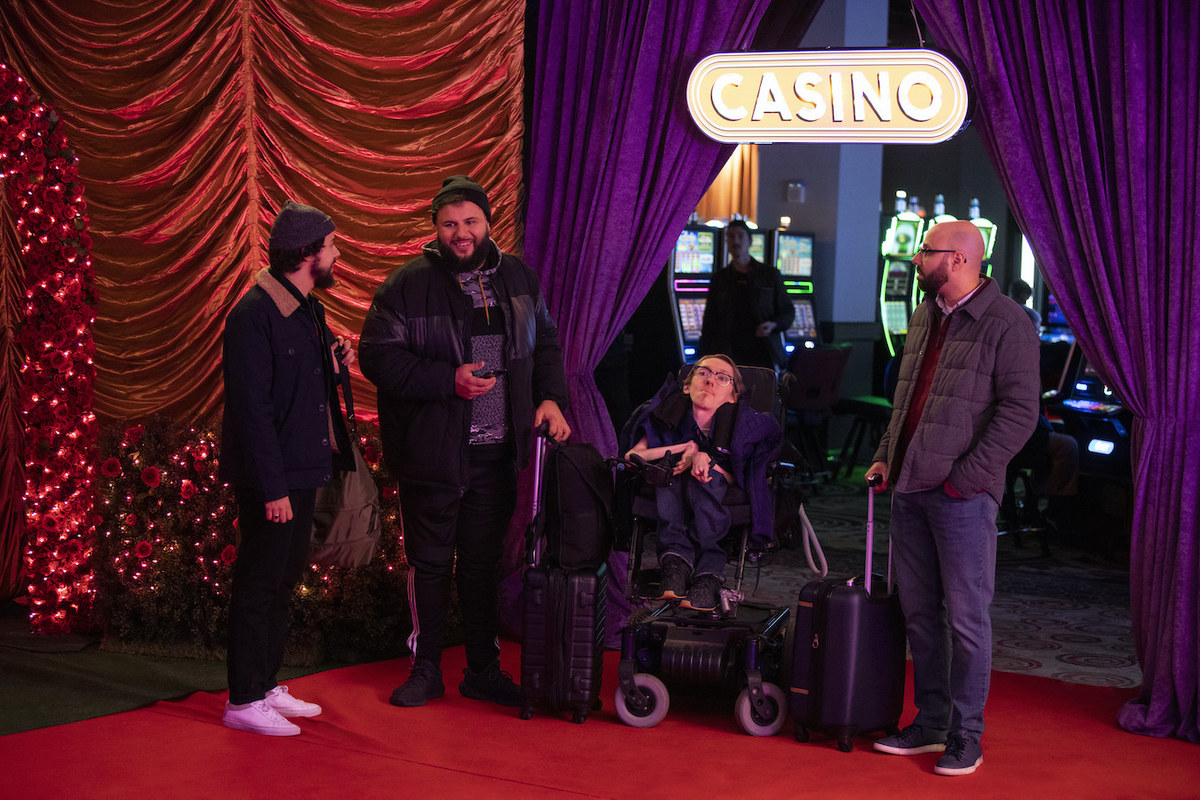
Amer is now at a point in his career where he’s able to share his stories with a wider audience than ever before. (Supplied)
“It’s just who I am. Once you see the experience through your parents’ eyes, and what they’ve gone through, it’s hard to shake that,” he says.
Amer is now at a point in his career where he’s able to share his stories with a wider audience than ever before. He’s also doing it through an artistic medium that, when it’s done right, is perhaps the most empathetic and soul-baring, allowing viewers to experience both his perspective and that of the Palestinian people in an incredibly intimate way.
“That’s why I think the art of stand-up is so liberating. It’s never been about the money. I could care less about money,” he says. “Making money is great, and I want to make what I can, but it’s about telling great stories. I’m less concerned about money, and more concerned about punching above my weight. Creating a masterpiece is a worthy trek. That’s how I feel. That’s where I’m at right now with my stand-up, and my TV show.”
Amer has never forgotten the mission he set for himself when he first adjusted the microphone to his tall frame — the days in his early teens when he first began sharing his comedy, and found that no one was telling stories about his experience, or the experience of Arabs of any descent.
“I first got on stage at 14 years old, and I started touring when I was 17. Immediately, I started noticing that there was this huge gap — a massive, gaping hole,” he says. “There was no real representation at all on any of those stages of Arabs or Muslims. I said to myself, “OK, why don’t I introduce it?’”
Decades later, while Amer is still intent on sharing the stories of both his family and his people, part of the real joy of this part of his career is that he no longer needs to introduce himself to every audience. With “Mo Amer: Mohammed in Texas,” the crowd knows both him and his work well, allowing Amer to spend the bulk of the time telling jokes about things far outside the realm of his identity.
“I’ve already told my story. Now I can just be a stand-up comedian, talking about whatever comes to mind. That’s something that I’ve always been waiting for. I’m not just explaining where I come from, and to me that’s really fulfilling,” Amer says. “I can just be me, and then at the end showcase a small village with 2,000 people in it where my family comes from, a bit of seasoning that I can pinch on at the end. And honestly, I’m still pinching myself that I’m there. I’m speechless.
“My first special ended up being about my mother, and the second one, completely unplanned, was about my father. It feels like I’ve done the biggest things I wanted to do,” he continues. “I’ve accomplished what I set out to do. Everything else is just gravy.”