Sri Lankan man lynched in Pakistan laid to rest in native village with state honors

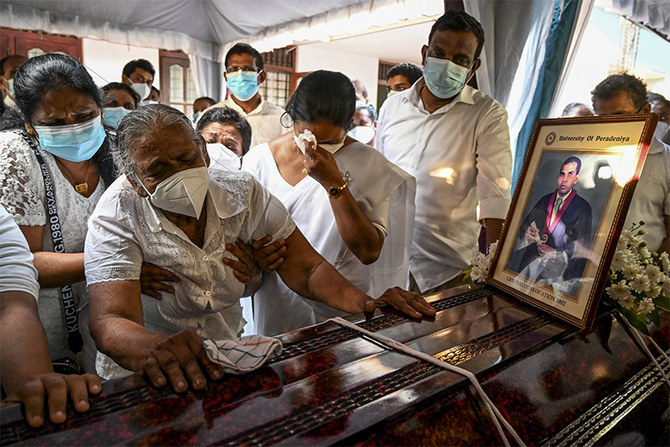
D.M.Kiriella (2L), mother of the slain Sri Lankan factory manager who was beaten to death and set ablaze by a mob in Pakistan, weeps while attending her son's last rites ceremony in Ganemulla, about 33 kms from Colombo on December 8, 2021. (AFP)
Short Url
Updated 09 December 2021
Follow

Sri Lankan man lynched in Pakistan laid to rest in native village with state honors

  • The road to the cemetery was decorated with condolence banners and white flags symbolizing mourning
  • Priyantha Kumara’s brother, who also works at a garment factory in Pakistan, called for secure work environment

COLOMBO, Sri Lanka: The body of a Sri Lankan factory manager who was tortured and set on fire by a mob in Pakistan for alleged blasphemy was buried in his native village with state honors on Wednesday.
Buddhist clergy performed religious rites at the home of Priyantha Kumara before police led a procession in which family and friends carried the casket with his charred remains to the cemetery.
The road was decorated with condolence banners and white flags symbolizing mourning.
Kumara was assaulted by a mob of hundreds of people and was dragged into the street and set on fire last Friday in Sialkot, Pakistan, where he helped run a sports equipment factory. Workers at the factory accused him of desecrating posters bearing the name of Islam’s Prophet Muhammad (PBUH).
The victim’s brother, Arunasiri Wasantha Kumara Diyawadana, who also works as a technical director at a garment factory in Pakistan, said factories should have a secure environment.
“That was not happening in this particular case,” he said.
He called for an improvement in management practices so any dispute can be resolved before it is too late.
He said the two governments should determine “the actual root cause for this, either if it’s a religious matter or an industrial dispute, and accordingly they have to find a solution.”
In Pakistan, mere allegations of blasphemy can trigger mob attacks. The country’s blasphemy law carries a possible death penalty.
Pakistani police have arrested dozens of people in connection with the violence, and Prime Minister Imran Khan has promised severe punishment for those found guilty.


Pakistan offers Arabian Sea trade routes to Russia, Central Asia, minister says

Updated 11 sec ago
Follow

Pakistan offers Arabian Sea trade routes to Russia, Central Asia, minister says

  • Islamabad pitches transit corridors linking Eurasia to global shipping lanes
  • Government invites foreign investment in Sukkur–Hyderabad M-6 motorway

ISLAMABAD: Pakistan is offering overland trade routes to Russia and landlocked Central Asian states through its Arabian Sea ports, Communications Minister Abdul Aleem Khan said on Thursday, positioning the country as a strategic transit hub as regional supply chains shift toward alternative corridors.

Pakistan has long sought to leverage its geography to connect landlocked Central Asian economies to warm-water ports, a strategy that has gained importance in recent years as countries explore routes that bypass traditional maritime chokepoints and longer shipping lanes. Islamabad promotes its ports at Karachi and Gwadar as gateways linking South Asia, the Middle East and Eurasia.

Speaking at the 88th session of the UN Economic Commission for Europe (UNECE) Inland Transport Committee in Geneva, Khan said Pakistan’s growing integration into Eurasian connectivity networks marked a new phase in regional trade cooperation.

“Pakistan’s strategic integration into the Belarus, Russia, and Central Asia corridors represents the dawn of a new era in regional connectivity,” he said, adding the country was providing “high-efficiency trade routes for Russia and landlocked Central Asian Republics.”

The minister said six land corridors were now facilitating transit trade, including routes via Türkiye, Azerbaijan and Iran, as well as China-Kazakhstan connectivity and Trans-Afghan links connecting Central Asian states to the Arabian Sea. He added that the Quadrilateral Traffic in Transit Agreement (QTTA) route could also expand northward.

He cited the transit of a Kazakh cargo shipment to the United Arab Emirates via Pakistan in June 2024 as proof of the country’s logistical viability for intercontinental trade.

Khan also pointed to more than 1,800 international TIR road-transit shipments — a UN customs system that allows sealed cargo trucks to cross borders without repeated inspections — as evidence of Pakistan’s operational readiness.

Central to Islamabad’s investment pitch was the proposed Sukkur–Hyderabad (M-6) motorway, a planned highway in southern Pakistan that would complete the country’s main north-south trade corridor linking ports on the Arabian Sea with inland and regional markets. Khan described it as a key missing link in Pakistan’s north-south transport backbone and an opportunity for foreign investors.

He said the project offered “nearly 30 percent guaranteed equity” and would significantly strengthen regional connectivity while generating predictable returns.

Pakistan has increasingly promoted infrastructure built under the China-Pakistan Economic Corridor (CPEC) as the backbone of its connectivity ambitions, arguing that improved road and logistics networks could transform the country into a transit economy rather than solely a destination market.

The government has also allocated a 100-acre terminal at Gwadar Port for Central Asian states and expanded visa-on-arrival access for citizens of 126 countries to facilitate business travel, according to the communications ministry.

Officials say digitalization of transport data and coordination with regional partners including Uzbekistan and Kazakhstan are aimed at making cross-border trade faster and compliant with international conventions.

Khan said the goal was to position Pakistan not merely as a transit territory but as “a proactive hub for global economic activity and a catalyst for a regional trade revolution.”