

Unvaccinated Lebanese face $165 fine for spreading COVID-19

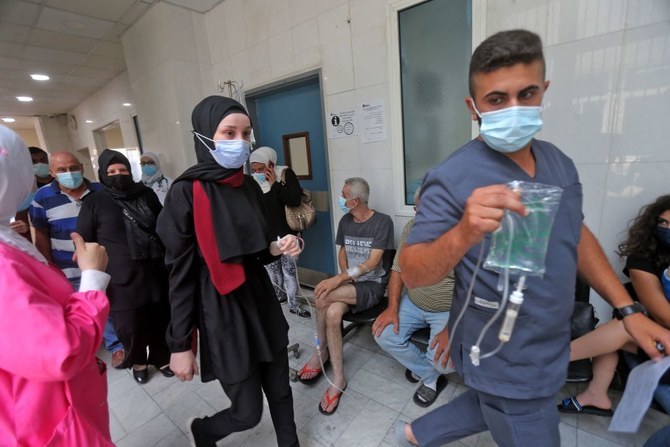
A medic assists a patient at Rafic Hariri University Hospital in Lebanon, whose lawmakers on Tuesday ratified a law fining the unvaccinated, who spread covid19, 250,000 Lebanese pounds. (STR/AFP via Getty Images)
Short Url
Updated 07 December 2021
Follow

Unvaccinated Lebanese face $165 fine for spreading COVID-19

  • Lebanon’s MPs ratify new law to punish country’s anti-vaxxers
  • Citizens criticize, ridicule lawmakers over ‘purposeless, late’ legislation

BEIRUT: Unvaccinated individuals who spread the coronavirus disease (COVID-19) in Lebanon could be fined 250,000 Lebanese pounds ($165, or a black-market rate of around $10) under a new law ratified by the country’s parliamentarians on Tuesday.

The penalty charge sees an increase on the previous fee of 50,000 Lebanese pounds imposed on people who had not been jabbed but had passed on the virus, the National News Agency reported.

However, the updated legislation did not make vaccination against COVID-19 obligatory.

Lebanese health officials have been urging the public to get inoculated amid a surge in daily infections with 1,707 new cases and 10 virus-related deaths recorded on Tuesday.

On whether citizens would take notice of the fine, Health Minister Dr. Firas Abiad told Arab News: “Within the economic financial situation in Lebanon, and the poverty level, it will certainly have an impact.”

However, Lebanese business manager, Hania Michele, criticized lawmakers for what she described as a “purposeless and meaningless law.”

She told Arab News: “It is not my fault if someone contaminates me with COVID-19 which will keep on spreading anyway. I don’t know if they are doing it purposely, to indirectly force the unvaccinated to get vaccinated.

“Even those who are vaccinated, they could still get infected and spread the virus. That’s why it’s impractical.”

Barber Yousef said less than 40 percent of Lebanon’s population had been vaccinated. “I am unsure if people, who are already bankrupt, would be able to afford paying 250,000 Lebanese pounds. So, why are people not getting vaccinated?

“It is not wrong to fine those who spread the virus, but people are broke and don’t have the money to pay for PCR (polymerase chain reaction) tests,” he said.

Banker, Ghalia Khalil, said that due to the country’s economic crisis the majority of people living in Lebanon could not afford to buy a facemask, never mind pay a hefty fine.

“Many parents and children aren’t complying with health restrictions and remain unmasked … they think if they’re vaccinated, they won’t get infected. The challenge will be in the implementation of the law rather than the stipulation.”

Shop owner, Mohammed Itani, said the lawmakers’ move was inefficient and too late.

“Increasing the fine from 50,000 to 250,000 pounds came very late. We are facing a fourth wave of COVID-19 and the daily infections are scary. Fines should have been made high to force citizens to wear masks and get vaccinated when the outbreak started,” he added.

One Lebanese educational consultant, who would only give her name as Nisreen C., said she would not be getting vaccinated and would rather protect herself by wearing a mask. “I am not getting vaccinated no matter how much it costs or what it takes,” she added. 

Schoolteacher, Marwa E., said: “This is a good step, though late. I believe that this steep fine, no matter how harsh it may sound amid our financial downfall, will eventually encourage people to getting vaccinated and wear masks.”


Security, economic and political partnerships in the spotlight at first Jordan-EU Summit

Updated 11 sec ago
Follow

Security, economic and political partnerships in the spotlight at first Jordan-EU Summit

  • Event reflects international confidence in Jordan as a reliable partner in efforts to address security threats, advance peace initiatives, and expand cooperation, analysts say
  • Timing is significant, expert says, given the region faces overlapping crises and threats that place security and defense cooperation at the heart of Jordanian-European relations

AMMAN: The inaugural Jordan-EU Summit underlined the depth of the country’s strategic partnership with Europe, officials and experts said, and confirmed the pivotal role Jordan plays in regional security, political stability and economic cooperation.

Analysts told the Jordan News Agency that Thursday’s summit took place at a sensitive moment for the region, but reflected international confidence in Jordan as a reliable partner in efforts to address cross-border security threats, advance peace initiatives, and expand cooperation in trade, investment and development.

Bashir Al-Dajeh, an expert in security and strategy, said the timing of the summit was significant, given the region is facing overlapping crises and transnational threats that place security and defense cooperation at the heart of Jordanian-European relations.

Jordan’s strategic location positions it on the front lines of efforts to tackle illegal migration, organized crime, drug and arms smuggling and cross-border terrorism, he added. The country has hosted more than 3.5 million refugees over the past decade without compromising its security infrastructure, he noted.

Jordan’s effective border controls were helping to curb irregular migration to Europe and disrupting the plans of extremist groups and trafficking networks, Al-Dajeh said, which was directly benefiting regional and European security.

Khaled Abu Hassan, a member of the Jordanian parliament, said the country’s foreign policy under King Abdullah had reinforced its influence, in the region and internationally, particularly its firm stance in support of the Palestinian cause and a two-state solution to the conflict with Israel.

He said the summit reaffirmed Jordan’s political influence in the shaping of regional balances and advancement of efforts to achieve a just and comprehensive peace. The timing of the meeting also demonstrated the resilience of the nation in managing multiple regional and domestic challenges.

Abu Hassan also highlighted the economic aspects of the summit, including the announcement of a Jordan-EU economic conference in April, as a sign of the international recognition of Jordan’s political and economic role.

Economist Mufleh Aql said the high-level summit reflected a shared desire for a broadening of cooperation to encompass politics, trade, security and renewable energy, and Jordan was well-placed to benefit from access to the EU’s large markets, technology and investment opportunities.

The country could benefit from increased exports, technology transfers and financing for major infrastructure projects in sectors such as water, transport and energy, he added, and in return offer the EU skilled human capital amid labor shortages in Europe.

EU support for Jordan’s positions on issues such as Jerusalem, regional stability, energy and migration further strengthens the partnership, Aql said. Jordan also already benefits from EU grants, concessional loans and exports of agricultural, pharmaceutical and chemical products to European markets, he noted.