

Palestinian teenager shot dead by Israeli guard

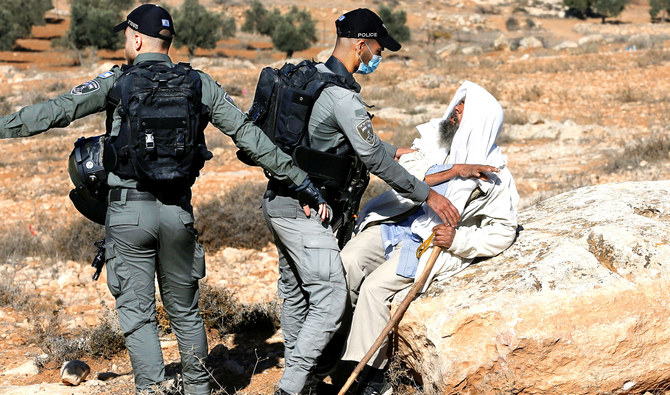
A Palestinian scuffles with Israeli border police officers as Israeli machinery demolishes a Palestinian house in the Israeli-occupied West Bank. (Reuters)
Short Url
Updated 07 December 2021
Follow

Palestinian teenager shot dead by Israeli guard

RAMALLAH: A Palestinian teenager who drove his car into an Israeli security checkpoint in the occupied West Bank was shot dead on Monday by a security guard at the scene, officials said.

The car-ramming occurred after 1 a.m. at the Te’enim checkpoint near the Palestinian city of Tulkarem, an Israeli Defense Ministry statement said, adding that the assailant had been “neutralized.”

It was not immediately clear if the alleged attacker was killed, but the official Palestinian news agency Wafa later reported that 15-year-old Mohammed Nidal Yunes died from injuries after being fired on at a checkpoint.

An Israeli security official confirmed to AFP that the driver of the vehicle was killed.

The Defense Ministry said that a security guard was “seriously injured” in the attack.

Israel’s Sheba Hospital said the guard’s injuries were not life threatening.

Israel has occupied the West Bank since 1967 and the Palestinian territory is now home to roughly 475,000 Jewish settlers living in communities widely considered illegal under international law.

Attacks on checkpoints are common, often carried out by individual Palestinians armed with knives, as well as attempted car-rammings and occasional shootings.

Monday’s incident came after a Palestinian assailant stabbed an Israeli civilian and attempted to attack police on Saturday near the Damascus Gate entry to the Old City in Israeli-annexed East Jerusalem.

The assailant was shot dead by officers who appeared to fire on the suspect after he was on the ground, stirring debate about excessive force.

Israeli authorities have insisted the officers acted appropriately.

BACKGROUND

Israel has occupied the West Bank since 1967 and the Palestinian territory is now home to roughly 475,000 Jewish settlers living in communities widely considered illegal under international law.

On Sunday, Israeli authorities freed a prominent Palestinian prisoner, two weeks after striking a release deal that ended his marathon 131-day hunger strike.

Kayed Fasfous, 32, had remained in an Israeli hospital since ending his strike on Nov. 23.

He was the symbolic figurehead of six hunger strikers protesting Israel’s controversial policy of “administrative detention,” which allows suspects to be held indefinitely without charge.

Israel claims the policy is necessary to keep dangerous suspects locked away without disclosing sensitive information that could expose valuable sources.

Palestinians and rights groups say the practice denies the right of due process, allowing Israel to hold prisoners for months or even years without seeing the evidence against them.  The law is rarely applied to Israelis.

The Palestinian Prisoners Club, a group representing former and current prisoners, confirmed Fasfous had returned home to the occupied West Bank through a military checkpoint near the southern city of Hebron on Sunday afternoon.

Online footage showed the former prisoner in a wheelchair celebrating his return to his southern hometown of Dura before being taken to a hospital in the West Bank city of Ramallah.

The plight of the six hunger strikers ignited solidarity demonstrations across the Israeli-occupied West Bank and Gaza in November mounting pressure on Israel to release the detainees.

At least four of the five other hunger strikers have since ended their protests after reaching similar deals with Israeli authorities. They are expected to be released in the coming months.

Hunger strikes are common among Palestinian prisoners and have helped secure numerous concessions from Israeli authorities.

The nature of these strikes vary from individuals protesting detention without charge to groups calling for improved cell conditions.

Around 500 of the 4,600 Palestinians detained by Israel are held in administrative detention according to Addameer, a Palestinian prisoner rights group.


Trump says Iran government change ‘best thing that could happen’

Updated 9 min 9 sec ago
Follow

Trump says Iran government change ‘best thing that could happen’

  • US president's comments come after he ordered a second aircraft carrier to head to the Middle East

FORT BRAGG, United States: US President Donald Trump said a change of government in Iran would be the “best thing that could happen,” as he ordered a second aircraft carrier to head to the Middle East.
“Seems like that would be the best thing that could happen,” Trump told reporters at the Fort Bragg military base in North Carolina when a journalist asked if he wanted “regime change” in Iran.
“For 47 years, they’ve been talking and talking and talking. In the meantime, we’ve lost a lot of lives while they talk,” he told reporters.

Trump declined to say who he would want to take over in Iran from supreme leader Ayatollah Ali Khamenei, but he added that “there are people.”
He has previously backed off full-throated calls for a change of government in Iran, warning that it could cause chaos, although he has made threats toward Khamenei in the past.
Speaking earlier at the White House, Trump said that the USS Gerald R. Ford — the world’s largest warship — would be “leaving very soon” for the Middle East to up the pressure on Iran.
“In case we don’t make a deal, we’ll need it,” Trump said.
The giant vessel is currently in the Caribbean following the US overthrow of Venezuela’s Nicolas Maduro. Another carrier, the USS Abraham Lincoln, is one of 12 US ships already in the Middle East.

When Iran began its crackdown on protests last month — which rights groups say killed thousands — Trump initially said that the United States was “locked and loaded” to help demonstrators.
But he has recently focused his military threats on Tehran’s nuclear program, which US forces struck last July during Israel’s unprecedented 12-day war with Iran.
The protests have subsided for now but US-based Reza Pahlavi, the son of Iran’s last shah, urged international intervention to support the Iranian people.
“We are asking for a humanitarian intervention to prevent more innocent lives being killed in the process,” he told the Munich Security Conference.
It followed a call by the opposition leader, who has not returned to his country since before the revolution, for Iranians at home and abroad to continue demonstrations this weekend.
Iran and the United States, who have had no diplomatic relations since shortly after the revolution, held talks on the nuclear issue last week in Oman. No dates have been set for new talks yet.
The West fears the program is aimed at making a bomb, which Tehran denies.
The head of the UN nuclear watchdog, Rafael Grossi, said Friday that reaching an accord with Iran on inspections of its processing facilities was possible but “terribly difficult.”

Trump said after talks with Israeli Prime Minister Benjamin Netanyahu earlier this week that he wanted to continue talks with Iran, defying pressure from his key ally for a tougher stance.
The Israeli prime minister himself expressed skepticism at the quality of any agreement if it didn’t also cover Iran’s ballistic missiles and support for regional proxies.
According to the US-based Human Rights Activists News Agency, 7,008 people, mostly protesters, were killed in the recent crackdown, although rights groups warn the toll is likely far higher.
More than 53,000 people have also been arrested, it added.
The Norway-based Iran Human Rights (IHR) NGO said “hundreds” of people were facing charges linked to the protests that could see them sentenced to death.
Figures working within the Iranian system have also been arrested, with three politicians detained this week from the so-called reformist wing of Iranian politics supportive of President Masoud Pezeshkian.
The three — Azar Mansouri, Javad Emam and Ebrahim Asgharzadeh — were released on bail Thursday and Friday, their lawyer Hojjat Kermani told the ISNA news agency.