

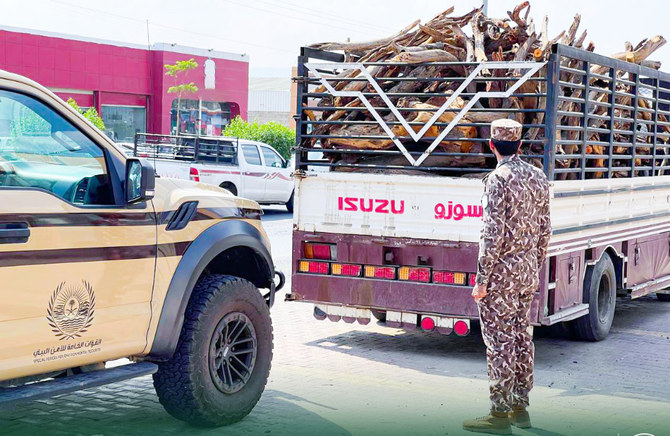
Saudi environmental security officers protect sea and land ecosystems

Saudi Arabia is committed to protecting the environment and its natural resources. (Twitter: @SFES_KSA)
Short Url
Updated 07 December 2021
Follow

Saudi environmental security officers protect sea and land ecosystems

  • Among the arrested are illegal firewood traders

RIYADH: The Saudi Special Forces for Environmental Security have apprehended dozens of offenders for environmental violations as part of a recent crackdown.

The forces, under the command of the Ministry of Interior, arrested individuals who illegally moved sand and soil in Jeddah and Tabuk. People who illegally entered the Imam Turki bin Abdullah Royal Reserve in northeast Riyadh and hunted wildlife in restricted areas were also detained.

Others were arrested while transporting local firewood and trafficking endangered fungi in Al-Muzahmiyya Governorate. Several other citizens were also caught selling local firewood in other regions of the Kingdom.

Saudi Arabia is committed to protecting the environment and its natural resources across its vast territory. The Saudi environment law focuses on conservation, protection, development, pollution prevention, public health protection and the rational use of natural resources.

It also aims to make environmental planning an integral part of comprehensive development in industrial, agricultural and urban areas.

One practice that harms the Saudi environment is illegal dredging. Talal S. Al-Rasheed, a consultant at Gulf Energy for Environmental Consultations, warned that dredging and similar practices can negatively impact the environment and economy if studies are not conducted beforehand. Reduced fish stocks and damage to coral reefs are major consequences of poorly planned and illegal dredging.

Al-Rasheed added that taking sand and soil without a license is a “major disaster” because it changes the nature of the land by creating deep pits that cause accidents and endanger the lives of road users.

“Because the marine environment is sensitive to its habitat, when anything changes in nature, creatures begin to shift to other locations. Some of these habitats might not suitable for living. Because of the availability of suitable places for marine organisms, every species in the marine environment has a designated place to adapt to,” Al-Rasheed said.

Nasser M. Al-Hamidi, an environmental activist, said that burning or cutting trees in natural forests for wood is harmful to the environment and local communities due to smoke pollution.

He added that any attack on the environment, including dredging and stealing natural materials such as mountain rock deposits, poses a severe threat to the Kingdom’s natural beauty, which should be preserved for future generations.


Klija Festival in Buraidah empowers small businesses

Updated 24 January 2026
Follow

Klija Festival in Buraidah empowers small businesses

  • Half a million attend 15-day celebration of heritage; event creates 1,500 seasonal jobs

RIYADH: The 17th Klija Festival in Buraidah drew more than half a million visitors during its 15-day run, celebrating the region’s heritage and entrepreneurial spirit.

Organized by the Qassim Chamber of Commerce, the event highlighted small businesses, providing a platform for entrepreneurs to showcase local products.

More than 340 sales outlets, marketing corners and points of sale welcomed attendees, while the festival provided 1,500 seasonal job opportunities, the Saudi Press Agency reported.

The small business pavilions featured families in the cottage industry, artisans and startups presenting traditional foods, and handicrafts and heritage items that reflect the region’s identity.

Participants said that the festival was a key marketing platform, boosting sales, increasing brand awareness, facilitating knowledge exchange and fostering connections with organizations supporting SMEs.

Mohammed Al-Hanaya, Qassim Chamber secretary-general and festival supervisor, said that the event brought together families, artisans, SMEs, companies and institutions, stimulating commercial activity, opening direct marketing channels and enhancing economic returns.

He added that the festival provided seasonal jobs for more than 1,500 young men and women across operations, marketing and services, supporting the labor market, empowering national talent, and connecting youth to the events and creative economy.

Klija, a traditional cookie made from wheat flour, dates or sugar, date syrup and natural ingredients such as cardamom and lemon, is a rich source of energy, carbohydrates, dietary fiber and natural proteins.

A cultural icon rooted in Qassim’s traditions, the cookie has gained international exposure through the festival, expanding the availability of packaged products.

Starting next year, the festival will be renamed the International Klija Festival, a rebranding approved by Qassim Gov. Prince Faisal bin Mishaal, who described it as a “successful model for turning local initiatives into global economic engines.”

This year’s festival, held at the King Khalid Cultural Center, included international participants from Egypt, Turkiye and Morocco, marking its evolution into a cross-cultural platform.
