

More attacks will happen, says UK’s top counterterrorism cop

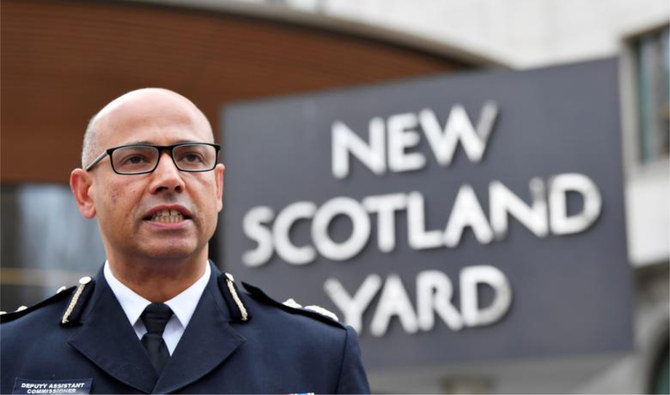
Neil Basu, the Metropolitan Police's Assistant Commissioner for counterterrorism outside New Scotland Yard in London, Britain. (Reuters/File)
Short Url
Updated 06 December 2021
Follow

More attacks will happen, says UK’s top counterterrorism cop

  • Neil Basu’s warning came during an inquiry into the 2017 bombing of an Ariana Grande concert in Manchester
  • ‘I’m going to be very blunt about this: We won’t stop them happening again, they will happen again. We have to try and minimize or reduce the risk,’ he said

LONDON: Britain’s highest-ranking counterterrorism police officer has warned that despite improvements in the ways agencies collaborate to prevent terror attacks, they cannot stop them all and it is inevitable that there will be more.

The comment by Assistant Commissioner Neil Basu of the Metropolitan Police Service came on Monday when he appeared at the inquiry into the 2017 Manchester Arena bombing. Twenty-two people were killed, including a number of children, when 22-year-old suicide bomber Salman Abedi detonated an explosive device at an Ariana Grande concert.

Basu, who serves as the National Police Chiefs Council lead for Counter Terrorism Policing, told the inquiry: “The horror of this makes you look very hard at, hopefully, preventing it ever happening again.”

But he added: “I’m going to be very blunt about this: We won’t stop them happening again, they will happen again. We have to try and minimize or reduce the risk and that means constantly trying to have a system that looks at improvement, no matter how busy we are.”

The inquiry into the attack in May 2017 is examining the activities of emergency services, including the police and intelligence agencies, in the lead-up to the attack.

Basu said the results of a joint police and MI5 review of a number of attacks that took place in 2017, including the arena bombing, were “humbling.” That review made 104 recommendations for improvements, four of which remain outstanding.

He added that cross-agency collaboration has improved since 2017 but that more work can yet be done to better align the work of agencies.

“We’re very close but we need to be closer still,” Basu said.

The inquiry also heard from Ian Fenn, the former headteacher of a Manchester school Abedi attended between 2009 and 2011. He said Abedi was not a good student and was, at times, “aggressive and rude” to teachers, and had been suspended for theft and for setting off fireworks.

However, there was “no indication,” Fenn added, that Abedi held extremist views at that time.

“He never came across as somebody who was opinionated, who was driven, that had an agenda,” he told the inquiry. “He was a typically lackluster child who drifted around.”


UN chief Guterres warns ‘powerful forces’ undermining global ties

Updated 25 min 54 sec ago
Follow

UN chief Guterres warns ‘powerful forces’ undermining global ties

  • Guterres paid tribute to Britain for its decisive role in the creation of the United Nations
  • He said 2025 had been a “profoundly challenging year for international cooperation and the values of the UN“

LONDON: UN chief Antonio Guterres Saturday deplored a host of “powerful forces lining up to undermine global cooperation” in a London speech marking the 80th anniversary of the first UN General Assembly.
Guterres, whose term as secretary-general ends on December 31 this year, delivered the warning at the Methodist Central Hall in London, where representatives from 51 countries met on January 10, 1946, for the General Assembly’s first session.
They met in London because the UN headquarters in New York had not yet been built.
Guterres paid tribute to Britain for its decisive role in the creation of the United Nations and for continuing to champion it.
But he said 2025 had been a “profoundly challenging year for international cooperation and the values of the UN.”
“We see powerful forces lining up to undermine global cooperation,” he said, adding: “Despite these rough seas, we sail ahead.”
Guterres cited a new treaty on marine biological diversity as an example of continued progress.
The treaty establishes the first legal framework for the conservation and sustainable use of marine diversity in the two-thirds of oceans beyond national limits.
“These quiet victories of international cooperation — the wars prevented, the famine averted, the vital treaties secured — do not always make the headlines,” he said.
“Yet they are real. And they matter.”