Pope calls neglect of migrants ‘shipwreck’ on Lesbos visit

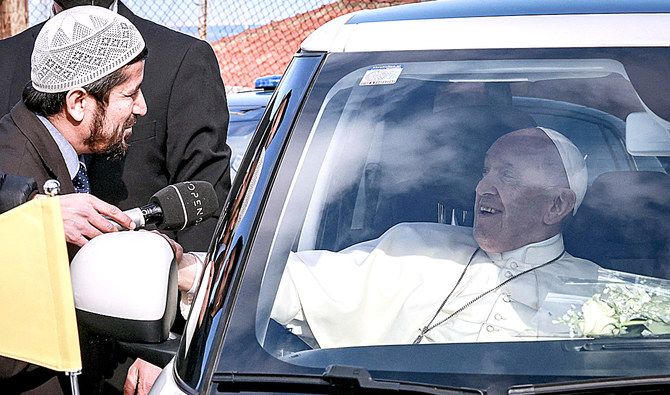
Pope Francis, right, speaks with an imam as he leaves in a car after meeting refugees in Mytilene on the island of Lesbos on Sunday. (AFP)
Short Url
Updated 06 December 2021
Follow

Pope calls neglect of migrants ‘shipwreck’ on Lesbos visit

  • Pope Francis has long championed cause of migrants, visit comes a day after he made a stinging rebuke to Europe

LESBOS ISLAND: Pope Francis on Sunday returned to the island of Lesbos, the migration flashpoint he first visited in 2016, calling the neglect of migrants the “shipwreck of civilization.”

The pope has long championed the cause of migrants and his visit comes a day after he delivered a stinging rebuke to Europe which he said was “torn by nationalist egoism.”

“In Europe there are those who persist in treating the problem as a matter that does not concern them,” the pope said as he spent some two hours at Lesbos’ Mavrovouni camp where nearly 2,200 asylum seekers live.

On the second day of his visit to Greece, he met dozens of child asylum seekers and relatives standing behind metal barriers and stopped to embrace a boy called Mustafa. 

People later gathered in a tent to sing songs and psalms to the pontiff.

Pope Francis warned that the Mediterranean “is becoming a grim cemetery without tombstones” and that “after all this time, we see that little in the world has changed with regard to the issue of migration.”

He said the root causes “should be confronted — not the poor people who pay the consequences and are even used for political propaganda.”

The European Union has been locked in a dispute with Belarus over an influx of migrants traveling through the former Soviet state seeking to enter Poland, Lithuania and Latvia in recent months.

Britain and France have traded barbs over the increasing number of migrants making the deadly Channel crossing to reach the UK in the wake of the November 24 mass drowning which claimed 27 lives.

“His visit is a blessing,” said Rosette Leo, a Congolese asylum seeker at the site.

The temporary Mavrovouni tent camp was hurriedly erected after the sprawling camp of Moria, Europe’s largest such site at the time, burned down last year.

Greek authorities blamed a group of young Afghans for the incident and security was substantially enhanced for the pontiff’s visit.

The pope’s trip to Lesbos was shorter than his last as he will hold a mass for some 2,500 people at the Megaron Athens Concert Hall later Sunday.

In Cyprus, where the pope visited before Greece this week, authorities said that 50 migrants will be relocated to Italy thanks to Francis.

Greek officials have not ruled out the possibility that some migrants from Mavrovouni could accompany him back to Italy.

He took 12 Syrian refugees with him during his last visit to Lesbos in 2016.

At the start of his Athens visit on Saturday, Francis “today, and not only in Europe, we are witnessing a retreat from democracy,” , warning against populism’s “easy answers.”

In 2016, Francis visited Moria with Bartholomew I, the spiritual leader of the world’s Orthodox Christians, and Archbishop Ieronymos II, head of the Church of Greece.

The Mavrovouni camp currently holds 2,193 people and has a capacity of 8,000, a facility official said this week.

Authorities insist asylum procedures and processing times are now faster.

With EU funds, Greece is building a series of “closed” facilities on Greek islands with barbed wire fencing, surveillance cameras, X-ray scanners and magnetic gates that are closed at night.

Three such camps have opened on the islands of Samos, Leros and Kos, with Lesbos and Chios to follow next year.

Once migrants receive asylum they are no longer eligible to remain in the camps with many then unable to find accommodation or work, drawing criticism from NGOS and aid agencies.

The groups have also raised concerns about the new camps, arguing that people’s movements should not be restricted as well as claiming Greek border officers have pushed back migrants.

Greece vehemently denies the claims, insisting its coast guard saves lives at sea.

The pope flew back to Athens after the visit and will return to Rome on Monday.


UN chief says 37,000 West Bank Palestinians displaced in 2025; warns Gaza war threatens two-state solution

Updated 5 sec ago
Follow

UN chief says 37,000 West Bank Palestinians displaced in 2025; warns Gaza war threatens two-state solution

  • ‘We enter 2026 with the clock ticking louder than ever. Will the year ahead bend towards peace or slip into the abyss of despair?” asks Secretary-General Antonio Guterres
  • Illegal settlement expansions, demolitions, displacements and evictions in the West Bank are accelerating, he says

NEW YORK CITY: More than 37,000 Palestinians were displaced in the occupied West Bank during 2025, a year in which there were also record-high levels of violence committed by Israeli settlers, UN secretary-General Antonio Guterres said on Tuesday.
The situation on the ground was rapidly eroding the prospects for a two-state solution, he warned.
“We enter 2026 with the clock ticking louder than ever,” Guterres told the opening session of the UN Committee on the Exercise of the Inalienable Rights of the Palestinian People. 
“Will the year ahead bend towards peace or slip into the abyss of despair?”
Illegal settlement expansions, demolitions, displacements and evictions in the West Bank were accelerating, said Guterres, who described the Israeli actions as destabilizing in nature and unlawful under international law.
“The recently published tender by Israel for 3,401 housing units in the E1 area (of the West Bank), alongside continued demolitions, is profoundly alarming,” he added.
“If carried forward, it would sever the northern and southern West Bank, undermine territorial contiguity, and strike a severe blow to the viability of a two-state solution.”
Turning to the situation in Gaza, Guterres said Palestinians there continued to endure “grave suffering.” More than 500 have been killed since the truce between Israel and Hamas in October, he noted.
“I urge all parties to implement the (ceasefire) agreement in full, exercise maximum restraint, and comply with international law and UN resolutions,” he said.
He called for the rapid and unimpeded delivery of humanitarian aid at scale, including through the Rafah border crossing between Gaza and Egypt, which Israel reopened on Monday.
Guterres criticized Israeli authorities for the continued suspension of international non-governmental organizations that provide aid, which he said “defies humanitarian principles, undermines fragile progress, and worsens the suffering of civilians.”
Regarding the future of Gaza, he said any sustainable solution must include governance of the territory and the West Bank, including East Jerusalem, by a unified and internationally recognized Palestinian government.
“Gaza is and must remain an integral part of a Palestinian state,” Guterres added.
He also reaffirmed his support for the UN Relief and Works Agency for Palestine Refugees, and condemned recent Israeli legislation and other actions he said impeded the ability of the agency to operate, including moves to demolish its Sheikh Jarrah compound in occupied East Jerusalem.
“Let me be clear: UNRWA premises are United Nations premises,” he said. “They are inviolable and immune from any form of interference.”
Guterres described public threats against UNRWA staff as “utterly abhorrent,” and said Israel was obliged under international law to respect the privileges and immunities of the UN.
He also reiterated that an end to Israeli occupation of Palestinian territory was essential.
“There is only one viable route (to peace): the two-state solution, in line with international law and relevant United Nations resolutions,” he said, as he called on the international community to act “with clarity, unity and determination” on the issue.