Experts warn upcoming Libyan elections unlikely to heal rifts

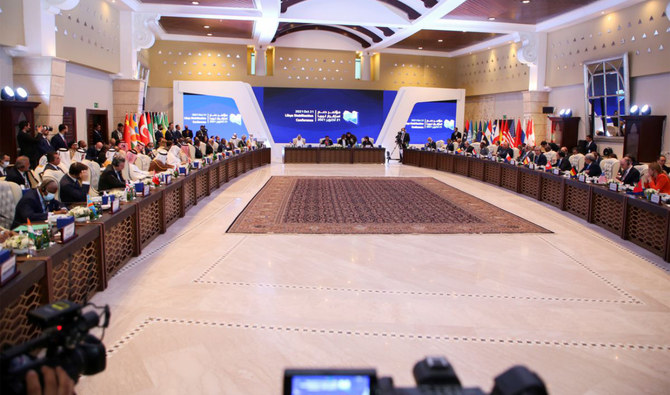
Delegates take part in an international conference to support the stability of Libya ahead of the country's presidential elections in December, in Tripoli, Libya, October 21, 2021. (Reuters)
Short Url
Updated 03 December 2021
Follow

Experts warn upcoming Libyan elections unlikely to heal rifts

  • Armed groups have reportedly already strongarmed voters at polling stations and the full list of candidates has still not been finalized

LONDON: The political situation in Libya will remain unstable whether or not planned elections go ahead later this month, experts have warned, pointing to legal, political, and security failings that endanger stability in the near future.

In an event hosted Thursday by London think-tank Chatham House and attended by Arab News, a panel of speakers outlined their grim predictions for the future of Libya’s political roadmap.

Wolfram Lacher, senior associate at the German Institute for International Affairs, warned that the political situation is even worse than in the lead-up to the 2014 election, which ultimately saw the eruption of conflict between Tripoli and Benghazi-based parties.

“The current situation is immensely more problematic than it was in 2014. It’s not comparable at all,” said Lacher.

Parliamentary and presidential elections are planned for Dec. 24 for the first time since the cessation of hostilities in a civil war between the Government of National Unity’s Tripoli-based forces, the Government of National Accordand Khalifa Haftar’s Libyan National Army, based in Benghazi.

Lacher explained that the years of division that ensued during that civil war have led to a more divided country than in pre-2014.

The creation of rival administrations, Lacher said, “essentially led to the whole constitutional architecture of Libya breaking down. There is no basis anymore than anyone agrees on.”

He continued: “We’ve had two civil wars in Libya since (2014) that have inflicted deep rifts on the social fabric. The militias have grown incredibly powerful since 2014, and much more politically involved.”

But Lacher warned that the legal process convened to run this month’s elections actually threatens to enflame these divisions, not heal them — as the election was intended to do.

Libyan authorities are currently embroiled in a dispute over the legal basis upon which certain candidates, such as former Prime Minister Abdulhamid Dbeibeh, could run. Some candidates have argued that Dbeibeh should be barred from running for President because he did not comply with laws that force officials to resign a minimum of three months before an election takes place.

But these ostensibly legal technical issues — that appear administrative in nature — have an important role in deciding the outcome of the vote itself, as well as the political reality and intra-Libyan dynamics in the days following the vote.

Experts warned that militias and armed factions could refuse to accept the vote if it does not go their way, and use legal issues, such as certain candidates being allowed to run, as grounds to delegitimize the entire process. It is not clear what would happen if losing candidates choose to do this.

Zahraa Langhi, member of the Libyan Political Dialogue Forum, told participants that both the LNA and GNA are currently benefitting from a political stalemate in Libya, and so they have no true interest in seeing a free and fair election carried out.

“The current political stalemate, the political fragmentation — all these forces are benefitting from it,” Langhi said, explaining that any delay in the election could “reward” those who spoil the election’s integrity.

She also said that interim governments, convened as part of international multilateral measures, “failed miserably” to rectify Libya’s political fragmentation — despite that objective being a “major, basic milestone in the roadmap to creating national unity.”

Langhi lamented a failure by the UN to engage effectively with actors on the ground in Libya.

“The (UN) special envoy is leaving (his post) in a couple of days, leaving the whole process without oversight.”

She said that the UN has left the issue of vetting candidates — fundamentally important to a safe and secure election — to Libya’s judiciary, which she believes has “failed to address the issue.”

Now Libyans are left with a series of candidates that Langhi said do not provide any real choice for Libyans, the most prominent of which are former Prime Minister Dbeibeh, former warlord Haftar, and possibly even Saif Al-Islam Qaddafi — son of late dictator Muammar Qaddafi. “This cannot continue,” she said.

But Otman Gajiji, former chairman of the Libyan High National Election Commission, cast doubt on the possibility that Libyans will manage to vote freely and fairly at all.

Not only do Libyans not have enough time to familiarize themselves with the dozens of candidates currently in the running for election, he said, but a series of attacks on polling stations are a grim omen for voting day.

“There are new unofficial reports that four polling stations were attacked by armed groups in Aziziya, and one was in Tripoli — all voter cards, or most of the voter cards, were taken by these armed groups. For me that is a very bad sign,” Gajiji said.

He added: “We are 22 days, three weeks, ahead of the elections. Such events are not a good indicator for the near future, or for the future of the elections.”


Palestinians wait at border between Gaza and Egypt as uncertainty clouds reopening of Rafah crossing

Updated 6 sec ago
Follow

Palestinians wait at border between Gaza and Egypt as uncertainty clouds reopening of Rafah crossing

  • At that pace, long waits are facing most of the roughly 20,000 sick and wounded people who Gaza’s Health Ministry has said need treatment abroad
  • Reopening the crossing is considered key as the ceasefire agreement moves into a complicated second phase
  • The bus with about 40 Palestinians that entered Gaza via Rafah on Tuesday arrived at Nasser hospital in Khan Younis early Wednesday morning, where their families welcomed them after spending the entire day waiting

KHAN YOUNIS, Gaza Strip: Palestinians gathered on both sides of Gaza’s border with Egypt on Tuesday hoping to pass through the Rafah crossing, after its reopening the previous day was marred by delays, interrogations and uncertainty over who would be allowed to cross.
On the Egyptian side were Palestinians who fled Gaza earlier in the Israel-Hamas war to seek medical treatment, according to Egypt’s state-run Al-Qahera News television. On the Gaza side, Palestinians in need of medical care that is unavailable in Gaza gathered at a hospital before ambulances moved toward Rafah, hoping for word that they would be allowed to cross the other way.
The office of the North Sinai governor confirmed Tuesday that an unknown number of patients and their companions had crossed from Gaza into Egypt.
The bus with about 40 Palestinians that entered Gaza via Rafah on Tuesday arrived at Nasser hospital in Khan Younis early Wednesday morning, where their families welcomed them after spending the entire day waiting.
Though hailed as a step forward for the fragile ceasefire struck in October, it took more than 10 hours for only about a dozen returnees and a small group of medical evacuees to cross in each direction on the first day Rafah reopened.
Three women who crossed into Gaza on Monday told The Associated Press on Tuesday that Israeli troops blindfolded and handcuffed them, then interrogated and threatened them, holding them for several hours before they were released.
The numbers permitted to cross on Monday fell well short of the 50 people that officials had said would be allowed each way and barely began to address the needs of tens of thousands of Palestinians who are hoping to be evacuated for treatment or to return home.
The import of humanitarian aid or goods through Rafah remains prohibited.
’Not a solution to the crisis’
Evacuation efforts on Tuesday morning converged around a Red Crescent hospital in Khan Younis, where a World Health Organization team arrived and a vehicle carrying patients and their relatives rolled in from another hospital. Then the group of WHO vehicles and Palestinian ambulances headed toward Rafah to await crossing.
As the sick, wounded and displaced waited to cross in both directions, health officials said the small number allowed to exit so far paled beside Gaza’s tremendous needs. Two years of fighting destroyed much of its medical infrastructure and left hospitals struggling to treat trauma injuries, amputations and chronic conditions like cancer.
In Gaza City, Shifa Hospital director Mohamed Abu Selmiya called the pace “crisis management, not a solution to the crisis,” imploring Israel to permit the importing of medical supplies and equipment. He wrote on Facebook: “Denying the evacuation of patients and preventing the entry of medicines is a death sentence for them.”
UN and WHO officials said the trickle of patients allowed out and restrictions on bringing in desperately needed supplies are prolonging a disastrous situation in Gaza.
“Rafah must function as a real humanitarian corridor so we can have a surge in aid deliveries,” said Tom Fletcher, the UN’s top relief official.
Palestinian Red Crescent spokesperson Raed Al-Nims told AP that only 16 patients with chronic conditions or war wounds, accompanied by 40 relatives, were brought from Khan Younis to the Gaza side of Rafah on Tuesday — less than the 45 patients and wounded the Red Crescent was told would be allowed.
After days of anticipation over the reopening, hope lingered that it might mark a meaningful first step. In Khan Younis, Iman Rashwan waited for hours until her mother and sister returned from Egypt, hoping others would soon see their loved ones again.
Waiting on both sides
Officials say the number of crossings could gradually increase if the system works, with Israel and Egypt vetting those allowed in and out. But security concerns and bureaucratic snags quickly tempered expectations raised by officials who for weeks had cast reopening as a major step in the ceasefire deal.
There were delays on Monday over disagreements about luggage allowances. Returnees were carrying more than anticipated with them, requiring additional negotiations, a person familiar with the situation told the AP, speaking on condition of anonymity to discuss the diplomatic matter.
“They didn’t let us cross with anything,” Rotana Al-Regeb said as she returned around midnight Monday to Khan Younis. “They emptied everything before letting us through. We were only allowed to take the clothes on our backs and one bag per person.”
The initial number of Palestinians allowed to cross is mostly symbolic. Israeli and Egyptian officials have said that 50 medical evacuees would depart — along with two caregiver escorts — and 50 Palestinians who left during the war would return.
At that pace, long waits are facing most of the roughly 20,000 sick and wounded people who Gaza’s Health Ministry has said need treatment abroad. About 150 hospitals across Egypt are ready to receive patients, authorities said.
Who and what would be allowed through Rafah was a central concern for both Israel and Egypt.
Israeli Prime Minister Benjamin Netanyahu has said that anyone who wants to leave will eventually be permitted to do so, but Egypt has repeatedly said the Rafah crossing must open in both directions, fearing Israel could use it to push Palestinians out of Gaza.
Reopening the crossing is considered key as the ceasefire agreement moves into a complicated second phase. That calls for installing a new Palestinian committee to govern Gaza, deploying an international security force, disarming Hamas and taking steps to begin rebuilding.
In a meeting Tuesday with US special envoy Steve Witkoff in Jerusalem, Netayanhu repeated Israel’s “uncompromising demand” that Hamas be disarmed before any reconstruction begins, the prime minister’s office said.
A 19-year-old killed in southern Gaza
Nasser Hospital in Khan Younis said Ahmed Abdel-Al, 19, was shot and killed by Israeli troops on Tuesday morning in a part of the southern Gaza City, some distance away from the area under the Israeli military’s control.
Israel’s military said it was not immediately aware of any shootings in the area.
Abdel-Al was the latest of the 529 Palestinians killed by Israeli fire since the Oct. 10 start of the ceasefire, according to Gaza’s Health Ministry. They are among more than 71,800 Palestinians killed since the start of the war, according to the ministry, which does not distinguish between fighters and civilians.
The ministry, part of Gaza’s Hamas-led government, keeps detailed casualty records that are seen as generally reliable by UN agencies and independent experts.