

Pakistan urges OIC to help address Afghanistan's urgent humanitarian needs

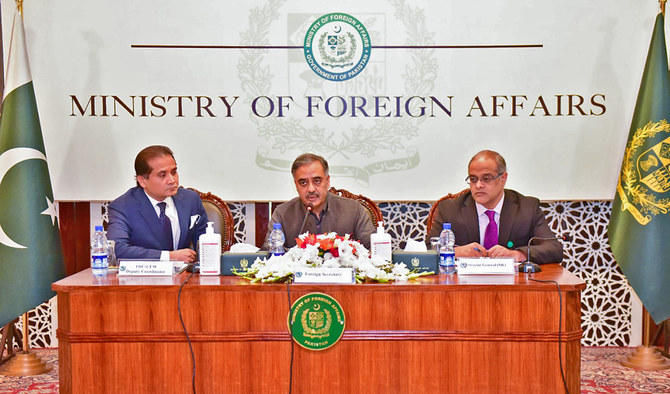
Pakistan's foreign secretary Sohail Mahmood, center, briefs the OIC heads of mission in Islamabad, Pakistan, on December 1, 2021. (Photo courtesy: Pakistan foreign office)
Short Url
Updated 01 December 2021
Follow

Pakistan urges OIC to help address Afghanistan's urgent humanitarian needs

  • The Organization of Islamic Cooperation will be holding an extraordinary session on Afghanistan later this month
  • Pakistan's foreign secretary says 60 percent of Afghan nationals can face 'crisis level of hunger' that may lead to mass refugee exodus

ISLAMABAD: Pakistan's foreign secretary Sohail Mahmood said on Wednesday the Organization of Islamic Cooperation (OIC) should play a role in helping the people of Afghanistan who were facing a serious humanitarian crisis.

Afghanistan witnessed a major political change in August when the Taliban seized control of its capital city, Kabul, while the international community was still in the process of pulling out its troops.

The political change exposed the economic vulnerabilities of the country, however, which required substantial foreign assistance after being in a state of war for several decades.

The top official of Pakistan's foreign office briefed the Islamabad-based heads of OIC missions on the prevailing situation in Afghanistan ahead of the group's proposed extraordinary session on the subject later this month.

"The Foreign Secretary emphasized that as the collective voice of the Islamic Ummah, the OIC, can and must play its part in helping address the urgent humanitarian and economic needs of our Afghan brethren," said an official statement released by the foreign office in Islamabad. "In addition, he underlined, OIC’s leadership could help galvanize other international actors to come forward and extend a helping hand to the Afghan people currently in dire need of international support and solidarity."

The Pakistani official informed that the OIC extraordinary session was organized after Saudi Arabia took the initiative last month, adding that the administration in Islamabad welcomed the decision and offered to host the foreign ministers of OIC nations on December 17.

Quoting the United Nations estimates, he said that 60 percent of Afghanistan's 38 million people faced "crisis level of hunger," adding there was a risk of acute malnutrition among Afghan women and children along with the problem of internal displacement.

The foreign secretary maintained a potential economic collapse in Afghanistan could not be ruled out.

"This would not only be a humanitarian tragedy but also exacerbate the security situation, spur instability, and lead to a mass exodus of refugees," he said, adding: "This would have grave consequences for international peace and stability."

Pakistan has also urged the international community in the past not to adopt a policy of disengagement toward Afghanistan after the Taliban takeover since it would have negative consequences for the people in the war-battered country along with the rest of the region.


Islamabad steps up vehicle checks to boost security as 166,000 cars get electronic tags

Updated 18 January 2026
Follow

Islamabad steps up vehicle checks to boost security as 166,000 cars get electronic tags

  • Authorities say over 3,000 vehicles registered in past 24 hours as enforcement intensifies
  • Extended service hours introduced to push full compliance with digital monitoring system

ISLAMABAD: Authorities in the Pakistani capital have intensified enforcement against vehicles without mandatory electronic tags with more than 166,000 cars now registered, according to data released on Sunday evening, as Islamabad moves to strengthen security and digital monitoring at key entry and exit points.

The Islamabad Capital Territory (ICT) administration introduced the electronic tagging system late last year as part of a broader effort to regulate traffic, improve record-keeping and enhance surveillance in a city that hosts the country’s main government institutions, foreign missions and diplomatic enclaves.

Under the system, vehicles are fitted with electronic tags that can be read automatically by scanners installed at checkpoints across the capital, allowing authorities to identify unregistered vehicles without manual inspections. Vehicles already equipped with a motorway tag, or m-tag, are exempt from the requirement.

“A total of 166,888 vehicles have successfully been issued M-Tags so far, including 3,130 vehicles in the last 24 hours,” the ICT administration said, according to the Excise Department.

Officials said readers installed at checkpoints across Islamabad are fully operational and are being used to stop vehicles still without tags, as enforcement teams carry out checks across the city.

To facilitate compliance, authorities have expanded installation facilities and extended operating hours. The Excise Department said m-tag installation is currently available at 17 booth locations, while select centers have begun operating beyond normal working hours.

According to Director General Excise Irfan Memon, m-tag centers at 26 Number Chungi and 18 Meel are providing services round the clock, while counters at Kachnar Park and F-9 Park remain open until midnight to accommodate motorists unable to visit during daytime hours.

Officials said the combination of enforcement and facilitation was aimed at achieving full compliance with minimal disruption, adding that operations would continue until all vehicles operating in the capital are brought into the system.

The enforcement drive builds on a wider push by the federal government to integrate traffic management, emergency response and security monitoring through technology-driven “safe city” initiatives. Last month, Interior Minister Mohsin Naqvi reviewed Islamabad’s surveillance infrastructure and said reforms in monitoring systems and the effective use of technology were the “need of the hour.”

Authorities have urged motorists to obtain electronic tags promptly to avoid delays and penalties at checkpoints as enforcement continues across the capital.