

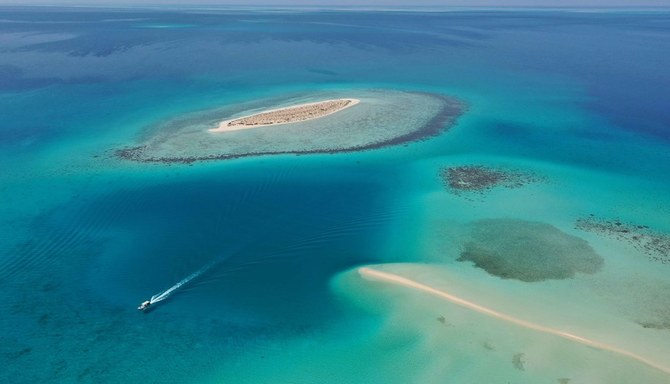
Saudi Arabia approves new authority for the Red Sea amid more steps to develop and protect it

(Supplied)
Short Url
Updated 30 November 2021
Follow

Saudi Arabia approves new authority for the Red Sea amid more steps to develop and protect it

  • The Saudi cabinet approved on Tuesday the establishment of a new body to protect the coral reefs and sea turtles in the Red Sea

RIYADH: Saudi Arabia is taking more steps to develop and protect the Red Sea, which the Kingdom deems to be a big contributor to the growth of its tourism industry. 

The Saudi Cabinet approved on Tuesday the establishment of a new body to protect the coral reefs and sea turtles in the Red Sea, as well as organizational preparation work for a new authority in the area, according to the cabinet's weekly statement carried by Saudi Press Agency.

The new authority will be chaired by Minister of Tourism Ahmed Al-Khateeb, and it includes the ministers of sport and culture as well as CEOs of NEOM and The Red Sea Development Co.

The authority will be responsible for organizing recreational activities, tours of cruise ships and yachts and build mechanisms to protect the coastal environment. 

“The Red Sea’s natural environment is one of our greatest assets,” said Al-Khateeb. 

“This (authority) will support our ambitious plans for tourism development, generate new job opportunities for Saudi citizens, and help us to attract international and domestic tourists,” he wrote on his Twitter account.  


Egypt’s Suez Canal, Namibian Ports Authority sign MoU to propel port development, training

Updated 7 sec ago
Follow

Egypt’s Suez Canal, Namibian Ports Authority sign MoU to propel port development, training

RIYADH: Egypt’s Suez Canal Authority and the Namibian Ports Authority have signed a memorandum of understanding amid efforts to propel cooperation in development and training.

The agreement aims to exchange expertise and enhance bilateral cooperation in several areas, most notably marine construction, the sale and leasing of marine units, and advanced training through the Suez Canal Authority’s academies, according to a statement.

This is supported by figures from the Suez Canal Authority, which reported revenues of $1.97 billion from 5,874 ship transits since early July, representing a 17.5 percent year-on-year increase, chairman Osama Rabie said during a recent meeting with an International Monetary Fund delegation.

It also aligns well with Rabie’s further forecast that the canal’s revenues would improve during the 2026/2027 fiscal year to around $8 billion, rising to approximately $10 billion the following year, according to a statement issued by the authority.

The newly released statement said: “Rabie affirmed the authority’s readiness for fruitful and constructive cooperation with the Namibian Ports Authority, given the expansion of the entity’s international projects and its efforts to open new markets and engage with the African continent.”

“The chairman explained that the Suez Canal Authority’s efforts succeeded in developing and reopening the Libyan port of Sirte after 14 years of closure, marking a successful start to international projects with friendly and sister nations,” it added.

The chairman instructed that all necessary support and procedures be put in place to initiate practical cooperation on multiple projects, highlighting that the authority offers a comprehensive system for maritime and logistics services through its shipyards and subsidiaries.

For her part, Nangula Hamunyela, chairperson of the Namibian Ports Authority, voiced her enthusiasm for collaborating with the Suez Canal Authority on advancing Namibia’s ambitious port development plan, home to the largest ports in West Africa.

She stressed that this partnership highlights the strong relationship between Egypt and Namibia and will help further deepen bilateral ties.

Hamunyela further highlighted that the Suez Canal Authority’s advanced technology and vast expertise across multiple sectors will play a key role in supporting and speeding up development efforts in Namibian ports, reducing dependence on foreign expertise and technology from outside the region.

Egypt’s Suez Canal generated a total of $40 billion between 2019 and 2024 and remains the country’s most important source of foreign currency.