

Barbados ditches Britain’s Queen Elizabeth

1 / 2
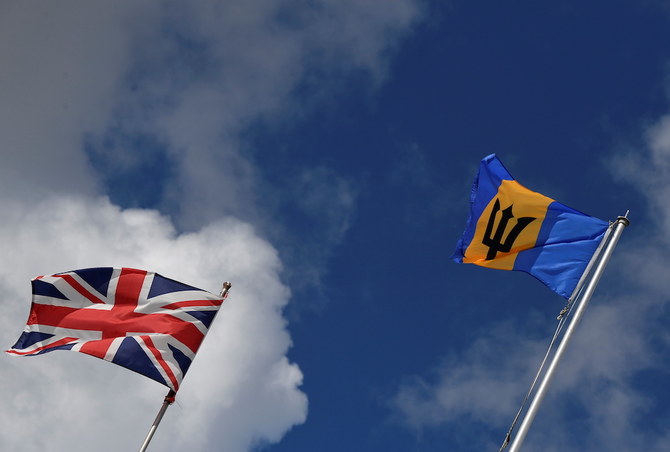
The birth of the republic comes 55 years to the day since Barbados declared independence. (AFP)
2 / 2
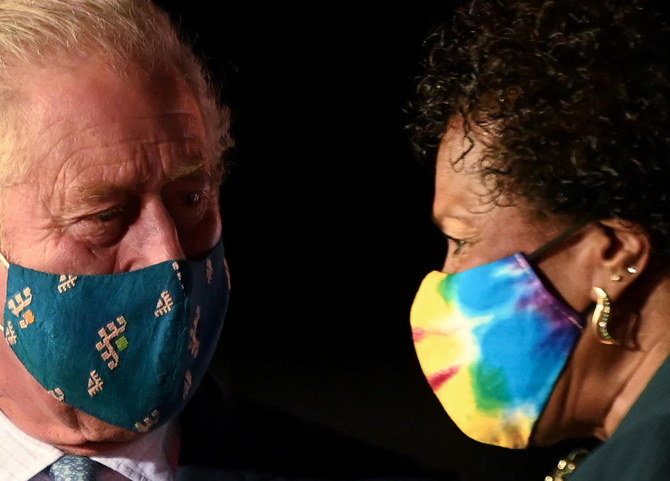
Prince Charles, greeted by Barbados President-elect Sandra Mason, arrives to take part in events marking the Caribbean island’s transition to republic status, Bridgetown, Barbados, Nov. 28, 2021. (Reuters)
Short Url
Updated 30 November 2021
Follow

Barbados ditches Britain’s Queen Elizabeth

  • Prince Charles, heir to the British throne, stood somberly as Queen Elizabeth’s royal standard was lowered and the new Barbados declared

BRIDGETOWN: Barbados ditched Britain’s Queen Elizabeth as head of state, forging a new republic on Tuesday with its first-ever president and severing its last remaining colonial bonds nearly 400 years after the first English ships arrived at the Caribbean island.

At the strike of midnight, the new republic was born to the cheers of hundreds of people lining Chamberlain Bridge in the capital, Bridgetown. A 21-gun salute fired as the national anthem of Barbados was played over a crowded Heroes Square.

Prince Charles, heir to the British throne, stood somberly as Queen Elizabeth’s royal standard was lowered and the new Barbados declared, a step which republicans hope will spur discussion of similar proposals in other former British colonies that have Queen Elizabeth as their sovereign.

Barbados casts the removal of Elizabeth II, who is still queen of 15 other realms including the United Kingdom, Australia, Canada and Jamaica, as a way to finally break with the demons of its colonial history.

After a dazzling display of Barbadian dance and music, complete with speeches celebrating the end of colonialism, Sandra Mason was sworn in as Barbados’s first president in the shadow of Barbados’s parliament.

“Full stop this colonial page,” Winston Farrell, a Barbadian poet told the ceremony. “Some have grown up stupid under the Union Jack, lost in the castle of their skin.”

“It is about us, rising out of the cane fields, reclaiming our history,” he said. “End all that she mean, put a Bajan there instead.”

The birth of the republic, 55 years to the day since Barbados declared independence, unclasps almost all the colonial bonds that have kept the tiny island tied to England since an English ship claimed it for King James I in 1625.

It may also be a harbinger of a broader attempt by other former colonies to cut ties to the British monarchy as it braces for the end of Elizabeth’s nearly 70-year reign and the future accession of Charles.

Prime Minister Mia Mottley, the leader of Barbados’ republican movement, helped lead the ceremony. Mottley has won global attention by denouncing the effects of climate change on small Caribbean nations.

“Tonight’s the night!” read the front-page headline of Barbados’ Daily Nation newspaper.

“I’m overjoyed,” Ras Binghi, a Bridgetown cobbler, said ahead of the ceremony. Binghi said he would be saluting the new republic with a drink and a smoke.

Prince Charles will give a speech highlighting the continuing friendship of the two nations despite England’s central role in the trans-Atlantic slave trade.

While Britain casts slavery as a sin of the past, some Barbadians are calling for compensation from Britain.

Activist David Denny celebrated the creation of the republic but said he opposes the visit by Prince Charles, noting the royal family for centuries benefited from the slave trade.

“Our movement would also like the royal family to pay a reparation,” Denny said in an interview in Bridgetown.

The English initially used white British indentured servants to toil on the plantations of tobacco, cotton, indigo and sugar, but Barbados in just a few decades would become England’s first truly profitable slave society.

Barbados received 600,000 enslaved Africans between 1627 and 1833, who were put to work in the sugar plantations, earning fortunes for the English owners.

More than 10 million Africans were shackled into the Atlantic slave trade by European nations between the 15th and 19th centuries. Those who survived the often brutal voyage, ended up toiling on plantations.

Barbados will remain a republic within the Commonwealth, a grouping of 54 countries across Africa, Asia, the Americas and Europe.

Outside the lavish official ceremony, some Barbadians said they were uncertain what the transition to a republic even meant or why it mattered.

“They should leave Queen Elizabeth be — leave her as the boss. I don’t understand why we need to be a republic,” said Sean Williams, 45, standing in the shadow of an independence monument.

The last time the queen was removed as head of state was in 1992 when the Indian Ocean island of Mauritius proclaimed itself a republic.


China’s top diplomat to visit Somalia on Africa tour

Updated 54 min 15 sec ago
Follow

China’s top diplomat to visit Somalia on Africa tour

  • Stop in Mogadishu provides diplomatic boost after Israel formally recognized breakaway Somaliland
  • Tour focusses on Beijing's strategic trade ​access across eastern and southern Africa

BEIJING: China’s top diplomat began his annual New Year tour of Africa on Wednesday, focusing on strategic trade ​access across eastern and southern Africa as Beijing seeks to secure key shipping routes and resource supply lines.
Foreign Minister Wang Yi will travel to Ethiopia, Africa’s fastest-growing large economy; Somalia, a Horn of Africa state offering access to key global shipping lanes; Tanzania, a logistics hub linking minerals-rich central Africa to the Indian Ocean; and Lesotho, a small southern African economy squeezed by US trade measures. His trip this year runs until January 12.
Beijing aims to highlight countries it views as model partners of President Xi Jinping’s flagship “Belt and Road” infrastructure program and to expand export markets, particularly in young, increasingly ‌affluent economies such ‌as Ethiopia, where the IMF forecasts growth of 7.2 percent this year.
China, ‌the ⁠world’s ​largest bilateral ‌lender, faces growing competition from the European Union to finance African infrastructure, as countries hit by pandemic-era debt strains now seek investment over loans.
“The real litmus test for 2026 isn’t just the arrival of Chinese investment, but the ‘Africanization’ of that investment. As Wang Yi visits hubs like Ethiopia and Tanzania, the conversation must move beyond just building roads to building factories,” said Judith Mwai, policy analyst at Development Reimagined, an Africa-focussed consultancy.
“For African leaders, this tour is an opportunity to demand that China’s ‘small yet beautiful’ projects specifically target our industrial gaps, ⁠turning African raw materials into finished products on African soil, rather than just facilitating their exit,” she added.
On his start-of-year trip in 2025, ‌Wang visited Namibia, the Republic of Congo, Chad and Nigeria.
His visit ‍to Somalia will be the first by a Chinese foreign minister since the 1980s and is ‍expected to provide Mogadishu with a diplomatic boost after Israel became the first country to formally recognize the breakaway Republic of Somaliland, a northern region that declared itself independent in 1991.
Beijing, which reiterated its support for Somalia after the Israeli announcement in December, is keen to reinforce its influence around the Gulf of Aden, the entrance ​to the Red Sea and a vital corridor for Chinese trade transiting the Suez Canal to Europe.
Further south, Tanzania is central to Beijing’s plan to secure access to Africa’s ⁠vast copper deposits. Chinese firms are refurbishing the Tazara Railway that runs through the country into Zambia. Li Qiang made a landmark trip to Zambia in November, the first visit by a Chinese premier in 28 years.
The railway is widely seen as a counterweight to the US and European Union-backed Lobito Corridor, which connects Zambia to Atlantic ports via Angola and the Democratic Republic of the Congo.
By visiting the southern African kingdom of Lesotho, Wang aims to highlight Beijing’s push to position itself as a champion of free trade. Last year, China offered tariff-free market access to its $19 trillion economy for the world’s poorest nations, fulfilling a pledge by Chinese President Xi Jinping at the 2024 China-Africa Cooperation summit in Beijing.
Lesotho, one of the world’s poorest nations with a gross domestic product of just over $2 billion, ‌was among the countries hardest hit by US President Donald Trump’s sweeping tariffs last year, facing duties of up to 50 percent on its exports to the United States.