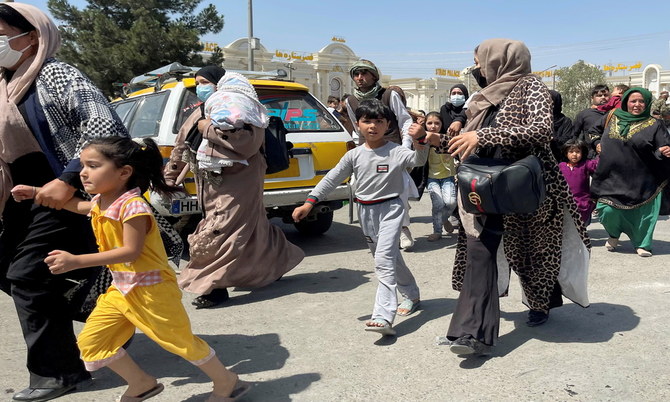
RIYADH: Afghans are facing a rapidly worsening humanitarian crisis this winter and millions of people are in need of immediate assistance, including access to food, medicine, and shelter, the Saudi Press Agency reported.
An impending economic collapse and further deterioration of living conditions will lead to more instability within Afghanistan, which will adversely affect regional and international peace and security.
Saudi Arabia has called on the Organisation of Islamic Cooperation to urgently convene an extraordinary ministerial meeting to discuss the humanitarian situation in Afghanistan and pathways for a humanitarian response.
Pakistan has offered to host this meeting in Islamabad on Dec. 17.
The Kingdom hopes that the meeting results in finding appropriate means and mechanisms to deliver aid to Afghans, and to coordinate procedures with relevant UN agencies, international financial institutions, and the global community to mitigate the humanitarian impact and alleviate the suffering of Afghans.
The Kingdom hopes it will also serve as an opportunity to demonstrate a collective stance on key principles.
These include the importance of taking steps to ensure Afghanistan’s security and stability and preserve its sovereignty and territorial integrity, free from external interference, while rejecting terrorism in all its forms and manifestations, and ensuring that Afghan territory is not used as a refuge or haven for terrorist and extremist groups.
This meeting should also urge the interim government in Afghanistan to be more inclusive, to abide by international norms and conventions, and to respect human rights and women’s rights to work and education granted in Islam.
The Kingdom urges member states, international organizations, and invited countries to actively participate in this extraordinary ministerial meeting in order to mobilize Islamic and international action to help Afghans.

Saudi Arabia to convene meeting to discuss Afghanistan’s humanitarian crisis
https://arab.news/j8jqn
Saudi Arabia to convene meeting to discuss Afghanistan’s humanitarian crisis
- Saudi Arabia hopes it will also serve as an opportunity to demonstrate a collective stance on key principles
Threat to Kingdom’s security is ‘red line’ that will be ‘addressed and neutralized,’ Saudi envoy says
- Abdulaziz Alwasil tells UN Security Council the situation in southern Yemen is ‘a just cause with social and historic dimensions’ that can only be resolved through dialogue
- Recent military activity in the south was unilateral, resulting in an escalation that harms the interests of Yemeni people and undermines efforts to address issues in the south, he said
NEW YORK CITY: Any attempt to threaten Saudi Arabia’s national security is a “red line” and will be met with decisive action, the Kingdom’s ambassador to the UN told the Security Council on Wednesday.
Speaking during a meeting of the council to discuss Yemen, Abdulaziz Alwasil said the situation in the south of the country is “a just cause with social and historic dimensions” that can only be resolved through dialogue.
“We stress that any attempt to threaten our national security is a red line, and we will not hesitate to take the necessary actions and steps to address it and neutralize it,” he added.
Alwasil reaffirmed Saudi Arabia’s support for Yemeni President Rashad Al-Alimi, the Presidential Leadership Council, and the Yemeni government in their efforts to achieve security, stability, development and peace while preserving national unity.
He said military activity by Southern Transitional Council forces in Hadramout and Al-Mahra on Dec. 2, 2025, was unilateral, did not have the approval of the Presidential Leadership Council, and was not carried out in coordination with the Coalition to Restore Legitimacy in Yemen.
It had resulted in an unjustified escalation that harmed the interests of the Yemeni people, undermined efforts to address the issues in the south, and ran counter to the coalition’s objectives, Alwasil added.
The Kingdom, working with its coalition partners, the Presidential Leadership Council and the Yemeni government, had moved to contain the situation by dispatching a military force to coordinate arrangements with the Southern Transitional Council in Aden, he said.
The aim was to ensure the return of the southern council’s forces to their previous positions outside of Hadramout and Al-Mahra, and the handover of camps to legitimate government forces and local authorities in line with agreed procedures, Alwasil added.
He expressed regret over the military operations that took place in Hadramout and Al-Mahra, close to Saudi Arabia’s southern border, which he said posed a direct threat to the Kingdom’s national security, as well as the security of Yemen and regional stability. Such steps were extremely dangerous, he added, and contradicted the principles on which the Coalition to Restore Legitimacy in Yemen had been founded.
Alwasil welcomed a prisoner and detainee exchange agreement signed in Muscat on Dec. 23, which he described as an important humanitarian measure to alleviate suffering and build confidence.
He praised Oman for hosting and sponsoring the consultations and supporting negotiations, and commended the efforts of UN’s special envoy for Yemen, Hans Grundberg, the International Committee of the Red Cross and all others that has played a part.
Regarding the political efforts to resolve the crisis, Alwasil said Saudi Arabia welcomed President Al-Alimi’s call for an inclusive conference in Riyadh to bring together all stakeholders to discuss just solutions to the situation in southern Yemen.
Preparations for the conference have begun, he added, in cooperation with the Yemeni government and southern representatives, reflecting the close ties between the two countries and their shared interests in stabilizing Yemen.
He urged all southern stakeholders to participate actively and constructively in the talks, to help find comprehensive and just solutions that meet the legitimate aspirations of the people of southern Yemen.
Alwasil called on all Yemeni forces and stakeholders to cooperate and intensify their efforts to reach a lasting political settlement that would ensure security and stability.
He described the southern issue as “a just cause with social and historic dimensions,” adding that “the only way to address it is through dialogue that leads to a comprehensive political solution” based on nationally and internationally agreed terms of reference.