

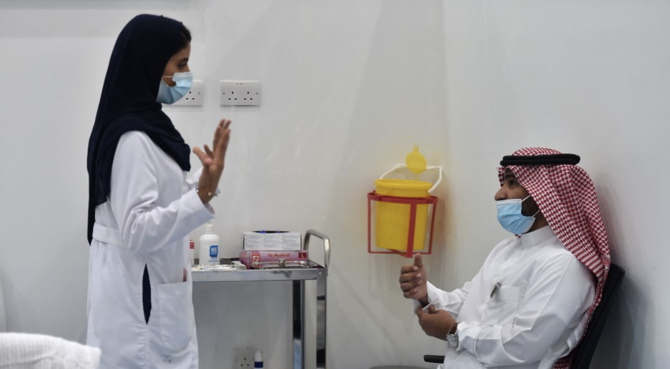

JEDDAH: With the COVID-19 omicron variant prompting renewed concern about the pandemic, a virologist has told Arab News that its early detection is a positive first step to overcoming the mutation.
omicron, or the B.1.1529 strain of the coronavirus, was marked a variant of concern on Nov. 26 by the World Health Organization, the fifth variant of concern to date.
But, as of Sunday, Saudi Arabia's Health Ministry said that no omicron cases had been detected in the country so far.
All viruses, including SARS-CoV-2, the virus that causes COVID-19, change over time. Most changes have little to no impact on the properties of the virus.
However, some may affect the transmissibility rate, associated disease severity, or the performance of vaccines.
Speaking to Arab News, Dr. Abdullah Algaissi, a virologist and assistant professor at the college of medical sciences at Jazan University, said: “The interesting thing about omicron is that it accumulated a very high number of mutations compared to other VOCs. The total number of mutations in the spike, the most important part of the virus, was 32, 10 of which were detected that bind to receptors on human cells. That's more than the delta variant, hence the concern.”
The WHO called for increased surveillance of the variant and laboratory experiments to better understand its biology.
The delta variant had nine mutations in the spike gene. According to Algaissi, there are shared mutations between the two, but what makes omicron more of a concern is the additional mutations.
HIGHLIGHT
Saudi Arabia suspended inbound and outbound flights from 14 African countries: South Africa, Namibia, Botswana, Zimbabwe, Mozambique, Lesotho, Eswatini, Malawi, Zambia, Madagascar, Angola, Seychelles, Mauritius, and Comoros.
“Based on what we know from the genetic sequencing, we don't have information that could tell us if these mutations will make the virus more lethal, more transmissible, if it will impact the immune response either after infection or vaccination. As of now, we don't know.”
Data shows that most of the infected patients in South Africa were unvaccinated, indicating that the vaccine's efficacy may still protect against omicron, but further studies are needed to determine by how much vaccine efficacy is reduced.
“Of the many concerns when it comes to VOCs is the effect it has on the diagnostic tool, in this case, the PCR tests,” added Algaissi. “Looking at the omicron mutation, early analysis shows that the current PCR used, especially here in the Kingdom, will still detect the variant.”
According to the Global Initiative on Sharing All Influenza Data database, more than 5.5 million COVID-19 genome sequence submissions have been made so far.
Last month, Saudi Arabia urged residents to get their booster shots to increase herd immunity further. Currently, 70 percent of the Kingdom's 34.8 million population has received at least one dose of the vaccine.
As of Sunday, Saudi Arabia temporarily suspended inbound and outbound flights from 14 African countries: South Africa, Namibia, Botswana, Zimbabwe, Mozambique, Lesotho, Eswatini, Malawi, Zambia, Madagascar, Angola, Seychelles, Mauritius, and Comoros.
Saudi Arabia announced on Sunday it would extend the validity of resident permits and exit and re-entry visas from countries facing entry suspension. The General Directorate of Passports said the move was the implementation of directive from King Salman.
The visas are extended until Jan. 1, 2022, without fees or charges. People were notified by email, where an e-visa form was attached.
Another concern is transmissibility. Algaissi noted the difficulty of measuring an increase in the transmissibility rate by the number of infected cases. Multiple factors could increase reported cases, such as the ease of restrictions and low vaccination rates.
“Further studies and experiments are needed to determine if the mutations in omicron enhance its binding to cells, thus becoming more transmissible, and it’ll take scientists weeks to understand the omicron variant, including how quickly it can spread and what the illness that results from infection looks like.”
According to South African health experts, omicron symptoms have been “pretty mild” so far.
In a joint press conference on Sunday, the acting CEO of Saudi Arabia’s Public Health Authority Dr. Abdullah Algwizani said the variant was being monitored and residents were urged to complete their vaccination schedule, to be wary of large gatherings, and adhere to precautionary measures.
The Kingdom’s Health Ministry said that 24 new cases of COVID-19 were recorded on Sunday, raising the total number of cases to 549,695. There have been 32 further recoveries, raising this total to 538,856.
There are currently 2,006 active cases, 48 of which are in critical care. One death was reported.


