

Pakistan's finance chief says no new taxes will be imposed in supplementary budget

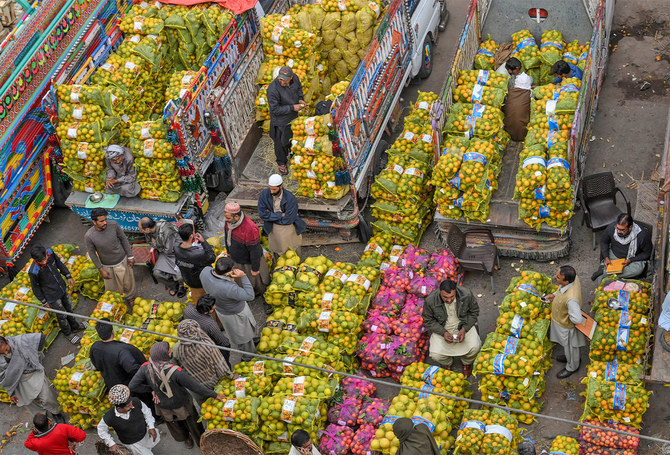
Traders gather at a fruit market in Lahore, Pakistan, on November 27, 2019. (AFP)
Short Url
Updated 27 November 2021
Follow

Pakistan's finance chief says no new taxes will be imposed in supplementary budget

  • Shaukat Tarin maintains the country's national currency is undervalued by about Rs10
  • The country's finance chief warns 'speculators' that the Pakistani rupee will soon move in the other direction and gain strength

ISLAMABAD: Pakistan's finance chief Shaukat Tarin said on Friday the government was not planning to introduce new taxes after securing a recent agreement with the International Monetary Fund, though he added it was going to withdraw certain exemptions.
The IMF announced earlier this week it had reached a staff level agreement with the administration in Islamabad which required the approval of the international financial institution's executive board following the implementation of fiscal and institutional reforms by Pakistan.
It laid out five conditions which included sales tax reforms, increase in petroleum development levy and the greater autonomy for the central bank.
Addressing a news conference shortly after the IMF announcement, Tarin had said the government would meet the five demands by presenting supplementary finance bills which are more popularly known as mini-budgets in Pakistan.
"We are not going to increase taxes but withdraw some exemptions," said the finance chief.


He recalled his statement after assuming the office that the government would not burden the country's taxpayers anymore, adding this was despite the fact that Pakistani officials had already agreed to impose new taxes to get $500 million from the IMF in March.
Asked about the dismal performance of Pakistan's national currency, Tarin said people previously thought the rupee was sliding due to the delay in the IMF agreement or increase in the discount rate amid souring inflation.
However, he maintained that Pakistan's national currency was under pressure due to speculative trading in the market.
Tarin said some people were even spreading rumors that the Pakistani currency would get demonetized, though he categorically announced that "nothing like that is going to happen at least on my watch."
"Let me warn the speculators that the Pakistani currency will also move in the other direction," he continued. "We are taking some measures to ensure that. And when the rupee is going to move on the other side, it hurt them a lot. So, they should not indulge in such speculation."
The finance chief said it was important to keep an eye on the real effective exchange rate to determine the real strength of the rupee.
"Experts say the Pakistani rupee should be somewhere around Rs165 to Rs167 against [the US dollar] ... Our national currency is undervalued by about Rs10," he said.
The Pakistani rupee traded at Rs175.46 in the interbank market on Friday.


IMF Executive Board to review $1.2 billion loan disbursement for Pakistan today

Updated 4 sec ago
Follow

IMF Executive Board to review $1.2 billion loan disbursement for Pakistan today

  • Pakistan, IMF reached a Staff-Level Agreement in October for second review of $7 billion Extended Fund, climate fund program
  • Economists view IMF bailout packages as essential for cash-strapped Pakistan grappling with a prolonged macroeconomic crisis

ISLAMABAD: The Executive Board of the International Monetary Fund (IMF) is set to meet in Washington today to review a $1.2 billion loan disbursement for Pakistan, state media reported on Monday.

Pakistan and the IMF reached a Staff-Level Agreement (SLA) in October for the second review of a $7 billion Extended Fund Facility (EFF) and the first review of its $1.4 billion Resilience and Sustainability Facility (RSF). 

The agreement between the two sides took place after an IMF mission, led by the international lender’s representative Iva Petrova, held discussions with Pakistani authorities during a Sept. 24–Oct. 8 visit to Karachi, Islamabad and Washington D.C.

“The International Monetary Fund’s (IMF) Executive Board is set to meet in Washington today to review and approve $1.2 billion in loan for Pakistan,” state broadcaster Pakistan TV reported. 

Pakistan has been grappling with a prolonged macroeconomic crisis that has drained its financial resources and triggered a balance of payments crisis for the past couple of years. Islamabad, however, has reported some financial gains since 2022, which include recording a surplus in its current account and bringing inflation down considerably.

Economists view the IMF’s bailout packages as crucial for cash-strapped Pakistan, which has relied heavily on financing from bilateral partners such as Saudi Arabia, China and the United Arab Emirates, as well as multilateral lenders including the IMF, World Bank, Asian Development Bank and Islamic Development Bank. 

Speaking to Arab News last month, Pakistan’s former finance adviser Khaqan Najeeb said the $1.2 billion disbursement will further stabilize Pakistan’s near-term external position and unlock additional official inflows.

“Continued engagement also reinforces macro stability, as reflected in recent improvements in inflation, the current account, and reserve buffers,” Najeeb said.

Pakistan came close to sovereign default in mid-2023, when foreign exchange reserves fell below three weeks of import cover, inflation surged to a record 38% in May, and the country struggled to secure external financing after delays in its IMF program. Fuel shortages, import restrictions, and a rapidly depreciating rupee added to the pressure, while ratings agencies downgraded Pakistan’s debt and warned of heightened default risk.

The crisis eased only after Pakistan reached a last-minute Stand-By Arrangement with the IMF in June 2023, unlocking emergency support and preventing an immediate default.