



World races to contain new COVID threat, the omicron variant

1 / 4
Intensive care nurses treat patients severely ill with Covid-19 disease in the Corona intensive care unit at the University Hospital in Halle/Saale on Monday, Nov. 22, 2021. (AP)
2 / 4
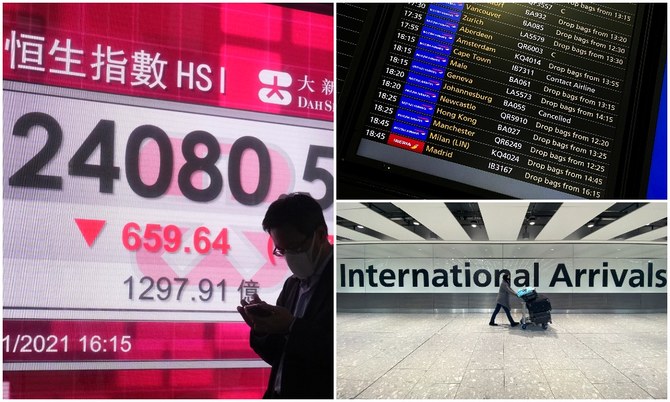
A jittery world is fearing the worst nearly two years after COVID-19 emerged and triggered a pandemic that has killed more than 5 million people around the globe. (AP photos)
3 / 4
Singapore swiftly joined Britain in imposing a travel ban, with the country’s health ministry saying it would restrict arrivals from South Africa and countries nearby as a precaution. (AFP)
4 / 4
South Africa has requested an urgent sitting of a World Health Organization working group on virus evolution on Friday to discuss the new variant. (AP)
Short Url
Updated 28 November 2021
Follow

World races to contain new COVID threat, the omicron variant

  • Scientists are still learning about the variant, first identified at the start of this week
  • Several countries, including in the Gulf, institute travel restrictions on visitors from southern Africa

JEDDAH: Fears mounted on Saturday that a highly infectious new COVID-19 strain was pushing its way into Europe as the world brought the shutters down to contain the new omicron variant.

Britain confirmed its first two infections and suspected new cases emerged in Germany and the Czech Republic, while Dutch authorities quarantined 61 passengers from South Africa who tested positive for COVID-19.

South Africa complained it was being “punished” with air travel bans for first detecting the strain, which the World Health Organization has termed a “variant of concern.”

South Korea, Australia, and Thailand joined the US, Brazil, Canada, and a host of other countries around the world restricting travel from the region, fearing a major setback to global efforts against the pandemic.

Saudi Arabia was among countries in the Middle East and North Africa to ban travelers from several African nations.

The Saudi Interior Ministry and authorities in the UAE said visitors from seven African countries were barred from entry.

They listed the countries as South Africa, Namibia, Botswana, Zimbabwe, Mozambique, Lesotho, and Eswatini.

The Saudi ban comprises flights to and from those countries. But foreign nationals from the seven countries could enter the Kingdom if they had spent the previous 14 days in another country and comply with Saudi health protocols.

In a separate announcement on Saturday, the Interior Ministry said the Kingdom will allow direct entry to travelers from all countries who have received one dose of a COVID-19 vaccine starting next Saturday. The ministry added the travelers would need to quarantine for three days.

Scientists are racing to determine the threat posed by the heavily mutated strain, which is more transmissible than the dominant Delta variant, and whether it can evade existing vaccines.

Anxious travelers thronged Johannesburg international airport, desperate to squeeze onto the last flights to countries that had imposed sudden travel bans. Many had cut holidays and rushed back from South African safaris and vineyards.

“It’s ridiculous, we will always be having new variants,” British tourist David Good said, passport in hand. “South Africa found it but it’s probably all over the world already.”

The WHO on Friday declared the recently discovered B.1.1.529 strain of COVID-19 to be a variant of concern, renaming it omicron.

Professor Andrew Pollard, the director of the Oxford Vaccine Group which developed the AstraZeneca vaccine, expressed cautious optimism that existing vaccines could be effective at preventing serious disease from the omicron variant.

He said most of the mutations appear to be in similar regions as those in other variants.

South Africa is worried that the curbs will hurt tourism and other sectors of its economy, the Foreign Ministry said, adding the government is engaging with countries that have imposed travel bans to persuade them to reconsider.

Omicron has emerged as many countries in Europe are already battling a surge in COVID-19 infections, and some have re-introduced restrictions on social activity to try to stop the spread. Austria and Slovakia have entered lockdowns.


Trump’s Iran war violates international law, experts say

Updated 3 sec ago
Follow

Trump’s Iran war violates international law, experts say

  • Mary Ellen O’Connell, a professor at the University of Notre Dame, said the attack on Iran “had no justification under international law“
  • “The US probably could have prevented any Israeli attack on Iran by virtue of the leverage afforded by critical US military support,” said Finucane

WASHINGTON: The United States insists it attacked Iran to curb “direct threats” from the Islamic republic, but legal experts say the dangers cited by Washington do not justify war under international law.
US and Israeli forces launched a massive air campaign against Iran on February 28, with Washington saying it aimed to curb nuclear and missile threats from Tehran. Yet the war has also decapitated the country’s government, and President Donald Trump is now demanding “unconditional surrender.”
The White House laid out Washington’s justification for the war during a news conference this week.
“This decision to launch this operation was based on a cumulative effect of various direct threats that Iran posed to the United States of America, and the president’s feeling, based on fact, that Iran does pose (an) imminent and direct threat,” Press Secretary Karoline Leavitt said Wednesday.
She went on to cite Iranian sponsorship of “terrorism,” its ballistic missile program and its alleged efforts to “create nuclear weapons and nuclear bombs.”
But Mary Ellen O’Connell, a professor at the University of Notre Dame, said the attack on Iran “had no justification under international law.”
“The law is clear that international disputes are to be resolved using peaceful means — negotiation, mediation, the intervention of international organizations,” said O’Connell, an expert in international law on the use of force and international legal theory.
The Trump administration has offered “vague mentions of imminent attacks by Iran and to prevent Iran from acquiring a nuclear weapon,” while the UN Charter “requires, at the least, that evidence of a significant attack by Iran be underway,” she said.

- ‘Even less plausible’ -

“No shred of such evidence has been provided. Nor is there any right whatsoever to start a war over a weapons program.”
While Leavitt cited threats from missiles and militants, US Secretary of State Marco Rubio offered a different justification for the war earlier in the week: fears that an Israeli attack would trigger reprisals against US forces.
Brian Finucane, senior adviser for the International Crisis Group’s US Program, said there were several issues with Rubio’s explanation, including that the Trump administration has since offered other rationales for the war.
“The US probably could have prevented any Israeli attack on Iran by virtue of the leverage afforded by critical US military support,” said Finucane, who previously worked in the Office of the Legal Adviser at the US Department of State.
The Iran war is not the only legally dubious military intervention by the Trump administration.
In early September, the United States began carrying out strikes on alleged drug-smuggling boats in the Caribbean and later the eastern Pacific — a campaign that has killed more than 150 people.
The US government has yet to provide definitive evidence that the vessels it targets are involved in drug trafficking, and legal experts and rights groups say the strikes likely amount to extrajudicial killings.
Trump also ordered strikes on Iranian nuclear sites last year, and sent US forces into Caracas in early January to seize leftist Venezuelan leader Nicolas Maduro, who is now on trial in the United States.
Finucane said Trump’s Friday demand for “unconditional surrender” by Iran “further undercuts prior justifications for US military action.”
“The administration has not even bothered to argue that Operation Epic Fury complies with international law, but certainly statements like this make any such argument even less plausible,” he said, referring to the Iran operation.