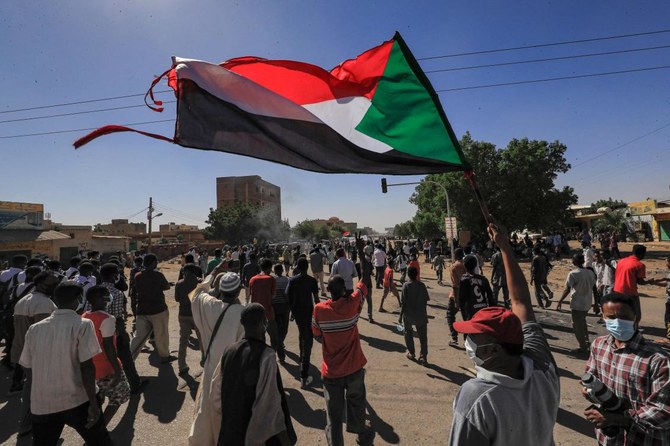
KHARTOUM: Thousands of Sudanese protested in the streets of Khartoum and other cities on Thursday, keeping up the pressure on military leaders after they struck a deal to bring back a civilian prime minister deposed in a coup one month ago.
Prominent political parties and Sudan's powerful protest movement have opposed Prime Minister Abdalla Hamdok's decision on Sunday to sign the accord with the military, with some calling it a betrayal or saying it provides political cover for the takeover.
"The revolution is the people's revolution. The army back to the barracks!" chanted protesters in Al Daim, a working class district of Khartoum. They called for justice for "martyrs" killed in earlier demonstrations.
Protesters also closed a main road in the Sahafa neighbourhood of the capital.
Carrying Sudanese flags, they chanted "Burhan you won’t rule. Down with military rule," referring to Sudan's military leader Abdel Fattah al-Burhan.
Live streams on social media also showed protests in cities including Port Sudan, Kassala, Wad Madani and El Geneina.
While Hamdok's reinstatement was a concession by military leader Burhan, key political parties and civilian groups say the army should play no role in politics.
University student Osama Ahmed said he was protesting against Burhan because he wants to bring down the revolution and prevent the creation of a civilian state.
Under the terms of Sunday's deal, Hamdok will lead a government of technocrats during a political transition expected to last until 2023 and will share power with the military.
It is meant to be based on an earlier deal struck between the military and civilian political forces following the 2019 overthrow of Omar al-Bashir, when they had agreed to share power until elections. The coup scuppered that partnership.
The civilian coalition that had been sharing power with the military before the takeover and its former ministers have rejected the agreement struck by Hamdok, citing a violent crackdown on anti-military protests over the past month.
Hamdok has said the Sudanese authorities are committed to democracy and freedom of expression.

Thousands of Sudanese protest against deal between PM Hamdok and military
Short Url
https://arab.news/6e3mx
Thousands of Sudanese protest against deal between PM Hamdok and military
- Prominent political parties and Sudan's powerful protest movement have opposed Prime Minister Abdalla Hamdok's decision to sign the accord with the military
- "The revolution is the people's revolution. The army back to the barracks!" chanted protesters in Al Daim district
France, allies preparing bid to ‘gradually’ reopen Strait of Hormuz: Macron
ABOARD FRENCH AIRCRAFT CARRIER CHARLES DE GAULLE: France and its allies are preparing a “defensive” mission to reopen the strategically vital Strait of Hormuz, President Emmanuel Macron said Monday as the Middle East war entered its second week.
The French leader landed by helicopter on the Charles de Gaulle aircraft carrier, dispatched to the Mediterranean after US-Israeli strikes on Iran on February 28 triggered a war that has sown regional chaos and which threatens to spill into other parts of the world.
Macron said during a visit to Cyprus earlier in the day that the Hormuz mission would be aimed at escorting container ships and tankers in order to gradually reopen the strait “after the end of the hottest phase of the conflict.”
“This is essential for international trade, but also for the flow of gas and oil, which must be able to leave this (Gulf) region once again,” Macron said during a visit to the island to discuss regional security.
Speaking alongside Cypriot President Nikos Christodoulides and Greek Prime Minister Kyriakos Mitsotakis, Macron said a “purely defensive, purely support mission” will be put together by European and non-European states.
The European Union on Monday said it was ready to “enhance” its operations to protect maritime traffic in the Middle East.
The EU has been discussing reinforcing its naval mission in the Red Sea after the US-Israeli attacks on Iran triggered a broader regional war.
Maritime traffic in the Strait of Hormuz, a key Gulf waterway through which a fifth of global crude passes, has all but halted since the war broke out.
Macron visited Cyprus after the EU member was targeted by Iranian-made drones last week.
The French leader said an attack on Cyprus was an attack on all of Europe.
“When Cyprus is attacked, it is Europe that is attacked,” he said.
The drone attack in Cyprus led to France’s deployment of the Charles de Gaulle carrier to the Mediterranean, as well as a frigate and air defense units to the island.
Paris has insisted its stance in the region is “strictly defensive.”
- Bombing won’t bring change -
The initial US-Israeli strikes on Iran killed supreme leader Ali Khamenei, and the Islamic republic on Monday named his son, Mojtaba Khamanei, as his successor — an appointment US President Donald Trump said he was “not happy” with.
Aboard the Charles de Gaulle, Macron said the conflict’s duration depended on what US-Israeli objectives were, warning that “profound” changes to the Iranian leadership could not occur “through American-Israeli bombings alone.”
“We are putting ourselves in a position to last,” he said, adding that the war, “in this intense phase,” could last “several days, perhaps several weeks.”
The flagship Charles de Gaulle may eventually be deployed to the Strait of Hormuz as part of the announced mission, Macron said.
A French frigate was already taking part in the EU’s Operation Aspides, which was launched in the Red Sea in 2024 to prevent attacks on trade vessels by Iran-backed Houthi rebel forces.
Macron earlier said that France would contribute “in the long term” with two frigates to Operation Aspides.
“What we want to do is to ensure freedom of navigation and maritime security,” he said.
Separately, the French president on Monday morning spoke to Israeli Prime Minister Benjamin Netanyahu about the situation in the Middle East and Lebanon, the Elysee said.
The French leader landed by helicopter on the Charles de Gaulle aircraft carrier, dispatched to the Mediterranean after US-Israeli strikes on Iran on February 28 triggered a war that has sown regional chaos and which threatens to spill into other parts of the world.
Macron said during a visit to Cyprus earlier in the day that the Hormuz mission would be aimed at escorting container ships and tankers in order to gradually reopen the strait “after the end of the hottest phase of the conflict.”
“This is essential for international trade, but also for the flow of gas and oil, which must be able to leave this (Gulf) region once again,” Macron said during a visit to the island to discuss regional security.
Speaking alongside Cypriot President Nikos Christodoulides and Greek Prime Minister Kyriakos Mitsotakis, Macron said a “purely defensive, purely support mission” will be put together by European and non-European states.
The European Union on Monday said it was ready to “enhance” its operations to protect maritime traffic in the Middle East.
The EU has been discussing reinforcing its naval mission in the Red Sea after the US-Israeli attacks on Iran triggered a broader regional war.
Maritime traffic in the Strait of Hormuz, a key Gulf waterway through which a fifth of global crude passes, has all but halted since the war broke out.
Macron visited Cyprus after the EU member was targeted by Iranian-made drones last week.
The French leader said an attack on Cyprus was an attack on all of Europe.
“When Cyprus is attacked, it is Europe that is attacked,” he said.
The drone attack in Cyprus led to France’s deployment of the Charles de Gaulle carrier to the Mediterranean, as well as a frigate and air defense units to the island.
Paris has insisted its stance in the region is “strictly defensive.”
- Bombing won’t bring change -
The initial US-Israeli strikes on Iran killed supreme leader Ali Khamenei, and the Islamic republic on Monday named his son, Mojtaba Khamanei, as his successor — an appointment US President Donald Trump said he was “not happy” with.
Aboard the Charles de Gaulle, Macron said the conflict’s duration depended on what US-Israeli objectives were, warning that “profound” changes to the Iranian leadership could not occur “through American-Israeli bombings alone.”
“We are putting ourselves in a position to last,” he said, adding that the war, “in this intense phase,” could last “several days, perhaps several weeks.”
The flagship Charles de Gaulle may eventually be deployed to the Strait of Hormuz as part of the announced mission, Macron said.
A French frigate was already taking part in the EU’s Operation Aspides, which was launched in the Red Sea in 2024 to prevent attacks on trade vessels by Iran-backed Houthi rebel forces.
Macron earlier said that France would contribute “in the long term” with two frigates to Operation Aspides.
“What we want to do is to ensure freedom of navigation and maritime security,” he said.
Separately, the French president on Monday morning spoke to Israeli Prime Minister Benjamin Netanyahu about the situation in the Middle East and Lebanon, the Elysee said.
© 2026 SAUDI RESEARCH & PUBLISHING COMPANY, All Rights Reserved And subject to Terms of Use Agreement.


