PESHAWAR: An association of Pakistan’s Hindu community on Wednesday denied it had agreed to pay financial penalty on behalf of the leaders of a religious faction who were found guilty of attacking an old temple in the country’s northwestern Khyber Pakhtunkhwa province last December, calling such news reports “untrue.”
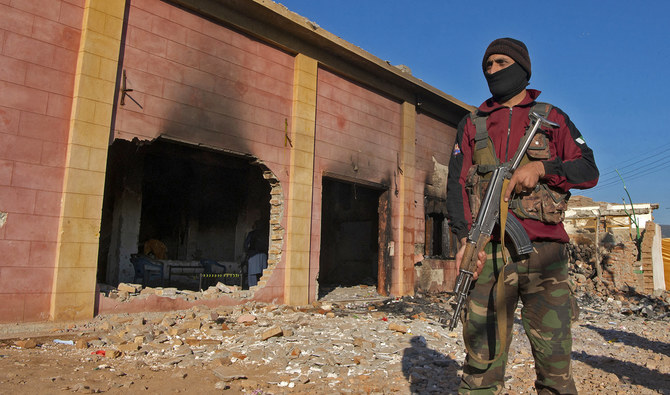
A mob in Pakistan’s Karak district desecrated a century-old temple and set it on fire last year, as members of the Hindu community were renovating the place and extending its prayer area.
The incident prompted Prime Minister Imran Khan to issue a warning that anyone targeting the country’s non-Muslim citizens would face stern consequences.
The Karak temple attack led to the arrest of several people, including members of the Jamiat-e-Ulama-e-Islam-Fazl (JUI-F) party, and it made the Supreme Court of Pakistan fine the accused for vandalizing the Hindu place of worship.
However, recent news reports maintained the Pakistani Hindu community was going to pay the money on behalf of 11 JUI-F members involved in the attack, using the funds maintained by the Pakistan Hindu Council (PHC).
“No, such decision [to pay the fine on behalf of the accused] has been made or is under consideration by the council,” said Ramesh Kumar Vankwani, the patron-in-chief of the association. “Any news in this regard is untrue.”
Rohit Kumar, the caretaker of the temple, also maintained the council had not taken any such decision, adding: “Let the apex court’s verdict take its course.”
Speaking to Arab News, Fazl-e-Haq Kohidamani, a senior lawyer at the Peshawar High Court, said it was not possible for any party to directly pay the fine on behalf of the accused after the Supreme Court decision.
“This [fine] is called error fixation and such fines cannot be paid like this under the contract act,” he said. “If the council provides the required amount to the accused, they can pay the fine. Otherwise, paying it on behalf of them can raise legal issues.”
Rehmat Salam Khattak, a senior JUI-F politician in the district, said he had already paid his share that amounted to Rs268,837, though he maintained he was trying to defuse the situation and stop the mob from attacking the temple.
“We follow rules and believe in the constitution of the country,” he said. “I paid my fine as per the law.”
Khattak added: “If the Hindu council wants to pay the fine of 11 accused people, it should probably facilitate the rest of us since most people were wrongly implicated in this case.”
Another local JUI-F cleric, Maulana Mirza Haqeem, said his party had been promoting interfaith harmony in Pakistan and believed in religious freedom.
“We have no role in attacking the temple,” he maintained. “I have no idea if the Hindu council is paying our fines, but the people implicated in this incident are mostly poor and cannot afford the financial penalty imposed on them.”


![]()

Karak temple attack: Pakistan Hindu Council denies reports it's paying fine on behalf of accused
Short Url
https://arab.news/2fkdh
Karak temple attack: Pakistan Hindu Council denies reports it's paying fine on behalf of accused
- A mob in Pakistan set a Hindu temple on fire in Pakistan last December, making the Supreme Court impose financial penalties on those involved
- Recent media reports suggested the Pakistan Hindu Council had decided to pay on behalf of 11 people accused in the case
Latest updates


Recommended


© 2026 SAUDI RESEARCH & PUBLISHING COMPANY, All Rights Reserved And subject to Terms of Use Agreement.