

Central bank says Pakistan must address structural impediments to sustain growth

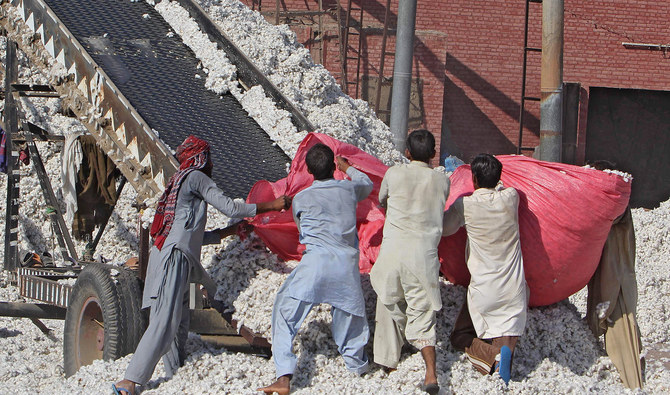
In this photograph taken on February 24, 2016, Pakistani workers process freshly picked cotton at a factory at Khanewal in the central province of Punjab. (AFP/File)
Short Url
Updated 25 November 2021
Follow

Central bank says Pakistan must address structural impediments to sustain growth

  • The State Bank of Pakistan predicts strong remittance inflows amid global economic recovery in its annual report
  • The central bank maintains the current account deficit is projected to be within the range of 2 to 3 percent of the GDP during FY22

KARACHI: Pakistan’s central bank said on Wednesday the country must address structural impediments to sustain its current economic momentum and reach a growth rate between 4 to 5 percent.

In its annual report, The State of Pakistan's Economy 2020-21, the bank reiterated its growth projection between 4 and 5 percent against the target of 4.8 percent on the back of the continued recovery momentum.

The report maintained it was crucial to deal with the structural impediments for sustainable economic expansion in the country.

“These impediments include consistent decline in the yield of important crops (especially cotton); insufficient export coverage of imports, low and declining productivity of labor, stagnant tax-to-GDP ratio; anemic investment-to-GDP ratio; and the rising fiscal burden of the power sector,” the State Bank of Pakistan (SBP) said.

The report maintained the national inflation rate was expected to remain within a range of 7 to 9 percent during the current fiscal year.

“The headline inflation is expected to retreat more visibly in the second half of the year, with the phasing out of the base impact of the hike in power tariffs,” the bank said, adding: “These projections are subject to multiple upside risks, including from a greater-than-anticipated increase in global commodity prices and upward revision in utility tariffs.”

“In addition to triggering a sharp increase in domestic prices, these developments may also give rise to significant second-round impacts on inflation,” said the SBP report.

According to the Federal Bureau of Statistics, inflation in Pakistan went up to 9.2 percent in October 2021 as compared to 8.9 percent in October 2020.

The SBP also envisaged the fiscal deficit within a range of 6.3 to 7.3 percent of the GDP for FY22.

“In the fiscal sector, the government plans to continue with the adjustment measures, which are projected to reduce the deficit to 6.3 percent of the GDP, from 7.1 percent in FY21,” the report added.

In the external sector, pressures are emerging from the import side, with payments exceeding $6 billion in recent months. The surge in imports is broad-based, partly reflecting the increasing pace of economic activity in the country.

“A part of the expansion in the import payments is projected to be financed through a consistent increase in the workers’ remittances and export receipts,” the central bank said. “Particularly, remittances are expected to remain upbeat amid the recovery in the global economy.”

The SBP maintained the current account deficit was projected to be within the range of 2 to 3 percent of the GDP during FY22.

It added the outlook of financial flows was likely to remain conducive on the back of the $3.8 billion already received from the global special drawing rights allocations and Eurobonds, along with further loan disbursements from multilateral and bilateral creditors, and inflows into the Roshan Digital Accounts.


Islamabad dismisses claims about paying up to 8 percent interest on foreign loans as ‘misleading’

Updated 22 February 2026
Follow

Islamabad dismisses claims about paying up to 8 percent interest on foreign loans as ‘misleading’

  • Pakistan has long relied on external loans to help bridge persistent gaps in public finances and foreign exchange reserves
  • Pakistan’s total external debt, liabilities stand at $138 billion at an overall average cost of around 4 percent, ministry says

KARACHI: Pakistan’s finance ministry on Sunday dismissed as “misleading” claims that the country is paying up to 8 percent interest on external loans, saying the overall average cost of external public debt is approximately 4 percent.

Pakistan has long relied on external loans to help bridge persistent gaps in public finances and foreign exchange reserves, driven largely by a narrow tax base, chronic trade deficits, rising debt-servicing costs and repeated balance-of-payments pressures.

Over the decades, successive governments have turned to multilateral and bilateral lenders, including the International Monetary Fund, the World Bank and the Asian Development Bank, to support budgetary needs and shore up foreign exchange reserves.

The finance ministry on Sunday issued a clarification in response to a “recent press commentary” regarding the country’s external debt position and associated interest payments, and said the figures required contextual explanation to ensure accurate understanding of Pakistan’s external debt profile.

“Pakistan’s total external debt and liabilities currently stand at $138 billion. This figure, however, encompasses a broad range of obligations, including public and publicly guaranteed debt, debt of Public Sector Enterprises (both guaranteed and non-guaranteed), bank borrowings, private-sector external debt, and intercompany liabilities to direct investors. It is therefore important to distinguish this aggregate figure from External Public (Government) Debt, which amounts to approximately $92 billion,” it said.

“Of the total External Public Debt, nearly 75 percent comprises concessional and long-term financing obtained from multilateral institutions (excluding the IMF) and bilateral development partners. Only about 7 percent of this debt consists of commercial loans, while another 7 percent relates to long-term Eurobonds. In light of this composition, the claim that Pakistan is paying interest on external loans ‘up to 8 percent’ is misleading.

The overall average cost of External Public Debt is approximately 4 percent, reflecting the predominantly concessional nature of the borrowing portfolio.”

With respect to interest payments, public external debt interest outflows increased from $1.99 billion in Fiscal Year (FY) 2022 to $3.59 billion in FY2025, representing an increase of 80.4 percent, not 84 percent as reported. In absolute terms, interest payments rose by $1.60 billion over this period, not $1.67 billion, it said.

According to the State Bank of Pakistan’s records, Pakistan’s total debt servicing payments to specific creditors during the period under reference were as follows: the IMF received $1.50 billion, of which $580 million constituted interest; Naya Pakistan Certificates payments totaled $1.56 billion, including $94 million in interest; the Asian Development Bank received $1.54 billion, including $615 million in interest; the World Bank received $1.25 billion, including $419 million in interest; and external commercial loans amounted to nearly $3 billion, of which $327 million represented interest payments.

“While interest payments have increased in absolute terms, this rise cannot be attributed solely to an expansion in the debt stock,” the ministry said. “Although the overall debt stock has increased slightly since FY2022, the additional inflows have primarily originated from concessional multilateral sources and the IMF’s Extended Fund Facility (EFF) under the ongoing IMF-supported program.”

Pakistan secured a $7 billion IMF bailout in Sept. 2024 as part of Prime Minister Shehbaz Sharif’s efforts to stabilize the South Asian economy that narrowly averted a default in 2023. The government has since been making efforts to boost trade and bring in foreign investment to consolidate recovery.

“It is also important to note that the increase in interest payments reflects prevailing global interest rate dynamics. In response to the inflation surge of 2021–22, the US Federal Reserve raised the federal funds rate from 0.75-1.00 percent in May 2022 to 5.25–5.50 percent by July 2023. Although rates have since moderated to around 3.75 percent, they remain significantly higher than 2022 levels,” the finance ministry said.

“The government remains committed to prudent debt management, transparency, and the continued strengthening of Pakistan’s macroeconomic stability,” it added.