Pakistani cultural capital is now world’s most polluted city

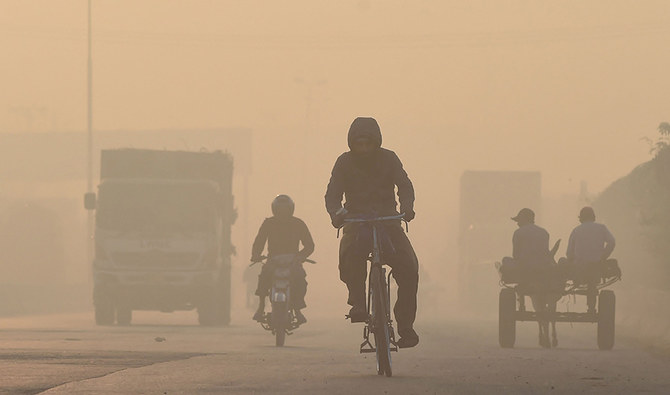
Commuters make their way along a road amid smoggy conditions in Lahore on November 23, 2021. (AFP)
Short Url
Updated 24 November 2021
Follow

Pakistani cultural capital is now world’s most polluted city

  • Lahore now stands at the top of its polluted cities ranking — with an air quality index of 203 on the US AQI scale
  • Increasing smog and particle-laden air has sickened thousands of people with respiratory and other illnesses

LAHORE: A thick cloud of smog that enveloped Pakistan’s cultural capital on Wednesday has earned it the ignominious title of the world’s most polluted city, according to a Swiss air quality monitoring company.
Platform IQAir said that Lahore now stands at the top of its polluted cities ranking — with an air quality index of 203 on the US AQI scale, versus runner-up Dehli, India, with 183. That standing was at 0949 GMT; the two cities had traded places at least once over the course of the morning.
Increasing smog and particle-laden air has sickened thousands of people with respiratory and other illnesses, forcing many to stay at home on particularly dirty days like Wednesday.
Dhaka, Bangladesh came in third, with an index of 169, and Kolkata, India at fourth, with a reading of 168. Lahore stood at third place a day earlier.
Lahore was once known as the city of gardens, which were ubiquitous during the Mughal era of the 16th to 19th centuries. Intense urbanization and surging population growth have left little room for greenery across the city, Pakistan’s second largest after the capital Karachi.
Doctors are advising people to wear face masks to avoid respiratory related diseases.


Afghan interior minister welcomes Pakistani scholars’ ‘positive’ remarks about Kabul

Updated 5 sec ago
Follow

Afghan interior minister welcomes Pakistani scholars’ ‘positive’ remarks about Kabul

  • Pakistani religious scholars on Dec. 23 called for easing tensions between Islamabad and Kabul, resumption of trade
  • Sirajuddin Haqqani says Afghanistan is committed to regional peace, Afghans have “no intentions to threaten anyone”

PESHAWAR: Afghanistan’s Interior Minister Sirajuddin Haqqani recently thanked Pakistan’s Deputy Prime Minister Ishaq Dar and religious scholars from the country for expressing positive statements for Kabul despite tensions between the two countries. 

A meeting of religious scholars in Pakistan on Dec. 23, attended by Jamiat Ulama-e-Pakistan political party head Maulana Fazl-ur-Rehman, called for easing tensions between the two states. The scholars also called for allowing resumption of trade and movement of people between Pakistan and Afghanistan. 

Pakistani news media outlets reported on Saturday that Dar, who is also Pakistan’s foreign minister, praised Haqqani’s earlier statement in which the Afghan minister stressed resolving tensions between Islamabad and Kabul through dialogue. 

In a video statement on Sunday, Haqqani said Afghanistan is committed to peace and stability in the country and the region, adding that Afghans have “no intentions to threaten anyone.” He appreciated Rehman and religious scholar Mufti Taqi Usmani for speaking in a “positive” manner about Afghanistan in the Dec. 23 meeting.

“We are thankful and grateful for their approach and views,” Haqqani said. 

“Similarly, we really appreciate the positive remarks by Foreign Minister Ishaq Dar, who spoke in a positive way about Afghanistan.” 

The Afghan minister’s statement comes in the backdrop of increased tensions between Afghanistan and Pakistan amid a surge in militant attacks in the latter’s territory. 

Pakistan blames Afghanistan’s government for facilitating attacks by the Pakistani Taliban or TTP group. Islamabad accuses Kabul of allowing TTP militants to take shelter in sanctuaries in Afghanistan from where they carry out attacks targeting Pakistan. 

Kabul denies the charges and says it cannot be held responsible for security lapses and challenges in Pakistan. 

The two countries engaged in fierce border clashes in October that led to the killings of dozens of soldiers and civilians on both sides. Pakistan and Afghanistan subsequently agreed to a temporary ceasefire and have held three rounds of peace talks that remained inconclusive. 

Tensions persist as Pakistan has vowed to go after militants even in Afghanistan that threaten the lives of its citizens. Afghan officials have warned Pakistan of retaliation if it attacks Afghanistan.