

JEDDAH: King Salman confirmed Saudi Arabia’s belief in the importance of strategic meetings between the Islamic world and the Russian Federation for enhancing regional and international security and stability.
In a speech delivered by the Emir of Makkah Prince Khaled Al-Faisal on behalf of the Saudi king, he said that the Islamic region is characterized by tolerance and moderation, and this is why it accepts all races and ethnicities.
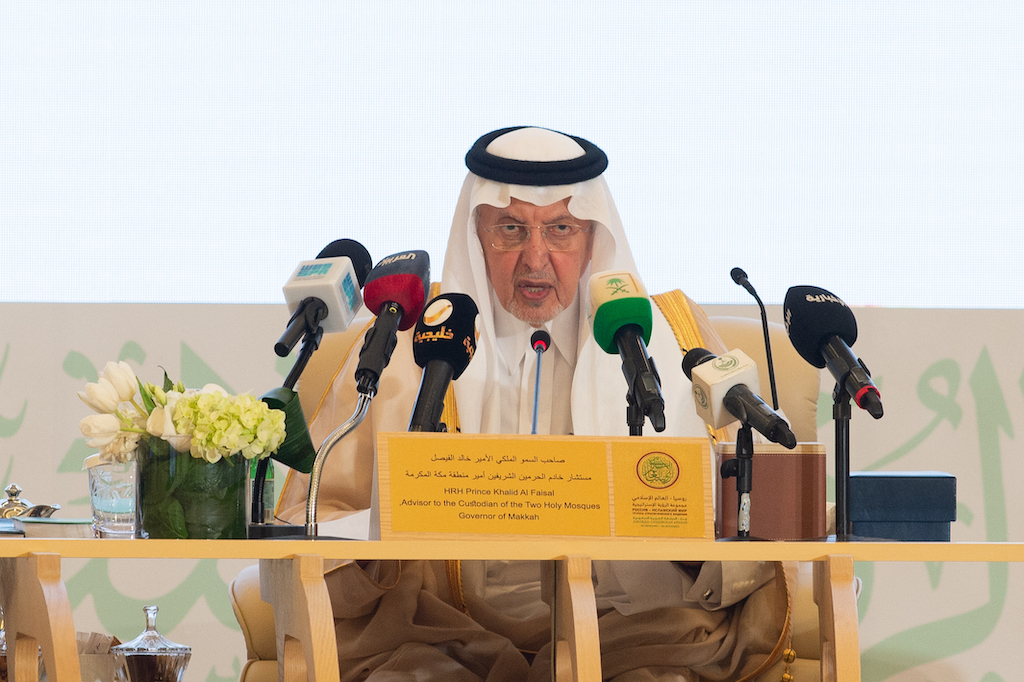
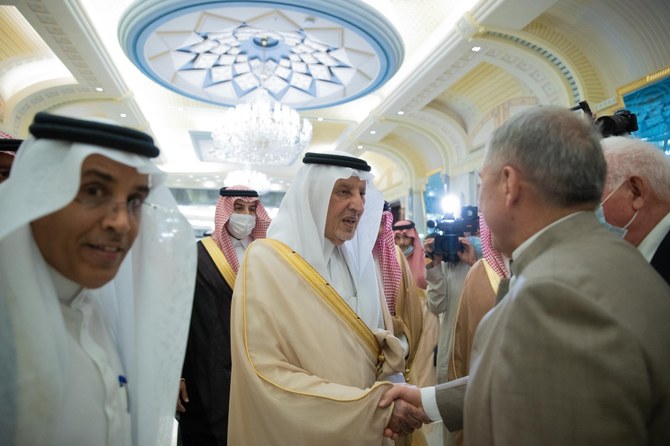
Makkah governor Prince Khaled Al-Faisal delivers a speech on behalf of King Salman. (Supplied)
“Saudi Arabia has an honorable role in adopting the principles of moderation and coexistence, as it has striven to support regional and international efforts in this field, and has presented many initiatives in this regard, most notably, the adoption of the Makkah Declaration, supporting the office of the UN Alliance of Civilizations,” he said.
The king added in his speech that Saudi Arabia is committed to support any future efforts aimed at serving these principles, believing that difference does not mean discord and that tolerance calls for transcendence.
He added that the Saudi-Russian relations, which have extended for a period of 95 years, are strong and historical.
“These relations have witnessed qualitative leaps in recent years, and culminated in high-level visits between the two countries. These visits resulted in signing many joint agreements in all economic, cultural, and defense fields. They also paved the way for the development of these relations and consolidating the level of trust between the two countries,” said Prince Khaled Al-Faisal on behalf of the king.
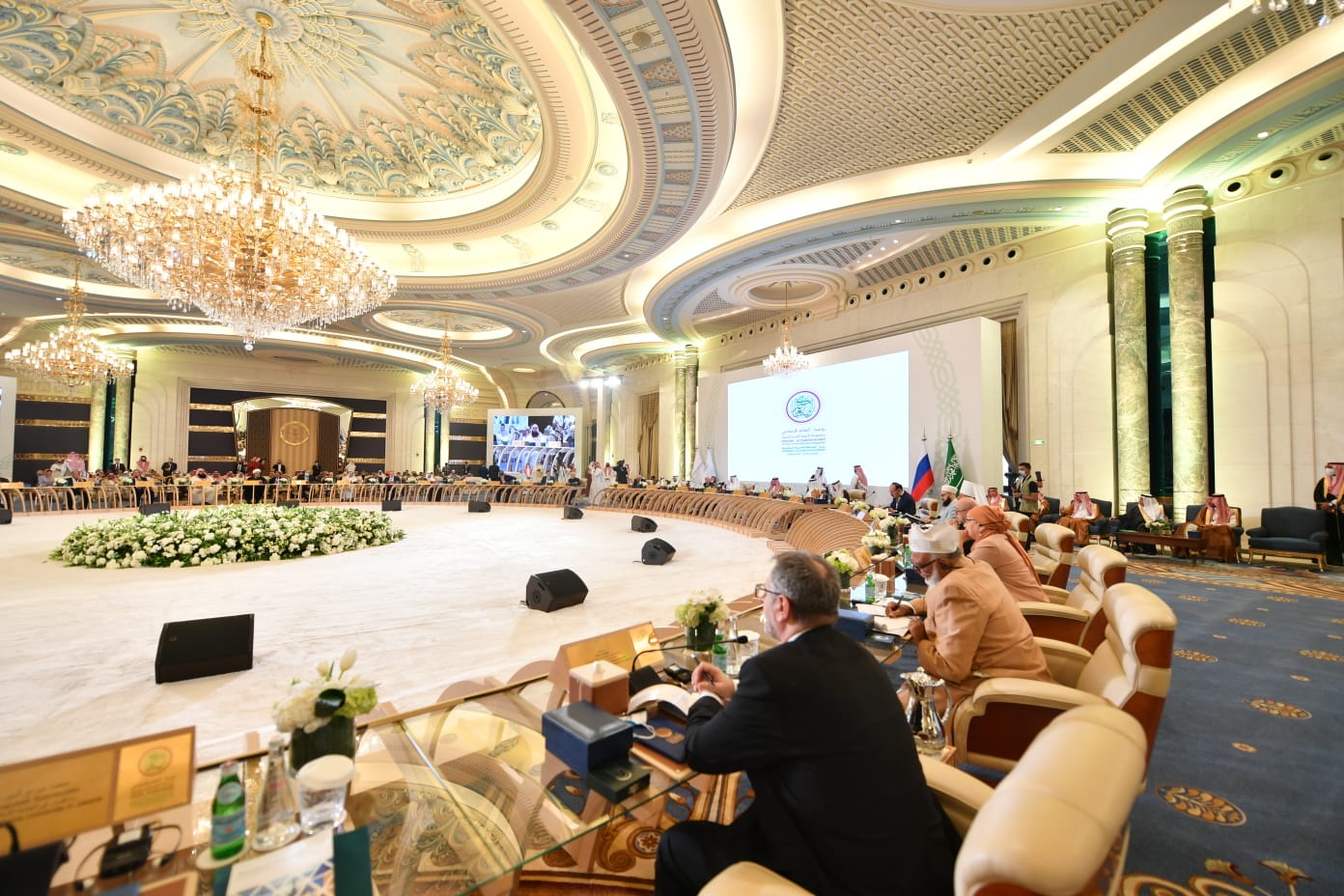
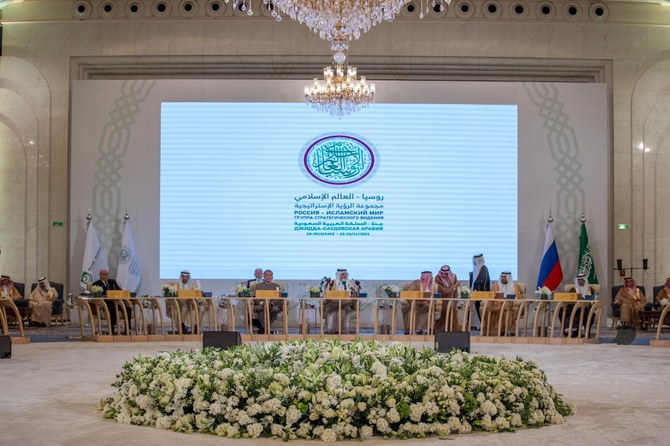
Attendees take part in the the Group of Strategic Vision Russia — Islamic World summit. (SPA)
King Salman said that Russia and the Islamic world share deep cultural heritage, which paves the way for activating the role of religious institutions, developing an environment that supports peaceful coexistence between followers of different religions and races, preserving the role of the family and spiritual values, and protecting human rights.
He added that Russia has deep-rooted relations with the Islamic world, as evidenced by its presence as an observer of the Organization of Islamic Cooperation for more than 15 years, which has resulted in fruitful cooperation with the organization.
“He added that more than 20 million Muslims live in harmony with their communities, and enjoy the right to freely practice their religious rites,” he said.
He pointed out that the dynamics of the relationship of Islamic countries with Russia is diverse, and prepares for building bridges of scientific and technological cooperation and promoting them in the field of development, education, software, and applications of the fourth industrial revolution.
Saudi Ambassador Extraordinary and Plenipotentiary to the Russian Federation Abdulrahman Al Ahmed told Arab News that Saudi-Russia relations began in 1926 when Karim Hakimov was appointed as an envoy to the late King Abdul Aziz.
The Strategic Vision Group meeting between Russia and the Islamic world is being held to discuss common issues. (Supplied)
“That was followed by letters between the leaders of the two countries. In 1932, King Faisal, who was at that time the viceroy of the Hijaz and foreign minister, made an official visit to Moscow. In 1990, Prince Saud Al-Faisal visited Moscow to resume relations and sign agreements and political discussions between the two countries,” he said.
He added that the relations became even stronger at the turn of the century when King Abdullah and Prince Sultan visited Moscow.
“There was a qualitative leap in the relations between the two countries through the visits made by Crown Prince Mohammed bin Salman to Moscow in 2015, 2016, 2017, and 2018. These visits were crowned with a visit by King Salman to Moscow in 2017, during which a number of agreements were signed. In 2019, President Vladimir Putin visited Riyadh, and again, several agreements were inked.”
He stressed that cooperation between Saudi Arabia and Russia has reached wider horizons at all levels of the economy, in policy, culture, arts, and energy. “Saudi Arabia and Russia are members at OPEC+ and other fields,” he added.
Commenting on how such meetings could enhance cooperation between Russia and the Islamic world, Vitaliy Naumkin, director of the Institute of Oriental Studies, told Arab News that: “This conference is very important as it is held for the first time during the pandemic. Moreover, there are also many people attending this conference. Also, very important representatives are present. So we need more cooperation because of the pandemic and the new development in the world.”
Naumkin added that the two sides have signed important agreements.
“We are signing other important agreements today here in Saudi Arabia, and these will be followed by new steps, and I am sure these steps will be very positive.
“There will be more cooperation between Russia and the Islamic world, especially Saudi Arabia, which is located in the center of the Islamic world, and it has a key role in this cooperation.”
Meanwhile, in an article posted on the Saudi Embassy’s website on Monday, Al- Ahmed said that among the urgent international issues the group will pay attention to are combating terrorism, international peace and security, the role of international organizations in the peaceful settlement of disputes, promoting a culture of peace, and economic cooperation in the post-COVID-19 world.
He added that the meeting would also focus on dialogue and cultural and humanitarian rapprochement, as well as other demanding issues.
“In this context, I am pleased to commend the efforts the Group of Strategic Vision “Russia — Islamic World” has been making in rapprochement between the Russian Federation and the Muslim world through joint work to enhance dialogue and understanding, reject extremist ideas, and strengthen joint measures to combat international terrorism,” Al-Ahmed said.
“I would like to point out the firm positions of the Russian Federation on the just issues of the Muslim world and the Russian political leadership’s keenness to achieve harmony, understanding, tolerance and coexistence between the people of the Russian Federation and the peoples of Islamic countries to face common challenges and achieve progress and prosperity for all,” he added.
Guests and speakers at the event included Rustam Minnikhanov, president of the Republic of Tatarstan and chairman of the Group of Strategic Vision – “Russia — Islamic World”; Hussein Ibrahim Taha, secretary-general of the OIC; Walid bin Abdul Karim, Saudi deputy minister of foreign affairs, and others.