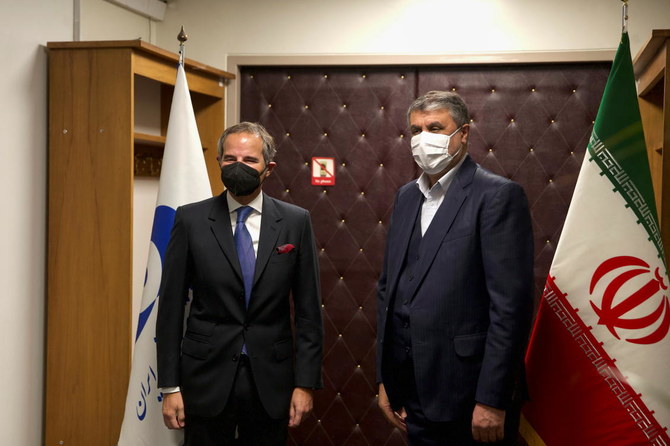
DUBAI: UN nuclear watchdog chief Rafael Grossi said on Tuesday that he wanted to deepen cooperation with Iran in his talks in Tehran, days before resumption of negotiations between the Islamic Republic and world powers to revive a 2015 nuclear deal.
“The agency is seeking to continue and deepen the dialogue with the government of Iran... We agreed to continue our joint work on transparency and this will continue,” Grossi, who arrived in Tehran on Monday, told a televised news conference.
The International Atomic Energy Agency (IAEA) last week issued reports detailing its conflicts with Iran, from rough treatment of its inspectors to re-installing cameras it deems “essential” for the revival of Tehran’s nuclear deal.
Tehran and Washington will resume indirect negotiations on Nov. 29 in Vienna, which have been on hold since June, to find ways to reinstate the nuclear deal that former US President Donald Trump exited three years ago and reimposed harsh sanctions on Iran.
Tehran responded by breaching key limits on nuclear activity set by the accord, including rebuilding stockpiles of enriched uranium, refining it to higher fissile purity and installing advanced centrifuges to speed up output.
Failure of diplomacy to bring back Tehran and Washington into compliance with the nuclear deal would carry the risk of a fresh regional war.
Israeli Prime Minister Naftali Bennett signalled readiness on Tuesday to step up Israel’s confrontation with Iran and reiterated that his country would not be bound by any new Iranian nuclear deal with world powers.
In September, Western powers at the IAEA’s 35-nation Board of Governors scrapped plans for a resolution against Iran after Tehran agreed to prolong monitoring of some nuclear activities.
But they still demand Iranian action on two central issues — explaining uranium traces found at three undeclared sites and granting IAEA inspectors access to the TESA Karaj centrifuge component manufacturing workshop to replace the agency’s monitoring cameras there.
The workshop was the victim of apparent sabotage in June in which one of four IAEA cameras there was destroyed. Iran has not returned that camera’s “data storage medium” and the IAEA said it had asked Iran to locate it and explain.
“Some questions were raised based on documents published by our enemies. These questions have now been answered,” Iran’s nuclear chief, Mohammad Eslami, said after meeting with Grossi.
“Tehran is determined to resolve technical issues with the agency without politicizing the matter.”
For fear of harming nuclear talks between Iran and world powers, diplomats say no action is likely to be taken against Iran when the board holds a meeting on Nov. 24.

IAEA’s Grossi says in Iran that he wants to deepen cooperation
https://arab.news/rqfnk
IAEA’s Grossi says in Iran that he wants to deepen cooperation
US condemns RSF drone attack on World Food Programme convoy in Sudan’s North Kordofan
- Denise Brown, the UN Humanitarian Coordinator for Sudan, also expresses concern over the drone attack
WASHINGTON: The US has condemned a drone attack by Rapid Support Forces on an aid convoy in Sudan’s North Kordofan state that killed one person and injured three others.
“The United States condemns the recent drone attack on a World Food Program convoy in North Kordofan transporting food to famine-stricken people which killed one and wounded many others,” US Senior Adviser for Arab and African Affairs Massad Boulos wrote on X.
“Destroying food intended for people in need and killing humanitarian workers is sickening,” the US envoy wrote.
“The Trump Administration has zero tolerance for this destruction of life and of U.S.-funded assistance; we demand accountability and extend our condolences to all those affected by these inexcusable events and terrible war,” he added.
The Sudan Doctors Network said the convoy was struck by RSF drones in the Allah Karim area as it headed toward displaced people in El-Obeid, the state capital, Anadolu Agency reported.
The network described the attack as a “clear violation of international humanitarian law,” warning that it undermines efforts to deliver life-saving aid to civilians amid worsening humanitarian conditions across the country.
There was no immediate comment from the rebel group.
The United States condemns the recent drone attack on a World Food Program convoy in North Kordofan transporting food to famine-stricken people which killed one and wounded many others. This follows an attack earlier this week in Blue Nile state that injured a @WFP staff member.…
— U.S. Senior Advisor for Arab and African Affairs (@US_SrAdvisorAF) February 6, 2026
Denise Brown, the UN Humanitarian Coordinator for Sudan, in a statement also expressed concern over the drone attack which hit the aid trucks in North Kordofan.
“I am deeply concerned by a drone attack earlier today on trucks contracted by the World Food Programme (WFP) in North Kordofan, the aftermath of which I came across a few hours later, as I left the state capital, El Obeid.”
“The trucks were en route from Kosti to deliver life-saving food assistance to displaced families near El Obeid when they were struck, tragically killing at least one individual and injuring many more. The trucks caught fire, destroying food commodities intended for life-saving humanitarian response.”
Brown added that “Humanitarian personnel, assets and supplies must be protected at all times. Attacks on aid operations undermine efforts to reach people facing hunger and displacement.”
“Safe and unimpeded humanitarian access remains critical to ensure assistance reaches the most vulnerable people across Sudan.”
Since April 2023, the conflict between Sudan’s army and the paramilitary forces has killed tens of thousands, displaced 11 million and which the UN has described as one of the world’s worst humanitarian crises.
An alert issued by the Integrated Food Security Phase Classification (IPC), confirmed famine conditions in El-Fasher and Kadugli, the capital of South Kordofan, about 800 kilometers to the east.
The IPC said that 20 more areas in Sudan’s Darfur and neighboring Kordofan were at risk of famine.
Of Sudan’s 18 states, the RSF controls all five states in the western Darfur region, except for parts of North Darfur that remain under army control. The army holds most areas of the remaining 13 states across the south, north, east and center of the country, including the capital, Khartoum.
The conflict between the army and the RSF, which erupted in April 2023, has killed thousands of people and displaced millions.