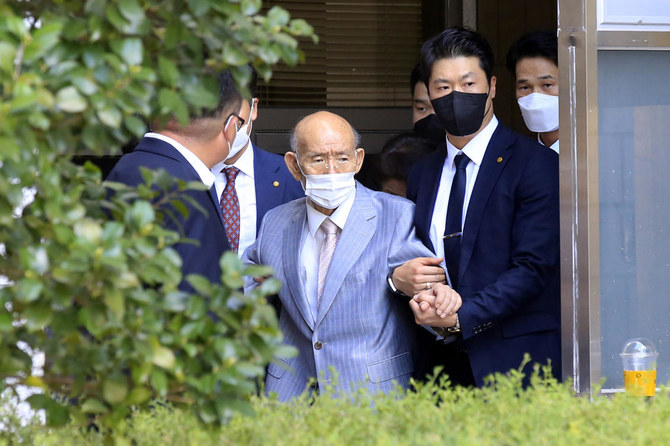
SEOUL: Former South Korean President Chun Doo-hwan, whose iron-fisted rule of the country following a 1979 military coup sparked massive democracy protests, died on Tuesday at the age of 90, his former press aide said.
Chun had multiple myeloma, a blood cancer which was in remission, and his health had deteriorated recently, his former press secretary Min Chung-ki told reporters. He passed away at his Seoul home early in the morning and his body was moved to a hospital for a funeral later in the day.
A former military commander, Chun presided over the 1980 Gwangju army massacre of pro-democracy demonstrators, a crime for which he was later convicted and received a commuted death sentence.
His death came about a month after coup co-conspirator and succeeding President Roh Tae-woo, who played a crucial but controversial role in the country’s troubled transition to democracy, died at age 88.
An aloof, ramrod-straight Chun during his mid-1990s trial defended the coup as necessary to save the nation from a political crisis and denied sending troops into Gwangju.
“I am sure that I would take the same action, if the same situation arose,” Chun told the court.
Chun was born on March 6, 1931, in Yulgok-myeon, a poor farming town in the southeastern county of Hapcheon, during Japanese rule over Korea.
He joined the military straight out of high school, working his way up the ranks until he was appointed a commander in 1979. Taking charge of the investigation into the assassination of President Park Chung-hee that year, Chun courted key military allies and gained control of South Korea’s intelligence agencies to headline a Dec. 12 coup.
“In front of the most powerful organizations under the Park Chung-hee presidency, it surprised me how easily (Chun) gained control over them and how skilfully he took advantage of the circumstances. In an instant he seemed to have grown into a giant,” Park Jun-kwang, Chun’s subordinate during the coup later told journalist Cho Gab-je.
Chun’s eight-year rule in the presidential Blue House was characterised by brutality and political repression. It was, however, also marked by growing economic prosperity.
Chun resigned from office amid a nationwide student-led democratic movement in 1987 demanding a direct electoral system.
In 1995, he was charged with mutiny, treason and was arrested after refusing to appear at the prosecutors’ office and fleeing to his hometown.
At what local media dubbed the “trial of the century,” he and Roh were found guilty of mutiny, treason and bribery. In their verdict, judges said Chun’s rise to power came “through illegal means which inflicted enormous damage on the people.”
Thousands of students were believed to have been killed at Gwangju, according to testimonies by survivors, former military officers and investigators.
Roh was given a lengthy jail term while Chun was sentenced to death. However, that was commuted by the Seoul High Court in recognition of Chun’s role in the fast-paced economic development of the Asian “Tiger” economy and the peaceful transfer of the presidency to Roh in 1988.
Both men were pardoned and freed from jail in 1997 by President Kim Young-sam, in what he called an effort to promote “national unity.”
An association of survivors’ groups said at a news conference on Tuesday that it was lamentable that Chun died without apologizing for the coup and Gwangju “massacre,” vowing to continue seeking the truth and “justice of history.”
Chun made several returns to the spotlight. He caused a national furor in 2003 when he claimed total assets of 291,000 won ($245) of cash, two dogs and some home appliances — while owing some 220.5 billion won in fines. His four children and other relatives were later found to own large swaths of land in Seoul and luxurious villas in the United States.
Chun’s family in 2013 vowed to pay off the bulk of his debt, but his unpaid fines still totalled some 100 billion won as of last December. Seoul city said last week that his unpaid taxes exceeded 980 million won.
In 2020, Chun was found guilty and received an eight-month suspended sentence for defaming a late democracy activist and Catholic priest in his 2017 memoirs. Prosecutors have appealed, and Chun had faced a trial next week.
Chun had wished to be cremated and buried near the border with North Korea, but his family would make a final decision when his youngest son, living in the United States, arrives, Min said. ($1 = 1,188.3000 won)

Former South Korean military dictator Chun Doo-hwan dies at 90
https://arab.news/j6nwy
Former South Korean military dictator Chun Doo-hwan dies at 90
- His death came about a month after coup co-conspirator and succeeding President Roh Tae-woo died at age 88
- Chun’s eight-year rule in the presidential Blue House was characterised by brutality and political repression
The shootings in Minneapolis are upending the politics of immigration in Congress
- Many GOP lawmakers continue to embrace the Trump administration’s deportation strategy
WASHINGTON: The shooting deaths of two American citizens during the Trump administration’s deportation operations in Minneapolis have upended the politics of immigration in Congress, plunging the country toward another government shutdown.
Democrats have awakened to what they see as a moral moment for the country, refusing funds for the Department of Homeland Security’s military-style immigration enforcement operations unless there are new restraints. Two former presidents, Barack Obama and Bill Clinton, have broken from retirement to speak out.
At the same time, Republicans who have championed President Donald Trump’s tough approach to immigration are signaling second thoughts. A growing number of Republicans want a full investigation into the shooting death of Alex Pretti and congressional hearings about US Immigration and Customs Enforcement operations.
“Americans are horrified & don’t want their tax dollars funding this brutality,” Sen. Chris Van Hollen, D-Md., wrote on social media. “Not another dime to this lawless operation.”
The result is a rapidly changing political environment as the nation considers the reach of the Trump administration’s well-funded immigration enforcement machinery and Congress spirals toward a partial federal shutdown if no resolution is reached by midnight Friday.
“The tragic death of Alex Pretti has refocused attention on the Homeland Security bill, and I recognize and share the concerns,” said Sen. Susan Collins of Maine, the GOP chair of the Appropriations Committee, in brief remarks Monday.
Still, she urged colleagues to stick to the funding deal and avoid a “detrimental shutdown.”
Searching for a way out of a crisis
As Congress seeks to defuse a crisis, the next steps are uncertain.
The White House has indicated its own shifting strategy, sending Trump’s border czar Tom Homan to Minneapolis to take over for hard-charging Border Patrol Commander Gregory Bovino, which many Republicans see as a potential turning point to calm operations.
“This is a positive development — one that I hope leads to turning down the temperature and restoring order in Minnesota,” Senate Majority Leader John Thune posted about Homan.
Behind the scenes, the White House is reaching out to congressional leaders, and even individual Democratic senators, in search of a way out of another government shutdown.
At stake is a six-bill government funding package, not just for Homeland Security but for Defense, Health and other departments, making up more than 70 percent of federal operations.
Even though Homeland Security has billions from Trump’s big tax break bill, Democrats are coalescing around changes to ICE operations. “We can still have some legitimate restriction on how these people are conducting themselves,” said Sen. Ruben Gallego, D-Arizona
But it appears doubtful the Trump administration would readily agree to Democrats’ demands to rein in immigration operations. Proposals for unmasking federal agents or limiting their reach into schools, hospitals or churches would be difficult to quickly approve in Congress.
White House press secretary Karoline Leavitt said that while conversations are underway, Trump wants to see the bipartisan spending package approved to avoid the possibility of a government shutdown.
“We absolutely do not want to see that funding lapse,” Leavitt said.
Politics reflect changing attitudes on Trump’s immigration agenda
The political climate is a turnaround from just a year ago, when Congress easily passed the Laken Riley Act, the first bill Trump signed into law in his second term.
At the time, dozens of Democrats joined the GOP majority in passing the bill named after a Georgia nursing student who was killed by a Venezuelan man who had entered the country illegally.
Many Democrats had worried about the Biden administration’s record of having allowed untold immigrants into the country. The party was increasingly seen as soft on crime following the “defund the police” protests and the aftermath of the death of George Floyd at the the hands of law enforcement.
But the Trump administrations tactics changed all that.
Just 38 percent of US adults approve of how Trump is handling immigration, down from 49 percent in March, according to an AP-NORC poll conducted in January, shortly after the death of Renee Good, who was shot and killed by a ICE officer in Minnesota.
Last week, almost all House Democrats voted against the Homeland Security bill, as the package was sent the Senate.
Then there was the shooting death of Pretti over the weekend in Minneapolis.
Rep. Tom Suozzi of New York, who was among the seven Democrats who had voted to approve the Homeland Security funds, reversed course Monday in a Facebook post.
“I hear the anger from my constituents, and I take responsibility for that,” Suozzi wrote.
He said he “failed to view the DHS funding vote as a referendum on the illegal and immoral conduct of ICE in Minneapolis.”
Voting ahead as shutdown risk grows
Senate Democratic Leader Chuck Schumer said Monday the responsibility for averting another shutdown falls to Republicans, who have majority control, to break apart the six-bill package, removing the homeland funds while allowing the others to go forward.
“We can pass them right away,” Schumer said.
But the White House panned that approach and House Speaker Mike Johnson, who has blamed Democrats for last year’s shutdown, the longest in history, has been mum. The GOP speaker would need to recall lawmakers to Washington to vote.
Republicans believe they will be able to portray Democrats as radical if the government shuts down over Homeland Security funds, and certain centrist Democrats have warned the party against strong anti-ICE language.
A memo from centrist Democratic group Third Way had earlier warned lawmakers against proposals to “abolish” ICE as “emotionally satisfying, politically lethal.” In a new memo Monday it proposed “Overhauling ICE” with top-to-bottom changes, including removing Homeland Security Secretary Kristi Noem from her job.
GOP faces a divide on deportations
But Republicans also risk being sideways with public opinion over Trump’s immigration and deportation agenda.
Republicans prefer to keep the focus on Trump’s ability to secure the US-Mexico border, with illegal crossings at all-time lows, instead of the military-style deportation agenda. They are particularly sensitive to concerns from gun owners’ groups that Pretti, who was apparently licensed to carry a firearm, is being criticized for having a gun with him before he was killed.
GOP Sen. Rand Paul, the chairman of the Homeland Security and Government Oversight Committee, demanded that acting ICE director Todd Lyons appear for a hearing — joining a similar demand from House Republicans over the weekend.
At the same time, many GOP lawmakers continue to embrace the Trump administration’s deportation strategy.
“I want to be very clear,” said Sen. Rick Scott, R-Fla., in a post. “I will not support any efforts to strip DHS of its funding.”
And pressure from their own right flank was bearing down on Republicans.
The Heritage Foundation chastised those Republicans who were “jubilant” at the prospect of slowing down ICE operations. “Deport every illegal alien,” it said in a post. “Nothing less.”