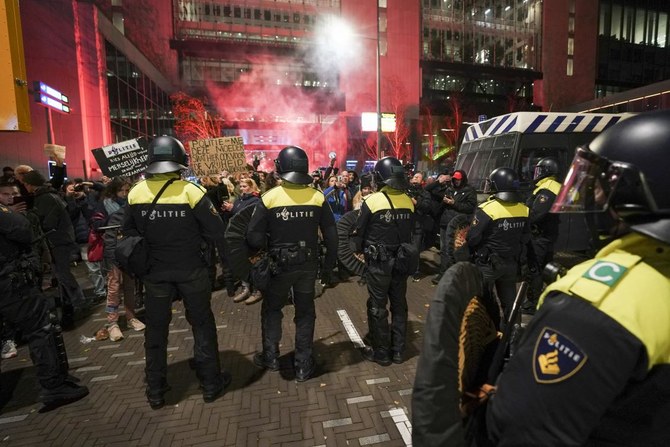
Dutch police detain dozens in a second night of COVID-19 rioting

Some of the most serious confrontations on Saturday night were in The Hague, where five officers were hurt. (File/AFP)
Short Url
Updated 21 November 2021
Follow

Dutch police detain dozens in a second night of COVID-19 rioting

  • Three people believed to be hit by police bullets remained in hospital on Sunday,
  • The Netherlands reimposed some lockdown measures on its 17.5 million population last weekend for an initial three weeks in an effort to slow a resurgence of the virus

AMSTERDAM: Five police officers were injured in the Netherlands and at least 28 people detained across three provinces as violent protests against COVID-19 restrictions continued for a second night into Sunday.
Dutch authorities used water canon, dogs and mounted police to stop rioting youths who set fires and threw fireworks in the worst disturbances since a full lockdown led to widespread disorder and more than 500 arrests in January.
The latest unrest began on Friday night in Rotterdam, where police opened fire on a crowd that had swelled to hundreds during a protest the city’s mayor said had turned into “an orgy of violence.”
Three people believed to be hit by police bullets remained in hospital on Sunday, a statement by the authorities said.
The protests were sparked by opposition to government plans to restrict use of a national corona pass to people who have either recovered from COVID-19 or have been vaccinated, excluding those with a negative test result.
The Netherlands reimposed some lockdown measures on its 17.5 million population last weekend for an initial three weeks in an effort to slow a resurgence of the virus, but daily infections have remained at their highest levels since the start of the pandemic.
Youths were also angered by a New Year’s Eve firework ban to avoid added pressure on hospitals that have already been forced to scale back care due to a surge in COVID-19 patients.
Some of the most serious confrontations on Saturday night were in The Hague, where five officers were hurt, one of them seriously, a police statement said. Police carried out charges on horseback and arrested seven people, one of them for throwing a rock through the windshield of a passing ambulance.
Another 13 arrests were reported by police in two towns in the southern province of Limburg, while disturbances were also reported in the northern province of Flevoland. Eight people were detained in the town of Urk, where a COVID-19 testing station was torched earlier this year.


Kabul shakes as 5.8-magnitude earthquake hits eastern Afghanistan

Updated 9 sec ago
Follow

Kabul shakes as 5.8-magnitude earthquake hits eastern Afghanistan

  • The 5.8-magnitude quake struck a mountainous area around 130 kilometers northeast of Kabul
  • Earthquakes are common in Afghanistan, particularly along the Hindu Kush mountain range

KABUL: A strong earthquake rocked eastern Afghanistan including the capital Kabul on Friday, AFP journalists and residents said.
The 5.8-magnitude quake struck a mountainous area around 130 kilometers (80 miles) northeast of Kabul, the United States Geological Survey said.
The epicenter was near several remote villages and struck at 5:39 p.m. (1309 GMT), just as people in the Muslim-majority country were sitting down to break their Ramadan fast.
“We were waiting to do our iftars, a heavy earthquake shook us. It was very strong, it went on for almost 30 seconds,” said Zilgay Talabi, a resident of Khenj district near of the epicenter.
“Everyone was horrified and scared,” Talabi told AFP, saying he feared “landslides and avalanches” may follow.
Power was briefly cut in parts of the capital, while east of Kabul an AFP journalist in Nangarhar province also felt it.
Earthquakes are common in Afghanistan, particularly along the Hindu Kush mountain range, near where the Eurasian and Indian tectonic plates meet.
Haqmal Saad, spokesman for the Panjshir province police, described the quake as “very strong” and said the force was “gathering information on the ground.”
Mohibullah Jahid, head of Panjshir Natural Disaster Management agency, told AFP he was in touch with several officials in the area.
The district governor had told him there were reports of “minor damage, such as cracks in the walls, but we have not received anything serious, such as the collapse of houses or anything similar,” Jahid said.
Residents in Bamiyan and Wardak provinces, west of Kabul, told AFP they also felt the earthquake.
In Pakistan’s Khyber Pakhtunkhwa province, rescue service official Bilal Ahmad Faizi said the quake was felt in border areas.
In August last year, a shallow 6.0-magnitude quake in the country’s east wiped out mountainside villages and killed more than 2,200 people.
Weeks later, a 6.3-magnitude quake in northern Afghanistan killed at least 27 people.
Large tremors in western Herat, near the Iranian border, in 2023, and in Nangarhar province in 2022, killed hundreds and destroyed thousands of homes.
Many homes in the predominantly rural country, which has been devastated by decades of war, are shoddily built.
Poor communication networks and infrastructure in mountainous Afghanistan have hampered disaster responses in the past, preventing authorities from reaching far-flung villages for hours or even days before they could assess the extent of the damage.