MANAMA: The US envoy for Iran warned Friday that Tehran was approaching the point of no return for reviving a nuclear deal after it boosted its stocks of enriched uranium before talks resume this month.
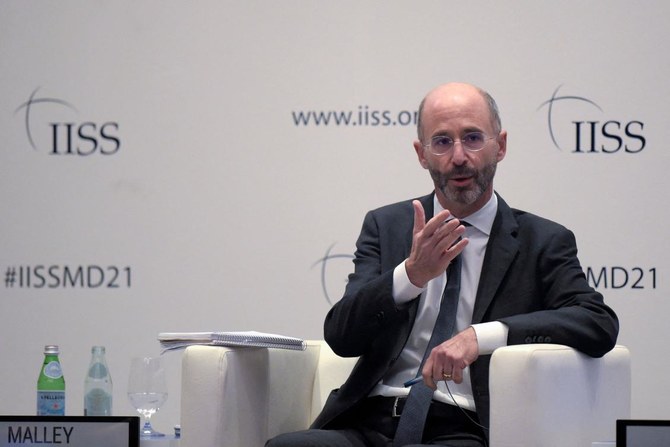
Robert Malley said Iran risked making it “impossible” to gain any benefit from resuming the agreement, which has been on hold since then president Donald Trump walked away in 2018.
This week, with Iran set for talks with world powers in Vienna on November 29, the International Atomic Energy Agency said Tehran had again increased its stockpile of highly enriched uranium.
“The time will come if Iran continues at this pace with the advancements they’ve made, (it) will make it impossible even if we were going to go back to the JCPOA to recapture the benefits,” Malley told the Manama Dialogue conference in Bahrain.
The Joint Comprehensive Plan of Action was the agreement struck in 2015 under which Iran agreed to clear limits on its nuclear activities in return for an easing of sanctions.
“Iran’s advances are spreading alarm across the region... that’s what’s making the clock tick faster and making all of us say that the time is short for a return to the JCPOA,” Malley said.
On Wednesday, the US and its Gulf Arab allies accused Iran of causing a nuclear crisis and destabilising the region with its ballistic missile program and support for armed militias.
Malley said the US shared a “commonality of purpose” with rivals Russia and China “because we want to avoid that crisis, all of us, the crisis that would be sparked if Iran continues on its current path.”
“And I want to be clear, because there’s no ambiguity about what they seem to be doing now, which is to drag their feet on the nuclear talks and accelerate the progress in their nuclear program.”
The US envoy said he was not encouraged by the statements from the new Iranian government of President Ebrahim Raisi, which earlier on Friday accused Washington of conducting a “propaganda campaign” against the country.
“If they stick to their public pronouncements, unfortunately we’re not headed in the right direction... but let’s wait to see what happens,” he said, pledging that President Joe Biden would honor a revived deal.
“Our intent, our clear intent in coming back into the deal is to stick with the deal because we don’t want to see a nuclear crisis,” Malley said.
Iran had reacted angrily to a US pledge to take its Gulf Arab allies’ interests into account in any revived nuclear deal with their arch rival.
“The US government, which is responsible for the current situation after withdrawing from the nuclear deal, is once again trying to provoke a crisis,” foreign ministry spokesman Saeed Khatibzadeh charged.


![]()

Time shrinking for Iran nuclear deal, US envoy warns
Short Url
https://arab.news/zmadw
Time shrinking for Iran nuclear deal, US envoy warns
- Robert Malley said Iran risked making it “impossible” to gain any benefit from resuming the agreement
- This week, the IAEA said Tehran had again increased its stockpile of highly enriched uranium


Latest updates


© 2026 SAUDI RESEARCH & PUBLISHING COMPANY, All Rights Reserved And subject to Terms of Use Agreement.