

Army engineers from UK to assist Poland on Belarus border

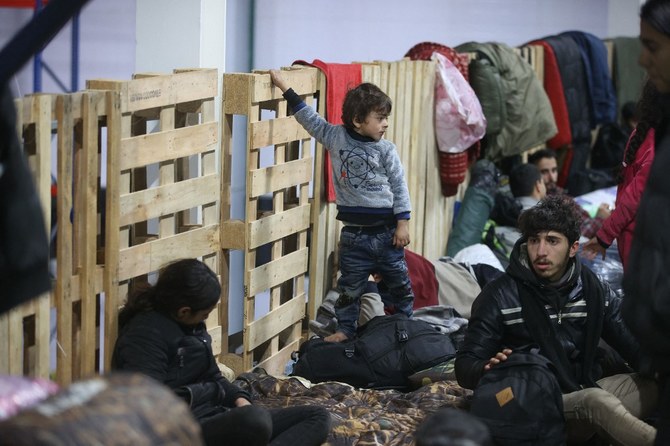
Migrants stay in the transport and logistics centre near the Bruzgi border point on the Belarusian-Polish border in the Grodno region on November 18, 2021. (FIle/AFP)
Short Url
Updated 19 November 2021
Follow

Army engineers from UK to assist Poland on Belarus border

  • Around 140 to be deployed to reinforce and maintain security and logistical infrastructure
  • British defense secretary: Deployment could come in ‘days or weeks’

LONDON: A force of British Army Royal Engineers is to be dispatched to Poland to assist the country’s military to maintain infrastructure on its border with Belarus.

The move comes after weeks of tension, with thousands of migrants trying to cross into the EU via Poland, causing damage to border fences and other security installations, and throwing missiles at personnel on the Polish side.

Poland has deployed around 15,000 troops to the border to maintain order. Earlier this week, tear gas and water cannons were used to disperse migrants, many of whom are from the Middle East. 

UK Defense Secretary Ben Wallace said a reconnaissance team of engineers had already visited the Polish border, and a larger force of around 140 will be deployed “within days or weeks.”

He is thought to have discussed the proposal with his Polish counterpart Mariusz Blaszczak on Thursday during a visit to the country, and added that he will put the proposal to Parliament before the deployment.

“What we’ll do is send some Royal Engineers — that’s part of the army designed for building or making fences or roads or putting in infrastructure,” Wallace told the BBC.

“We’re going to be using that part of our forces to help the Poles and potentially other Baltic states to secure their border,” he added. “This isn’t combat — this is support to the Poles.”

Blaszczak told local media: “The task of British soldiers will be to repair the temporary fence on the Polish-Belarusian border and to maintain and unblock road connections.”

Belarus has come under intense international scrutiny, with President Alexander Lukashanko accused of “weaponizing” migrants against the EU following the bloc’s decision to impose sanctions on Minsk in response to human rights violations. 

Thousands of people are now thought to be trapped in deteriorating conditions around the border with Poland, with harsh winter weather setting in.

“I’m particularly worried for the women and children and the vulnerable people who are being trafficked by the Belarusians into this game they seem to be playing,” Wallace said.

“It’s a horrendous thing to do, to force migrants to be a tool in a game to try to destabilize their neighbors.”


UN warns 200,000 more Afghan children face acute malnutrition in 2026

Updated 8 sec ago
Follow

UN warns 200,000 more Afghan children face acute malnutrition in 2026

“Acute malnutrition ⁠among children is ⁠soaring,” WFP’S Country Director John Aylieff said
Some 200,000 additional children face acute malnutrition this year

GENEVA: Hundreds of thousands more children face acute malnutrition in Afghanistan this year amid a hunger crisis exacerbated by foreign aid cuts and violence on the border with Pakistan, a UN official said on Tuesday.
International aid to Afghanistan has fallen sharply since 2021, when US-led forces exited the country and the Taliban regained power. The crisis has been compounded by natural calamities including earthquakes.
“Acute malnutrition ⁠among children is ⁠soaring. Last year we saw the highest surge ever recorded in Afghanistan, and this year, a staggering 3.7 million children will need malnutrition treatment,” the World Food Programme’s Country Director John Aylieff told a Geneva press briefing.
Some 200,000 additional children face acute malnutrition this year, he added.
Funding ⁠cuts mean the UN agency only has the resources to treat one in every four children needing treatment for acute malnutrition, Aylieff said.
Others do not even have the means to reach clinics, he said, voicing concerns that some are trapped by snowfall in remote highland areas.
Most children who die in Afghanistan do so “during the winter... at home silently,” he said.
“What I fear is when the snow is melted at the end of March or in ⁠April, we ⁠will find there has been a very high toll of child deaths in the villages.”
Expulsion policies in neighboring Pakistan and Iran have resulted in over 5 million returnees since late 2023, further straining limited resources, Aylieff said.
Many of those returning to Afghanistan are close to areas where Pakistani and Afghan troops have clashed in recent days, forcing WFP to suspend some services there.
“We foresee that acute malnutrition will be driven up further by the conflict as people are prevented from accessing health services,” imperilling tens of thousands of children, said Aylieff.