

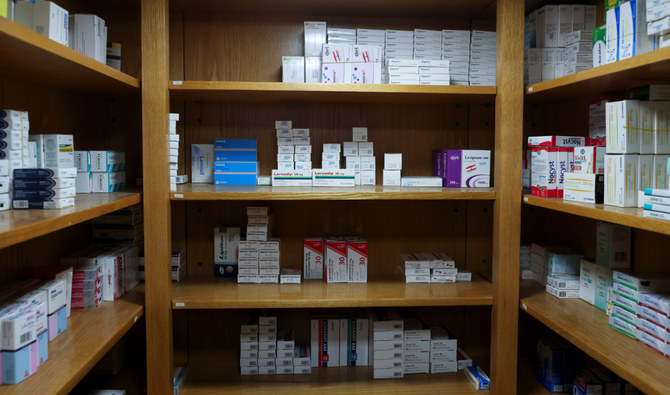

BEIRUT: Lebanese people have been left sobbing in pharmacies after medicine subsidies were lifted, as one lawmaker warned that people with chronic health conditions were being put at risk.
The new price list for subsidized and unsubsidized medicines was published by the Ministry of Health a few days ago and showed a frightening rise in prices, some by 830 percent.
Only medicines to treat cancer and other incurable diseases are still subsidized, at the official exchange rate of LBP1,500 to the US dollar.
Subsidies were lifted amid a decline in the Central Bank’s hard currency reserves due to the country’s economic and financial crises.
The head of Lebanon's parliamentary health committee, MP Assem Araji, called on Prime Minister Najib Mikati to “personally intervene with the Central Bank to increase subsidies for medicines for chronic diseases.”
Some pharmacy bills now cost more than a month's salary.
Charbel, a pharmacist in Beirut, told Arab News: “People are beyond shocked. They come to the pharmacy and ask about the price of the medicine before buying it, and many end up leaving empty-handed.”
Some had even cried right in front of Charbel.
It was especially upsetting when a father asked about the price of baby formula, only to learn that he could not afford it.
“For months, baby formula could not be found in pharmacies,” Charbel said. “After subsidies were lifted, importers began distributing them to pharmacies again, but a box that used to cost LBP12,000 is now priced at LBP93,000.”
MP Faisal Al-Sayegh confessed on social media: “We do not know how to answer people's painful questions.”
Araji warned that patients with diabetes, blood pressure, heart and nerve diseases were at great risk.
He told Arab News: “We will try to ask officials to increase the subsidy rate for chronic disease medicines from 35 percent to 45 percent so that people can afford them, and take strict measures to stop smuggling and illegally storing drugs. But we may not succeed. I was a doctor before I became an MP and my colleagues and I feel ashamed whenever we want to prescribe medicines to our patients because we know they cannot afford them. Even generic drugs are too expensive now.
“It's a shame that the cost of hospitalization is now 10 times more expensive as a result of the increasing costs of medical materials and medicines. In light of what is happening, the patient has no choice but to go to clinics and charities that receive donated medicines from abroad.”
He stressed the need to increase appeals to international institutions to supply such clinics with medicines.
Lifting subsidies on more medicines may completely topple drug security and threaten social security.
A pharmacist in a prestigious residential neighborhood in Beirut told Arab News: “I need to hire an employee whose only job would be to keep an eye on customers. Every day, we see customers trying to steal medicine or any other product available on the shelves. We had never seen such a phenomenon before.”
The Internal Security Forces has been issuing reports about the rise in the number of thefts.
Information International, a Beirut-based research firm, published a study this week based on those reports.
It said that, with the increasing severity of Lebanon’s economic and social collapse, those with money had become a target for those who did not have or no longer had anything.
The study also revealed that, during the first 10 months of 2021 and compared to the same period in 2019, murders increased by 101 percent and the number of cars stolen increased by 212 percent.
It said 1,097 cars were stolen in 2021, with 351 cars stolen during the same period in 2019.
Thefts increased by 265.6 percent during the first 10 months of 2021, compared to the same period in 2019. There were 503 thefts recorded during October, compared to 411 thefts in September.


