ISLAMABAD: Pakistani officials said on Thursday they had allocated more beds for dengue patients at various medical facilities as the country’s federal capital and Punjab province witness a major outbreak of the disease.
According to the official data compiled by the National Institute of Health in Islamabad, the total number of infections has crossed 27,000 in the aforementioned regions, leading to the death of over 100 people, as the relevant Pakistani authorities struggle to contain the growing epidemic.
The country has witnessed periodic outbreaks of dengue fever since 2010, as per official statistics, resulting in 22,938 confirmed dengue cases in 2017, over 3,200 cases in 2018, 24,547 cases in 2019, and 3,442 cases in 2020.
Islamabad and Punjab have been facing a continuous rise in the number of infections this year since October 8, putting significant pressure on public and private hospitals.
The Punjab has reported a total of 22,616 cases until now, with 105 related deaths across the province.
Lahore, the provincial capital, has become the epicenter of the disease where 16,476 cases were reported until Thursday.
According to official statistics, a total of 1,487 dengue patients have been admitted in the province’s public hospitals while 1,010 of them have only been admitted in Lahore.
Secretary Primary and Secondary Healthcare Punjab Imran Sikandar Baloch said the provincial government had allocated 5,173 beds in the public hospitals for the treatment of dengue patients while 1,487 of them had been occupied.
“The number of beds is being increased on a daily basis in teaching hospitals of Lahore to facilitate dengue patients,” he said, adding that health department teams checked 319,587 indoor places on Wednesday to control the breeding of dengue mosquitoes.
In the last 24 hours, a total of 306 dengue cases were reported in Punjab, including 225 in Lahore, 21 in Rawalpindi, 18 in Gujranwala, four each in Kasur, Rahim Yar Khan, Sargodha and Sheikhupura, three each in Attock, Dera Ghazi Khan, Faisalabad and Narowal and two patients each in Gujrat and Chiniot.
Likewise, Islamabad has reported 4,421 dengue cases so far from its urban and rural areas since October 8 while the district administration has been carrying out indoor residual spray and fogging in different areas to prevent the spread of the disease.
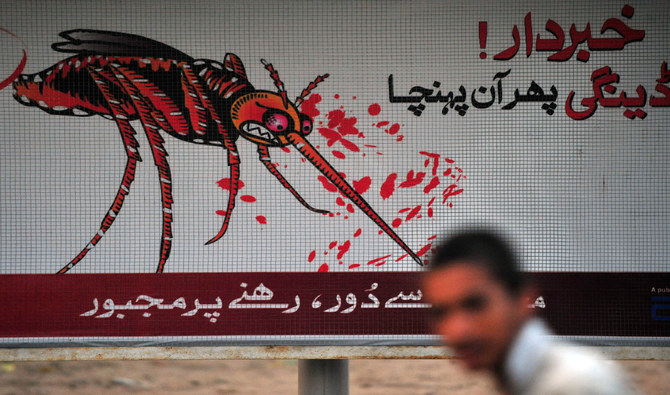
Dengue is a mosquito-borne viral infection, found in tropical and sub-tropical climates worldwide, mostly in urban and semi-urban areas. Its prevention depends on effective vector control measures.
There is no specific treatment for the disease, according to World Health Organization. However, early detection of the disease and access to proper medical care lowers the fatality rate to less than one percent.
The global incidence of dengue has grown dramatically in the recent decades as about half of the world’s population is now at risk of it. There are an estimated 100-400 million dengue infections each year across the globe, say the WHO data.
Dr. Javed Akram, vice chancellor of the University of Health Sciences Lahore, said dengue was a viral and vector-borne disease, adding it would therefore take time to subside.
“The virus will diminish automatically by mid-January with the fall in temperatures,” he told Arab News. “People should exercise prevention and care to deal with it as there is no proven medical treatment for the disease so far.”


![]()

Dengue outbreak grips Pakistan’s federal capital, Punjab province
Short Url
https://arab.news/m5xrq
Dengue outbreak grips Pakistan’s federal capital, Punjab province
- According to official data, Punjab has reported over 22,000 cases with 105 deaths across the province
- Health experts say the disease will automatically subside when temperatures fall by mid-January
Latest updates


© 2026 SAUDI RESEARCH & PUBLISHING COMPANY, All Rights Reserved And subject to Terms of Use Agreement.