10 shot dead in crackdown on Sudan anti-coup protests

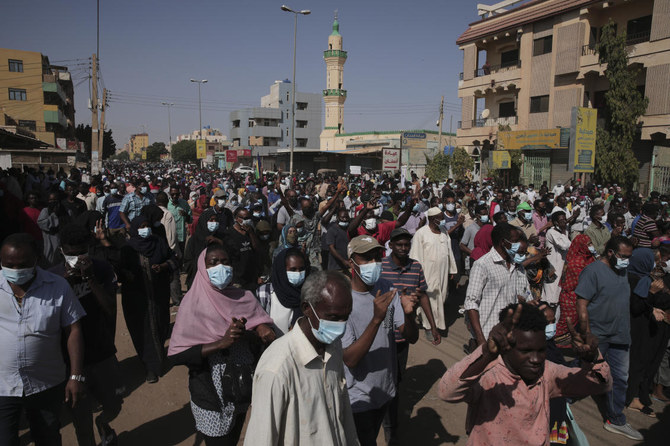
People protest in Khartoum, Sudan on Saturday. Pro-democracy protesters took to the streets across Sudan to rally against the military’s takeover last month. (AP)
Short Url
Updated 17 November 2021
Follow

10 shot dead in crackdown on Sudan anti-coup protests

  • The fatalities raised to 34 the death toll from unrest since the military seized power
  • Security forces fired tear gas, injuring several protesters, witnesses said

KHARTOUM: Sudanese security forces shot dead at least 10 anti-coup protesters and wounded dozens more on Wednesday, medics said, in the bloodiest day since the military's October 25 takeover.
The fatalities - all in Khartoum, especially its northern districts - raised to 34 the death toll from unrest since the military seized power, a pro-democracy doctors' union said. Hundreds more have been wounded.
Demonstrators had taken to the streets across the capital even though telephone lines and internet services had been disrupted since the military took over, AFP journalists reported.
"The people choose civilian rule," demonstrators chanted, also shouting slogans against Sudan's ruler, top general Abdel Fattah Al-Burhan.
The security forces fired tear gas, injuring several more protesters, witnesses said. They have denied using live ammunition.
The doctors' union said most of the casualties had suffered gunshot wounds to "the head, neck or torso", but added that the demonstrators were still marching.
Demonstrations also erupted in Port Sudan, an AFP journalist said, against the coup which halted a democratic transition that followed the 2019 toppling of longtime dictator Omar Al-Bashir.
"It was a very bad day for the protesters," Soha, a 42-year-old protester, told AFP. "I saw a person with gunshot wounds behind me and there were a lot of arrests" in Khartoum.
Efforts to stem the protests have seen hundreds arrested, including activists, passers-by and journalists. Qatari network Al Jazeera's bureau chief was arrested Sunday and released Tuesday.
The Central Committee of Sudanese Doctors has said security forces have also arrested injured people inside Khartoum hospitals.
The Sudanese Professionals Association, an umbrella of unions instrumental in the 2019 protests, denounced "immense crimes against humanity" and accused the security forces of "premeditated killings".
US Secretary of State Antony Blinken on a visit to Kenya on Wednesday urged Africans to watch out for rising threats to democracy.
He told Sudan's military the country stood to regain badly-needed international aid if it restores the "legitimacy" of civilian government.
Washington has suspended some $700 million in assistance to Sudan since the coup.
"If the military puts this train back on its tracks and does what's necessary, I think the support that has been very strong from the international community can resume," said Blinken.
Prior to 2019, Sudan had been under some form of military dictatorship for much of its modern history.
Burhan has declared a state of emergency, ousted the government and detained the civilian leadership, derailing a transition to full civilian rule and drawing international condemnation.
Burhan insists the military's move "was not a coup" but rather a push to "rectify the course of the transition".
US Assistant Secretary of State for African Affairs Molly Phee has been shuttling between the generals and the ousted civilian government in a bid to broker a way out of the crisis.
Phee has called for the reinstatement of ousted Prime Minister Abdalla Hamdok, who is effectively under house arrest.
The few remaining free members of his cabinet continue to describe themselves as the "legitimate" government and refuse to negotiate with the military leaders.
While some of the civilian leaders have been freed since the power grab, new ones have been arrested.
Burhan last week announced a new Sovereign Council, the highest transitional authority, with himself as chief and all nine military members keeping their posts.
Its four civilian members were replaced.
Burhan has also removed a clause in the transitional constitutional declaration that mentions the Forces for Freedom and Change, the key group behind the protests that toppled Bashir.
He has continued to promise elections will go ahead as planned in 2023, reiterating to Phee on Tuesday that his actions aimed to "correct the trajectory of the revolution".


UN finds dire conditions in Sudan’s El-Fasher during first visit since its fall

Updated 55 min 25 sec ago
Follow

UN finds dire conditions in Sudan’s El-Fasher during first visit since its fall

  • Paramilitary force overran the city in October committing widespread atrocities
  • UN team visited Saudi Hospital where RSF massacred hundreds of people

CAIRO: A UN humanitarian team visited El-Fasher in Sudan’s Darfur region for the first time since a paramilitary force overran the city in October, carrying out a rampage that is believed to have killed hundreds of people and sent most of the population fleeing.
The hours-long visit gave the UN its first glimpse into the city, which remains under control of the Rapid Support Forces. The team found hundreds of people still living there, lacking adequate access to food, medical supplies and proper shelter, the UN said Wednesday.
“It was a tense mission because we’re going into what we don’t know … into a massive crime scene,” Denise Brown, the UN humanitarian coordinator for Sudan, said of Friday’s visit.
For the past two months, El-Fasher has been nearly entirely cut off from the outside world, leaving aid groups unsure over how many people remained there and their situation. The death toll from the RSF takeover, which came after a more than a year-long siege, remains unknown.
Survivors among the more than 100,000 people who fled El-Fasher reported RSF fighters gunning down civilians in homes and in the streets, leaving the city littered with bodies. Satellite photos have since appeared to show RSF disposing of bodies in mass graves or by burning them.
Brown said “a lot of cleaning up” appeared to have taken place in the city over the past two months. The UN team visited the Saudi Hospital, where RSF fighters reportedly killed 460 patients and their companions during the takeover.
“The building is there, it’s clearly been cleaned up,” Brown said of the hospital. “But that doesn’t mean by any stretch of the imagination that this story has been wiped clean because the people who fled, fled with that story.”

El-Fasher lacks shelters and supplies

El-Fasher, the capital of North Darfur state, had been the last stronghold of the Sudanese military in the Darfur region until the RSF seized it. The RSF and the military have been at war since 2023 in a conflict that has seen multiple atrocities and pushed Sudan into one of the world’s worst humanitarian crises.
The UN team visiting El-Fasher focused on identifying safe routes for humanitarian workers and conducted only an initial assessment on the situation on the ground, with more teams expected to enter, Brown said.
“Villages around El-Fasher appeared to be completely abandoned. We still believe that people are being detained and that there are people who are injured who need to be medically evacuated,” said Brown, citing the initial UN findings.
The exact number of people still living in the city is hard to determine, but Brown said they’re in the hundreds and they lack supplies, social services, some medications, education and enough food.
They are living in deserted buildings and in shelters they erected using plastic sheets, blankets and other items grabbed from their destroyed homes. Those places lack visible toilets and access to clean drinking water.
The first charity kitchen to operate since the city’s fall opened Tuesday in a school-turned- shelter, according to the Nyala branch of the local aid initiative Emergency Response Rooms (ERR). The charity kitchen will be operated by ERR Nyala, serving daily meals, food baskets, and shelter supplies. More community kitchens are expected to open across 16 displacement centers, sheltering at least 100 people.
The UN team found a small open market operating while they were in the city, selling limited local produce such as tomatoes and onions. Other food items were either unavailable or expensive, with the price of one kilogram (2.2 pounds) of rice reaching as high as $100, Brown said.

‘Paralyzed’ health care system

Mohamed Elsheikh, spokesperson for the Sudan Doctors Network, told The Associated Press Wednesday that medical facilities and hospitals in El-Fasher are not operating in full capacity.
“El-Fasher has no sign of life, the health care system there is completely paralyzed. Hospitals barely have access to any medical aid or supplies,” he added.
Brown described the situation in El-Fasher as part of a “pattern of atrocities” in this war that is likely to continue in different areas.
The United States has accused the RSF of committing genocide in Darfur during the war, and rights groups said the paramilitaries committed war crimes during the siege and takeover of El-Fasher, as well as in the capture of other cities in Darfur. The military has also been accused of rights violations.