5 dead in crackdown on protest against military coup in Sudan

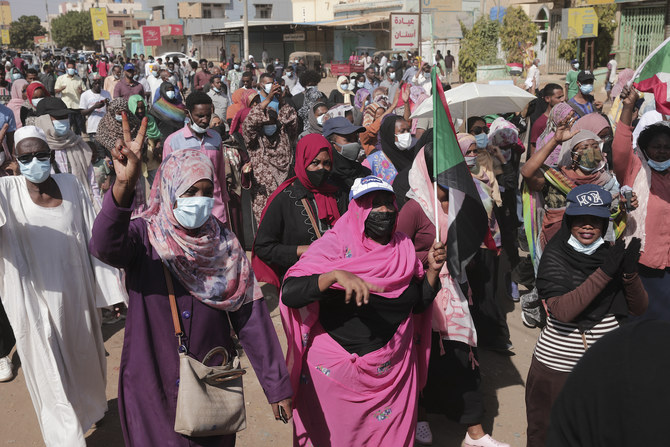
People protest in Khartoum, Sudan, Saturday, Nov. 13, 2021. (AP)
Short Url
Updated 14 November 2021
Follow

5 dead in crackdown on protest against military coup in Sudan

  • Security forces fire tear gas, live ammunition as tens of thousands take to the streets

JEDDAH: At least five people were killed and dozens injured on Saturday when army chiefs in Sudan cracked down on mass rallies protesting against last month’s military coup.

Security forces fired tear gas and live ammunition to disperse tens of thousands of people who took to the streets in the capital, Khartoum, and other cities.

The demonstrations come two days after military leader Abdel Fattah Al-Burhan formed a new ruling council that excluded the civilian coalition the military had been sharing power with since 2019.

Sudanese pro-democracy groups condemned the move and vowed to continue their campaign of civil disobedience and protests against the Oct. 25 coup.

Security forces closed bridges on Saturday between central Khartoum and its twin cities of Omdurman and Khartoum North, laying barbed wire to block access. Roads to strategic sites were also shut.

As protesters began to gather around the capital, security forces moved quickly to try to disperse them, firing tear gas and chasing demonstrators down side streets to prevent them reaching central meeting points.

“People were surprised that they fired the tear gas so early,” said one protester in Omdurman. Protesters “retreated into the neighborhood and barricaded the streets and now they’re coming back to the main road.”

The Central Committee of Sudanese Doctors, which is aligned with the protest movement, said protesters were “facing excessive repression using all forms of force including live bullets in several areas of Khartoum.”

In Wad Madani, southeast of Khartoum, large crowds gathered, chanting slogans including “Down, down with military rule.” There were also protests in Kassala in eastern Sudan and Atbara to the north.

The military takeover halted a transition toward democracy that began after the uprising that toppled dictator Omar Bashir in April 2019. Security forces detained senior officials appointed under a power-sharing arrangement between the military and civilian groups, and Prime Minister Abdalla Hamdok was placed under house arrest.

Protesters on Saturday carried pictures of Hamdok, now a symbol of resistance to military rule, while chanting against Gen. Al-Burhan and his deputy Mohammed Hamdan Dagalo, commander of the paramilitary Rapid Support Forces.

Mobile internet services have been cut off since the coup, despite a court order to restore them, and phone coverage has been disrupted, complicating efforts by the protest movement.

However, local resistance committees energized by the nomination of the new ruling council used flyers and organised smaller neighborhood protests in recent days.

“We reject any mediation or settlement with the coup leaders and will continue our struggle until we bring down the coup and bring the criminals to trial,” they said.

Despite pressure from Western powers that backed the transition, Burhan has pushed to consolidate the military’s position. Western states and the World Bank have suspended economic assistance designed to help pull Sudan out of decades of isolation and a deep economic crisis.


Israel warns will suspend several aid groups from Gaza

Updated 4 sec ago
Follow

Israel warns will suspend several aid groups from Gaza

  • Ministry says organizations that failed to submit list of Palestinian employees have been told their licenses will be revoked from January 1
JERUSALEM: Israel warned on Tuesday that it would suspend from January several aid organizations operating in Gaza for failing to provide details about their Palestinian staff, accusing two Doctors Without Borders employees of links to militant groups.
The Ministry of Diaspora Affairs and Combating Antisemitism said in a statement the move was part of Israel’s decision to “strengthen and update” regulations governing the activities of international NGOs in the Palestinian territory.
“Humanitarian organizations that fail to meet security and transparency requirements will have their licenses suspended,” the ministry said.
It added that organizations which “failed to cooperate and refused to submit a list of their Palestinian employees in order to rule out any links to terrorism” had received formal notice that their licenses would be revoked as of January 1.
The organizations concerned — whose names were not disclosed — were ordered to cease all activities by March 1.
The ministry said the groups were given 10 months to provide the requested information but “nonetheless failed to comply with the requirements.”
The ministry told AFP earlier this month that as of November 25, approximately 100 registration requests had been submitted and “only 14 organization requests have been rejected.”
“The remainder have been approved or are currently under review,” it added.
In its statement on Tuesday, the ministry alleged after an investigation that the international medical charity Doctors Without Borders (MSF) had employed two individuals with links to Palestinian militant groups.
“In June 2024, a member of Palestinian Islamic Jihad was identified as an employee of the organization,” it said.
“In September 2024, another MSF employee was identified as a Hamas sniper.
“Despite repeated requests, the organization did not provide full disclosure regarding the identities and roles of these individuals,” the statement added.
When contacted, MSF said it “would never knowingly employ people engaging in military activity.”
“Any employee who engages in military activity would pose a danger to our staff and our patients.”
The ministry’s statement did not say whether MSF’s license had been revoked.
“In terms of registration, MSF continues to engage and discuss with Israeli authorities,” the charity said. “We have not yet received a decision on re-registration.”
The ministry said its latest measures would not affect the delivery of aid to Gaza.
“Only a limited number of organizations — less than 15 percent — were found to be in violation of the regulatory framework,” it said.
Several NGOs have told AFP the new rules will have a major impact on aid distribution in Gaza.
The amount of aid entering Gaza remains inadequate.
While the October 10 ceasefire agreement stipulated the entry of 600 trucks per day, only 100 to 300 are carrying humanitarian aid, according to NGOs and the United Nations.