Biden, Xi agree to plan arms control talks: White House

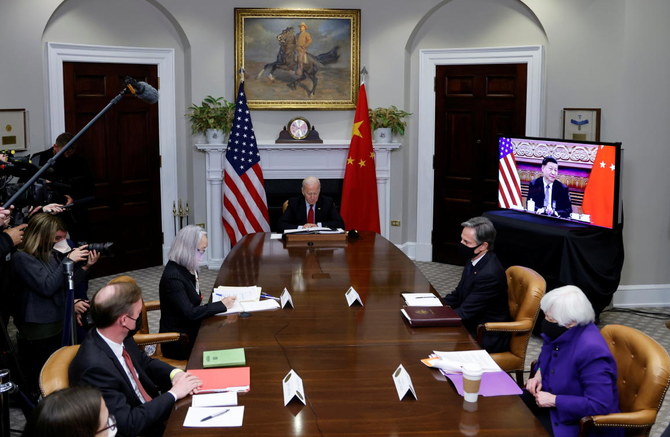
US President Joe Biden, with White House National Security Adviser Jake Sullivan, Secretary of State Antony Blinken and Treasury Secretary Janet Yellen, speaks virtually with Chinese leader Xi Jinping on Monday. (Reuters)
Short Url
Updated 16 November 2021
Follow

Biden, Xi agree to plan arms control talks: White House

  • Biden and Xi met via teleconference for over 3 hours late Monday in a bid to ease tensions between the world's top two economies
  • "President Biden did raise with President Xi the need for a strategic stability set of conversations," said National Security Advisor Jake Sullivan

WASHINGTON: US President Joe Biden and China’s Xi Jinping agreed during their virtual summit to work on organizing talks between the nuclear-armed nations on arms control, a senior White House official said Tuesday.
Biden and Xi met via teleconference for more than three hours late Monday (early Tuesday in Beijing) in a bid to ease tensions between the world’s top two economies and major geopolitical rivals.
“President Biden did raise with President Xi the need for a strategic stability set of conversations,” National Security Adviser Jake Sullivan told a conference, using an expression employed in diplomatic circles to indicate arms control.
“The two leaders agreed that we would look to begin to carry forward discussions,” he added, in comments made at the Brookings Institution think tank in Washington.
Sullivan, a top aide to Biden, had been asked about Beijing’s increasing military might.
The Pentagon recently confirmed that China in August carried out a test of a nuclear-capable hypersonic missile that would be difficult to defend against, and has said that Beijing is expanding its nuclear arsenal more quickly than anticipated.
While the United States and Russia have had a formal strategic stability dialogue since the days of the Cold War, producing several disarmament agreements, that is not the case between Washington and Beijing.
Biden’s predecessor Donald Trump repeatedly asked in vain that China be included in the US-Russian talks.
Biden, who took office in January, appears to be more interested in bilateral talks.
“That is not the same as what we have in the Russian context with the formal strategic stability dialogue that is far more mature, has a much deeper history to it,” Sullivan said.
“There’s less maturity to that in the US-China relationship, but the two leaders did discuss these issues and it is now incumbent on us to think about the most productive way to carry it forward from here.”


Lawsuit challenges Trump administration’s ending of protections for Somalis

Updated 8 sec ago
Follow

Lawsuit challenges Trump administration’s ending of protections for Somalis

  • The lawsuit cites a series of statements Trump has made describing Somalis as “garbage” and “low IQ people” who “contribute nothing.”

BOSTON: Immigrant rights advocates filed a lawsuit on Monday seeking to stop US President Donald Trump’s administration from next ​week ending legal protections that allow nearly 1,100 Somalis to live and work in the United States. The lawsuit, brought by four Somalis and two advocacy groups, challenges the US Department of Homeland Security’s decision to end Temporary Protected Status for Somali immigrants, whom Trump has derided in public remarks. Outgoing Homeland Security Secretary Kristi Noem in January announced that TPS for Somalis would end on March 17, arguing that Somalia’s conditions had improved, despite fighting continuing between Somali forces and Al-Shabab militants. The plaintiffs, who ‌include the groups ‌African Communities Together and Partnership for the Advancement ​of ‌New ⁠Americans, in the ​lawsuit filed ⁠in Boston federal court argue the move was procedurally flawed and driven by a discriminatory, predetermined agenda.
The lawsuit cites a series of statements Trump has made describing Somalis as “garbage” and “low IQ people” who “contribute nothing.”
The plaintiffs said the administration is ending TPS for Somalia and other countries due to unconstitutional bias against non-white immigrants, not based on objective assessments of country conditions.
“The termination of TPS for Somalia is racism masking as immigration policy,” ⁠Omar Farah, executive director at the legal group Muslim Advocates, said ‌in a statement.
DHS did not respond to ‌a request for comment. It has previously said TPS ​was “never intended to be a de ‌facto amnesty program.”
TPS is a form of humanitarian immigration protection that shields eligible migrants ‌from deportation and allows them to work. Under Noem, DHS has moved to end TPS for a dozen countries, sparking legal challenges. The administration on Saturday announced plans to pursue an appeal at the US Supreme Court in order to end TPS for over 350,000 Haitians. It ‌also wants the high court to allow it to end TPS for about 6,000 Syrians.

SOMALI COMMUNITY TARGETED
Somalia was first designated ⁠for TPS in ⁠1991, with its latest extension in 2024. About 1,082 Somalis currently hold TPS, and 1,383 more have pending applications, according to DHS. Somalis in Minnesota in recent months had become a target of Trump’s immigration crackdown, with officials pointing to a fraud scandal in which many people charged come from the state’s large Somali community. The Trump administration cited those fraud allegations as a basis for a months-long immigration enforcement surge in Democratic-led Minnesota, during which about 3,000 immigration agents were deployed, spurring protests and leading to the killing of two US citizens by federal agents.
In November, Trump announced he would end TPS for Somalis in Minnesota, and a month later said ​he wanted them sent “back to where they ​came from.”
The US Department of State advises against traveling to Somalia, citing crime and civil unrest among numerous factors.