KARACHI: Pakistan’s import of automobiles and other vehicles increased by 579 percent during the month of October amid widening trade deficit and depreciating national currency, though industrial stakeholders said it was still below the pre-pandemic level.
According to the data compiled by the State Bank of Pakistan, the country’s trade deficit increased by 106 percent to $7.6 billion during the July-October 2021 period of the current fiscal year as the nation’s imports increased by 65.4 percent to $25.1 billion from $15.1 billion last year.
The statistics related to the massive import of automobiles and other vehicles were released by the Trade Development Authority of Pakistan which indicated the sector's import bill had jumped from $20.26 million in October 2020 to $137.66 million last month, reflecting a 579 percent increase.
Meanwhile, the overall import of the transport group, including completed and semi-completed vehicles along with spare parts, increased by 140 percent to $1.5 billion during July-October 2021 (4MFY22) as compared to the corresponding period of the last fiscal year.
“The recent import of cars has witnessed an increase of 579 percent due to the arrival of the vehicles booked earlier, though it is still below the pre-COVID imports,” chairman of All Pakistan Motor Dealers Association HM Shahzad told Arab News on Tuesday. “The availability of ships and arrival of shipments have played a role in the rising number of auto imports.”
Pakistan’s growing imports have exerted tremendous pressure on the national currency, which closed at Rs174.89 to a dollar on Tuesday, gaining 0.23 percent against the previous close.
The sale of locally assembled passenger cars increased by 71 percent in the first four months of the current fiscal year from 43,865 units to 74,952 units, according to the Pakistan Automotive Manufacturers Association.
Car sales in October 2021 jumped by 45 percent from 11,997 units in October 2020 to 17,413 units last month. However, they declined by over eight percent on a monthly basis when compared to the statistics of September 2021.
Analysts attributed the growth in auto sales to the overall economic expansion amid a low-interest regime.
“The rise in auto demand has emerged within the context of economic growth triggered by the current interest rate scenario of seven to 7.25 percent which is very low,” Arsalan Hanif, an auto analyst at the Arif Habib Limited, commented. “The auto sales have increased due to consumer financing since the purchasing power of consumers has surged.”
Pakistan’s central bank recently took measure to limit auto financing through changes in regulations which effectively prohibit financing for imported vehicles.
It reduced the maximum tenure of auto finance from seven to five year and personal loan from five to four years.
The bank limited the auto financing availed to a single individual to not more than Rs3 million and increased the minimum down payment for auto financing from 15 to 30 percent.
Analysts said, however, the impact of the central bank’s measures would be visible after the first quarter of the next year.
“The impact is not visible currently since the auto delivery period has gone up to January and February and cars have already been booked and in the delivery pipeline,” Hanif said.
Dealers said the import and local assembling of passenger cars combined were still not meeting the growing demand in Pakistan which hovered around one million vehicles.
“The demand is not being met even through local assembling and imports combined since it is somewhere around a million vehicles,” Shahzad said.
Some dealers maintained the impact of price hike by local assemblers had also affected the sales of the imported vehicles.
“In a couple of years, the price of locally assembled cars has jacked up by Rs0.5-0.7 million which has also impacted the prices of imported cars,” Mirza Mehmood Baig, a motor dealer, said. “The sales have dropped because of higher prices.”
Dealers said due to the higher rates of local and imported vehicles, the major buying and selling activity was now gaining momentum in the market of used cars.


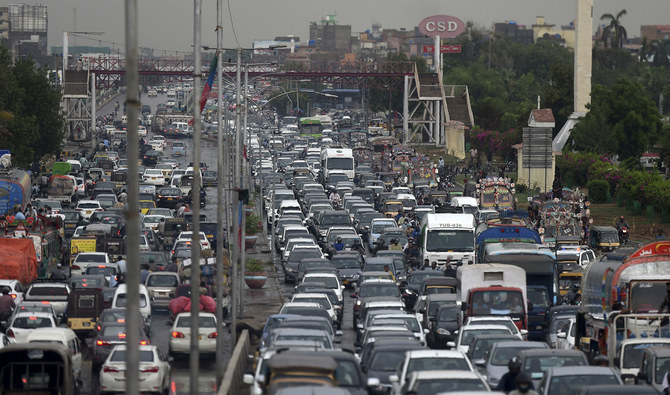
Pakistan’s car imports increased by 579 percent in October amid widening trade deficit
https://arab.news/g2z9d
Pakistan’s car imports increased by 579 percent in October amid widening trade deficit

- The country’s central bank has taken measures to limit auto financing, though the impact of the policy is likely to become visible in the next few months
- Industrial stakeholders say Pakistan’s auto imports are still below the pre-pandemic level

Kuwait-backed digital bank to enter Pakistan with $100 million investment
- Finance adviser Khurram Schehzad describes the development as sign of rising investor confidence
- It comes as Pakistan seeks foreign investment particularly from Gulf nations to bolster its economy
ISLAMABAD: Pakistan’s Finance Adviser Khurram Shehzad on Friday said Kuwait Investment Authority–backed Raqqami Islamic Digital Bank (RIDB) was set to invest $100 million in the South Asian country by launching operations in February this year.
The bank will be Pakistan’s first fully digital Shariah-compliant bank, according to its website. It offers online financing, savings, and payments to individuals and small-medium enterprises, with a focus on financial inclusion for underserved segments.
The development comes as Pakistan seeks foreign investment, particularly from Gulf nations, to bolster its economy and stabilize its finances. In 2024, the State Bank of Pakistan had issued a no-objection certificate to RIDB.
“Kuwait Investment Authority–backed Raqqami Bank set to launch in Pakistan with a $100 million investment,” Schehzad said in a post on X. “This is a strong vote of confidence in Pakistan’s improving economic outlook and reform momentum.”
Schehzad said Raqqami was backed by the State of Kuwait’s sovereign wealth fund, a development he described as a sign of rising investor confidence in Pakistan.
It also underscores strengthening investment ties between Pakistan and Kuwait, particularly in the financial and digital economy sectors, he added.
Earlier in January, Bank Islami launched Pakistan’s first Shariah-compliant QR payment gateway enabling real-time online payments allowing customers to pay instantly from their bank accounts and enabling merchants to receive payments securely through a smooth checkout experience.


