ISLAMABAD: A British man, who set out to cover 30,000 kilometers across the world on a tandem after being diagnosed with late-stage cancer at 24, found himself mesmerized by the exquisite landscapes in northern Pakistan.
Luke Grenfell-Shaw was diagnosed with a rare and aggressive sarcoma in June 2018 which had metastasized into his lungs. Yet, he decided to fight back by performing physically strenuous activities such as running a marathon in his hometown of Bristol in the United Kingdom.
In 2020, Grenfell-Shaw launched Bristol-2-Beijing, his plan to bike across the world not only to raise money for organizations fighting cancer but also to create awareness about what people with cancer were capable of. With a goal of raising GBP 300,000, he set off to introduce the world to “CanLivers.”
“Rather than the word ‘cancer survivor,’ which I think gives this false sense of certainty, I coined the word ‘CanLiver,’ or someone who is living with cancer,” he told Arab News on Monday while making a stopover in Islamabad. “Such people acknowledge their situation and the challenges and uncertainties associated with it, though they also demonstrate how people can live with cancer and still manage to fulfil their dreams and do much more.”
Grenfell-Shaw decided not to let his diagnosis stop him from living the life the way he wanted.
“There’s so many things that we can’t control, but it’s really important that we think about what we can control and do as much as possible with those things,” he continued. “I couldn’t control whether I had cancer or not, but I could control how I tried to live with it.”
“You only live once so you might as well make the best of it,” he added after a brief pause.
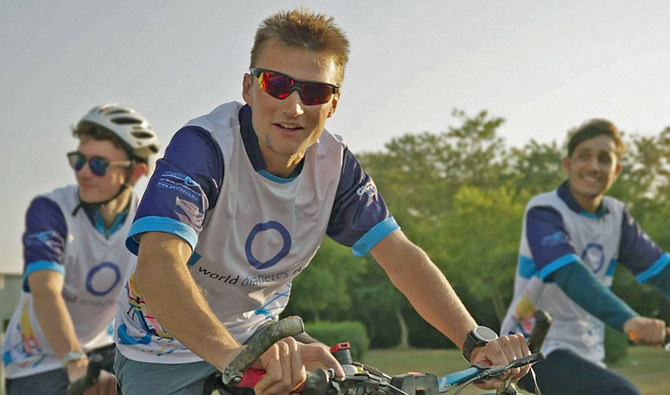
Before arriving in Islamabad, Grenfell-Shaw had already ridden across Europe, the Middle East and Central Asia. In Pakistan, he spent two weeks in the country’s north, biking through the Khunjerab Pass and taking in the mountains and landscapes of Hunza.
“We cycled across Pakistan for about two and a half weeks, covered 900 kilometers and did 9,000 meters of climbing. That’s insane! That’s more than like going through Kyrgyzstan, which is known as the Switzerland of Central Asia. The amount of climbing we did was ridiculous, like more than K2,” he said.
Grenfell-Shaw will be heading to Lahore from Islamabad where he will visit Shaukat Khanum Memorial Cancer Hospital and Research Center and make a donation.
He said his time in Pakistan had been a “really positive, warm experience.”
“I have been to many countries throughout the Middle East and Central Asia and I was really optimistic and expected a very warm welcome [in Pakistan],” he said. “That’s what so many Muslim countries actually give you. They are really, really hospitable. And that’s exactly what we’ve found here. It has been amazing that we had so many offers of chai. When the bike fell apart, people just came in and helped repair things. It’s been a really positive, warm experience.”
Grenfell-Shaw, who started his journey in January 2020, is doing so on a tandem bike, one that allows two people to cycle together. It was a decision he took to make his journey more inclusive by inviting people to join him from around the world.
Among the 150 people who joined him, 11 were CanLivers, “showing what’s possible with cancer.”
“I wanted to share this journey with different people because when you share an experience, it’s no longer a memory and becomes a conversation,” he said. “You develop friendships, much deeper friendships than you would with people otherwise, and you get to know people in a totally different way. So, for me, it’s a much richer way of traveling.”
One of the people who joined him on his bike was his university classmate and close friend, Edward Joseph Mitchell, who accompanied Grenfell-Shaw as he rode through northern Pakistan.
“When Luke got his diagnosis, as his close friend I was quite shocked, but we were all there for him immediately,” Mitchell told Arab News. “It’s crazy. Really. He is so fit and active and it’s incredibly encouraging for anyone. I don’t know anyone else who is as strong willed and as powerful and as positive as Luke is. It’s quite commendable on so many levels.”
Grenfell-Shaw, who is now in remission, will soon be heading toward India, Myanmar and China.
He has 13,000 kilometers left before he hits his final destination: Beijing.
Of his GBP 300,000 goal, he has already crossed GBP 100,000.
He also actively updates his followers about his location in the world by sharing latest news on his progress through his website, podcast and social media accounts.


![]()

Cycling around the world with cancer, Luke Grenfell-Shaw arrives in Pakistan
Short Url
https://arab.news/8cpz6
Cycling around the world with cancer, Luke Grenfell-Shaw arrives in Pakistan
- Luke Grenfell-Shaw was diagnosed with late-stage cancer two years ago but continued with rigorous physical activities like running marathons
- Last year, he decided to bike across the world on a tandem to raise money for organizations fighting cancer
Latest updates


Recommended


© 2026 SAUDI RESEARCH & PUBLISHING COMPANY, All Rights Reserved And subject to Terms of Use Agreement.