Iraq to start repatriating citizens in Belarus Thursday: ministry

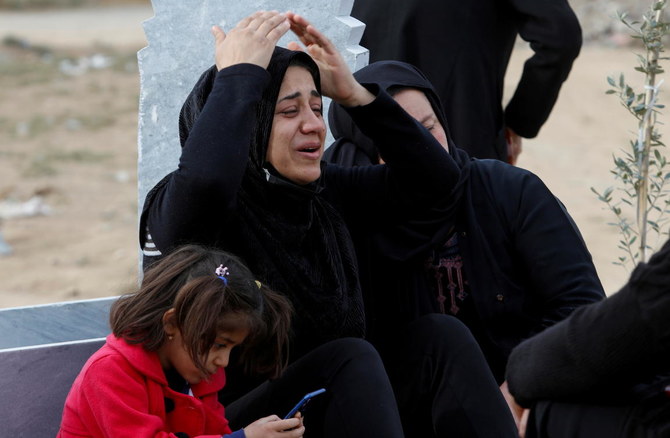
The sister of an Iraqi Kurdish migrant, who passed away in Belarus near the Polish border, reacts during his burial at a cemetery in Erbil, Iraq, November 15, 2021. (Reuters)
Short Url
Updated 15 November 2021
Follow

Iraq to start repatriating citizens in Belarus Thursday: ministry

BAGHDAD: The Iraqi government said it was organizing a repatriation flight this Thursday for its citizens stuck on the Poland-Belarus border on a “voluntary” basis.
“Iraq will carry out a first flight for those who wish to return voluntarily on the 18th” of November from Belarus, Iraqi foreign ministry spokesman Ahmed Al-Sahaf told Iraqi television overnight Sunday to Monday.
He did not say how many people would be able to board the Minsk-Baghdad flight, but said Iraq had recorded 571 of its citizens stuck on the border who have said they are ready to return “voluntarily.”
Thousands of migrants from the Middle East, including many from Iraq’s autonomous Kurdistan region, are camped out on the EU-Belarus border, creating a stand-off between the EU and US on one side and Belarus and its ally Russia on the other.
Western countries accuse Belarusian President Alexander Lukashenko’s government of engineering the crisis by encouraging migrants to come to Belarus and then taking them to the border.
Regular air links between Baghdad and Minsk have been suspended since August, while Belarusian diplomatic missions in Baghdad and Irbil, the capital of Iraqi Kurdistan, have been closed for more than a week.
The measures “have reduced the trips by Iraqis (to Belarus) but the problem is that some are now taking indirect flights, passing through Turkey, Qatar, the UAE and Egypt,” Sahaf said.
On Friday, Turkey banned citizens of Syria, Iraq and Yemen from flying from its airports to Belarus, while private Syrian carrier Cham Wings Airlines on Saturday halted flights to Minsk.
Iraq’s Kurdistan region presents itself as a haven of relative stability, but is often criticized for restricting freedom of expression. The region has been ruled for decades by two parties, the Patriotic Union of Kurdistan and the Kurdistan Democratic Party.
Several Iraqi Kurds have told AFP that a lack of economic prospects and security instability were behind their desire to leave.
European Commission vice president Margaritis Schinas is due to travel to Baghdad on Monday to discuss the migration crisis.


First responders enter devastated Aleppo neighborhood after days of deadly fighting

Updated 12 January 2026
Follow

First responders enter devastated Aleppo neighborhood after days of deadly fighting

  • The US-backed SDF, which have played a key role in combating the Daesh group in large swaths of eastern Syria, are the largest force yet to be absorbed into Syria’s national army

ALEPPO, Syria: First responders on Sunday entered a contested neighborhood in Syria’ s northern city of Aleppo after days of deadly clashes between government forces and Kurdish-led forces. Syrian state media said the military was deployed in large numbers.
The clashes broke out Tuesday in the predominantly Kurdish neighborhoods of Sheikh Maqsoud, Achrafieh and Bani Zaid after the government and the Syrian Democratic Forces, the main Kurdish-led force in the country, failed to make progress on how to merge the SDF into the national army. Security forces captured Achrafieh and Bani Zaid.
The fighting between the two sides was the most intense since the fall of then-President Bashar Assad to insurgents in December 2024. At least 23 people were killed in five days of clashes and more than 140,000 were displaced amid shelling and drone strikes.
The US-backed SDF, which have played a key role in combating the Daesh group in large swaths of eastern Syria, are the largest force yet to be absorbed into Syria’s national army. Some of the factions that make up the army, however, were previously Turkish-backed insurgent groups that have a long history of clashing with Kurdish forces.
The Kurdish fighters have now evacuated from the Sheikh Maqsoud neighborhood to northeastern Syria, which is under the control of the SDF. However, they said in a statement they will continue to fight now that the wounded and civilians have been evacuated, in what they called a “partial ceasefire.”
The neighborhood appeared calm Sunday. The United Nations said it was trying to dispatch more convoys to the neighborhoods with food, fuel, blankets and other urgent supplies.
Government security forces brought journalists to tour the devastated area, showing them the damaged Khalid Al-Fajer Hospital and a military position belonging to the SDF’s security forces that government forces had targeted.
The SDF statement accused the government of targeting the hospital “dozens of times” before patients were evacuated. Damascus accused the Kurdish-led group of using the hospital and other civilian facilities as military positions.
On one street, Syrian Red Crescent first responders spoke to a resident surrounded by charred cars and badly damaged residential buildings.
Some residents told The Associated Press that SDF forces did not allow their cars through checkpoints to leave.
“We lived a night of horror. I still cannot believe that I am right here standing on my own two feet,” said Ahmad Shaikho. “So far the situation has been calm. There hasn’t been any gunfire.”
Syrian Civil Defense first responders have been disarming improvised mines that they say were left by the Kurdish forces as booby traps.
Residents who fled are not being allowed back into the neighborhood until all the mines are cleared. Some were reminded of the displacement during Syria’s long civil war.
“I want to go back to my home, I beg you,” said Hoda Alnasiri.