

More Cirque du Soleil shows to come to Saudi Arabia, says president

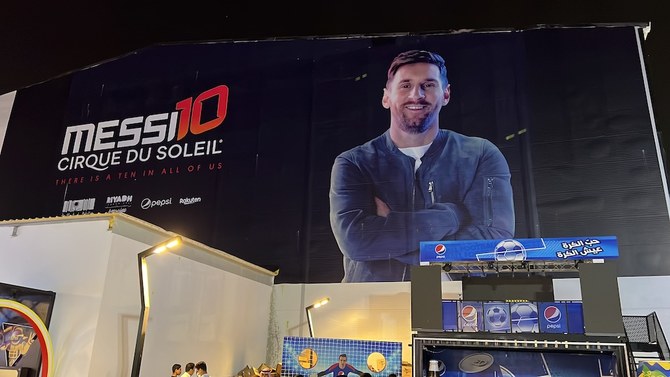
The show called “Messi10”, which lasts 90 minutes with a 25-minute intermission, pays homage to the Argentinian footballer. (AN Photo/Zaid Khashogji)
Short Url
Updated 11 November 2021
Follow

More Cirque du Soleil shows to come to Saudi Arabia, says president

  • Success of this year’s football-centred production brings hope of more dazzling spectacles in the future

RIYADH: The Canadian entertainment company Cirque du Soleil have more shows in the pipeline for Saudi Arabia after three well-received productions in the Kingdom.

Daniel Lamarre, president and chief executive officer of Cirque du Soleil, told Arab News that plans to bring more shows to the Kingdom are in the works after three successful undertakings. The first show was made exclusively for Saudi Arabia’s 88th national day in 2018, followed by the “Bazzar” production tour in 2019 and a return for the company at this year’s Riyadh Season.

The world-renowned circus of acrobats dazzled spectators on its opening night on Wednesday, with 46 performers from more than 20 nationalities in the company honoring the great Argentinian footballer Lionel Messi. “There is a ten in all of us,” runs the show’s tagline.

Few of the Paris Saint-Germain player’s peers can boast a spectacle like this.

Entitled Messi10, it captivates the audience with acrobatics, trampolines, diabolos, vertical ropes and lion dances. It narrates the story of Messi’s struggle to stardom and presents his legendary goals. A stout referee is cast in a jester role, bringing a comical touch.

“It’s massive, I didn’t expect it to be so big!” said Danae Knight, a British nurse at the Equine Hospital in Riyadh. “Saudi Arabia really puts on a show, I’ve always wanted to go see Cirque du Soleil and I was lucky enough to be in this beautiful country and be able to come.”

“We don’t have anything like that in England. It was amazing, it was completely mind-blowing, it was wonderful,” she said.

“The show was absolutely fantastic, the whole choreography, the music and how it all came together to tell us a story,” said Stewart Hassall, British auctioneer and race commentator at the Saudi Arabia Jockey Club.

“I was very impressed. It exceeded my expectations,” he said.

The audience sits on both sides of the stage like a crowd around a football pitch, enabling them to visually and physically feel the emotion and madness of the world of football.

Sony reportedly spent months searching for the right music that would bring Cirque du Soleil Messi10 to life.

The show premiered at Parc del Fòrum in Barcelona in 2019, followed by a world tour that began in 2020.

Messi10 is laid on by the Ministry of Culture and is located in the Riyadh Boulevard Arena, one of the many areas of the 900,000 square-meter Riyadh Boulevard City.

The two-hour show (which includes a 25-minute interval) is on Monday to Saturday at 8 p.m., except Thursday and Friday, when there two shows at 6 p.m. and 10 p.m.

Tickets can be found on the Riyadh Season mobile application or website, with prices starting at SAR115 ($30.66) and going up to SAR800.

Saudi Arabia’s Riyadh Season 2021 kicked off on Oct. 20 in the Kingdom’s capital with an opening parade attended by more than 750,000 people.


Najran’s camels are embedded in local culture and traditions

Camels are not only a vital livestock resource in Najran, but also a cornerstone of local identity and tradition. (SPA)
Updated 25 December 2025
Follow

Najran’s camels are embedded in local culture and traditions

  • Several distinct camel breeds are found in the region
  • Animals permeate Arab consciousness, says expert

RIYADH: In Najran, camels are not only a vital livestock resource but also a cornerstone of local identity and tradition.

According to Hadi Benyan Al-Amer, head of Najran’s Camel Association, the region has several distinct camel breeds.

Principal among them is the Awarik, an ancient Arabian lineage linked to territories where arak trees flourish, the Saudi Press Agency reported on Thursday.

These light-colored, sparsely-haired camels possess remarkable resilience, and are prevalent across southern Arabia.

The Majahim are characterized by dark hues spanning black to brown, and excel in both milk yield and endurance.

The Asayil are prized for their sleek, lean physiques, and dominate in speed-based competitions.

Al-Amer said traditional water sources known as Odood, or traditional water wells and artesian wells, have sustained herders navigating the Empty Quarter’s grazing lands for generations.

These permanent water points, equipped with dedicated drinking basins for camels, showcase the animals’ extraordinary environmental resilience.

Among the principal wells accessible from Najran are Al-Minkhali, Abu Shadid, Hamra Nathil, Tamani, Umm Al-Wahat, and Khujaima.

Countless additional wells dot the Empty Quarter and adjacent territories, forming the backbone of camel owners’ far-reaching pastoral networks.

Dr. Hind bint Dawood Al-Shuqair of Najran University’s Arabic Language Department explained how camels have permeated Arab consciousness through legends and stories spanning thousands of years.

Representing endurance, power, and grace, they have become inseparable from Arab cultural identity.

Archaeological evidence at Al-Ukhdood, Mount Al-Tharwa and Hima, preserves through carvings and ancient artwork the deep bond between people and camels, Al-Shuqair said.

She drew attention to Saudi Arabia’s substantial investment in camel heritage, exemplified by proclaiming 2024 as the Year of the Camel.

This designation emphasizes their importance to national prosperity and cultural heritage while backing global initiatives to promote awareness of camels as valuable economic and cultural assets.

The Kingdom further demonstrates its commitment to protecting the animals through the annual King Abdulaziz Festival, the SPA reported.