

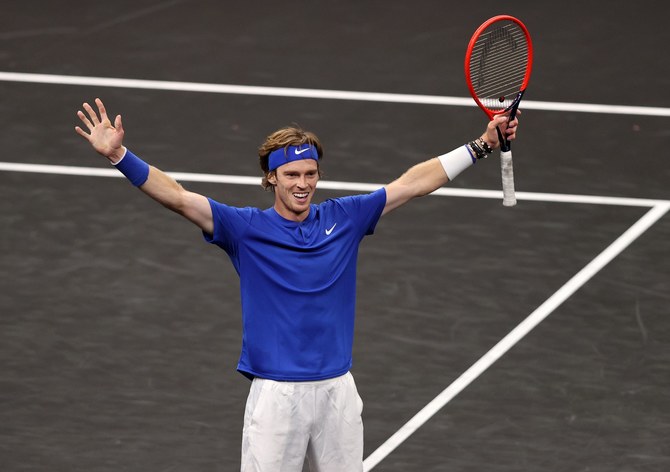
World No. 5 Andrey Rublev confirmed for Mubadala World Tennis Championship in Abu Dhabi

Andrey Rublev has been confirmed for the Mubadala World Tennis Championship in Abu Dhabi this December. (MWTC)
Short Url
Updated 14 November 2021
Follow

World No. 5 Andrey Rublev confirmed for Mubadala World Tennis Championship in Abu Dhabi

  • 13th edition of MWTC is back at International Tennis Centre, Zayed Sports City from Dec. 16-18

ABU DHABI: World No. 5 Andrey Rublev is heading to Abu Dhabi for the Mubadala World Tennis Championship, which returns after a year’s absence to the International Tennis Centre, Zayed Sports City, from Dec. 16-18.

The Russian tennis ace, who has enjoyed a successful 2021 season, knows the championship well having made his Abu Dhabi debut in 2017 and lined up for the 12th edition in 2019. Rublev’s confirmation means the championship now has five of the world’s top 20 male players, along with women’s US Open champion Emma Raducanu and fellow Olympic champion Belinda Bencic, lining up for the three-day festival.

Championship owners Flash Entertainment recently announced the tournament will operate at full capacity following the updated pandemic-related protocols for events, making it also accessible to international visitors after Abu Dhabi’s recent lifting of quarantine requirements for fully vaccinated travelers.

“We’ve raised the bar every year since the inception of the Mubadala World Tennis Championship and always strive to bring the best players in the world to Abu Dhabi,” said John Lickrish, CEO, Flash Entertainment.

“Andrey has a great connection with the championship and has a strong following in the UAE, so his return to a full stadium will undoubtedly create a lot of enthusiasm among tennis fans in the UAE and beyond.”

Rublev is relishing his return to the UAE capital, having enjoyed a fine season during which he reached a career high of World No. 5, earned a gold medal in the mixed doubles at 2020 Tokyo Olympics and won the ATP title in Rotterdam — his eighth career title — as well as recording 47 singles victories.

“It’s really exciting to be heading back to Abu Dhabi and playing in front of the fans there. They really know their tennis and make a real difference. And with the event at full capacity, it’s going to be a great way to begin a busy 2022 season,” said the 24-year-old.


The perils of comparing T20 franchise cricket leagues

Updated 12 sec ago
Follow

The perils of comparing T20 franchise cricket leagues

  • By most criteria, major cricket outlets consider the IPL the top league, but elsewhere factors such as entertainment and viability play a role in the rankings

LONDON: On occasion, I am asked to compare the franchised cricket leagues — a subjective exercise, given there are no agreed criteria on which to base such analysis.

It was interesting, therefore, to discover last week that The Cricketer magazine has published its own ranking of the leagues. It is not the first to do so — in August 2025, the BBC produced an assessment under the heading “Which franchise league is most entertaining?”

There is an understandable tendency for such rankings to focus on the biggest leagues. According to the World Cricketers Association, there are just short of 50 active short-form cricket leagues around the world. The Cricketer drew up its rules of engagement to include leagues that it judged to be “franchise-style,” excluding the T20 Blast in England and Wales which features the same county clubs that compete in other forms of domestic cricket. Only men’s leagues were included, whilst competitions that were not the biggest within a certain country or territory were excluded. This meant, for example, that the ILT20 was chosen as the UAE's primary league rather than the Abu Dhabi T10.

This pruning reduced the number of leagues under consideration to 10. Three criteria were set: the quality of cricket, entertainment value and viability.

The quality criterion related to the on-field spectacle, including the standard of players on show and the competitiveness of the league. Entertainment related to crowd engagement and spectator experience, both in-ground and through the league's broadcast. Viability focussed on whether each league was likely to not only survive, but tthrive in the long run.

In order to truly apply these criteria, a range of relevant metrics needs to be available. They vary in sufficient quantity and quality, breadth and depth. The BBC analysis did adopt imaginative metrics to create an entertainment index, based on data from CricViz. These included the average number of fours and sixes per game, dot-ball percentage, the impact of home advantage, average strike-rate, the style of bowling taking the wickets and how many games went down to the last over or even the last ball.

The whole ethos of T20 cricket is that it should be entertaining. My observations are that spectators respond most enthusiastically to six-hitting, followed by spectacular catching, the sight of ball breaking wicket and close finishes. One of the criticisms of T20 cricket is that it has become weighted too much in favor of batters, encouraged by the provision of pitches and balls which offer little help to bowlers, along with restrictions on the number of boundary fielders. No bowler likes being hit for six, so they have had to hone new skills in their attempts to reduce the incidence. These attempts may have gone unnoticed by those who only wish to see sixes hit.

This comes back to how should the quality of cricket be defined. Instinctively, it might be assumed that it equates with the quality of the players. Both The Cricketer and the BBC place the Indian Premier League first on this metric. The Cricketer focussed on the IPL’s commercial might and its lasting ability to pull spectators and viewers in over eight long weeks. It is difficult to distinguish whether its attraction is the quality of cricket, the charisma of the players or the entertainment value.

All of India’s best players and emerging talent are available for the whole IPL. Four overseas players are allowed per playing XI. No Pakistanis are invited and, in 2026, no Bangladeshis. It could be argued that their exclusion means that the IPL does not maximize its quality. If an inclusivity criterion were added then the IPL’s rating would be negatively affected.

The BBC’s assessment of quality, as distinct from entertainment levels, focussed on the quality of player in each league, based on international caps across all formats. This was expressed as the average number of international caps held by the starting XIs in each game. Significant variation exists. The IPL had 335 but was behind ILT20 with 423 and the Pakistan Super League with 351. Australia’s Big Bash League was way below with an average of 145. There are structural reasons for these differences.

During the BBL, in which teams are allowed three overseas players in a playing XI, Australia’s best cricketers play an international series. Their unavailability was a factor in the BBC’s seventh placed ranking for the BBL, compared with third place by The Cricketer. Conversely, the PSL was ranked sixth by The Cricketer and third by the BBC. This is despite the challenges which it has faced in its 10 years. One of those challenges is its scheduling in relation to international commitments and other franchise leagues, with which it competes for players.

In 2026, it runs from March 26 until May 3, overlapping with the IPL. Its need for international players has increased with its expansion from eight to 10 teams. In recent days, several high-profile players have announced that they have reversed their original intention to participate, citing personal reasons.

In the ILT20, nine overseas players, one of whom must be from an associate country, are allowed per XI, with the other two places mandated for UAE players. The league had a salary cap of $2.5 million per franchise in its first three seasons, the highest outside of the IPL. In the recent fourth edition, the salary cap was reduced to $2 million, plus $250,000 for two wildcards. Other factors now come into a player’s decision making, such as the length of tournament and being in one place for its duration.

South Africa’s SA20 has a secure base in high quality local talent and a strong base in spectator attendance and involvement. ILT20 does not have that, yet, and it will take time to build up. It was this factor that was influential in The Cricketer placing SA20 second in its overall ranking and ILT20 in eighth place. The panel also downrated ILT20 in terms of its viability. This was based on its reliance on a broadcast deal with an Indian TV company and its dependency on overseas players, suggesting that UAE players “hardly feature beyond fielding.” In the most recent tournament, a UAE player scored the second highest number of runs and another took 13th spot. Two UAE bowlers were in the top four leading wicket-takers.

ILT20 has a clear strategy to develop local talent and has domestic structures in place to underpin this. On the surface, franchise leagues may look as if they have only one goal — to make money and achieve self-sufficiency for the national board. What is not so readily apparent is their investment in talent-hunt programs. Cricket South Africa was quite open about its reasons for introducing SA20. It was in serious financial difficulty and deliberately prioritized the franchise league to address not only that problem but also reawaken interest in the game and uncover new talent. In the last two years the performance of its national team has improved dramatically. Perhaps an additional criterion for ranking franchise leagues should be their success in contributing towards domestic cricket development.

There has been no space to discuss the Caribbean Premier League, The Hundred, the US’s Major League Cricket, the Lanka Premier League or the Bangladesh Premier League. The Cricketer ranked them fourth, fifth, seventh, ninth and 10th, whereas the BBC placed The Hundred at four and the CPL at five. It did not consider the leagues in the US, Sri Lanka or Bangladesh. These variations reflect the use of different criteria and the subjective nature of the assessments. However, by available criteria, it is obvious to all that the IPL is the top league. Until a more rigorous set of criteria is developed, the debate about the relative positions of other leagues will occupy many a cricket conversation.