

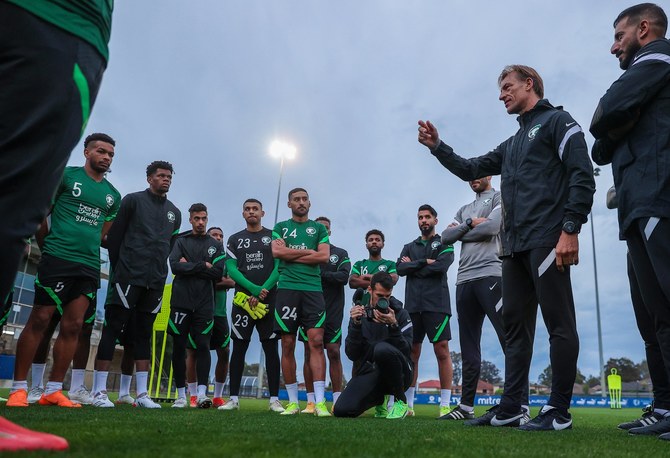

On Friday’s flight to Australia, Saudi Arabia coach Herve Renard had plenty of time to think about how qualification for the 2022 World Cup is going.
The Frenchman will be delighted with the four wins from four in the final round to sit three points ahead of Thursday’s opponents and six ahead of Japan. As it stands, the Green Falcons are very well placed to take one of the top two automatic qualification spots from the six-team Group B.
In the final round of qualification every game is big, with every three points a massive step toward the promised land.
There is more this week, however, as this is surely the biggest test that the Green Falcons have faced under Herve Renard since he took the job in the middle of 2019.
Let us count the reasons why. The first, most obvious point, is that Australia are one of Asia’s top teams, ranked 34 in the world, 15 places higher than Saudi Arabia. The 2015 continental champions have qualified for the last four World Cups, and as well as that history there is the present form.
Ahead of last month’s 2-1 loss in Japan, a defeat that was sealed with three minutes left thanks to an own goal, the Socceroos had won 11 World Cup qualifiers in succession — an impressive record and a world record.
Even more impressive was the fact that all those games took place away from home. The global pandemic and the decision of the government in Canberra to seal the international borders forced Graham Arnold’s men to play all their football a long way from home.
And that means there is another hurdle for Saudi Arabia to deal with. This is the first game since 2019 that will take place in Australia. On home soil, the Socceroos have a formidable record in qualification — one of the best on the planet.
Instead of facing them in Qatar or the UAE as could have happened, Saudi Arabia will have to make the mammoth journey all the way Down Under. It is hard enough at the best of times, but there will be more excitement in the country and especially among the 22,5000 fans at the Sydney stadium at the rare sight of their stars back playing in Australia.
There is more. The defeat to Japan means that Australia cannot afford to lose to another rival for the top two spots. The hosts are aggressive at home as a matter of course, and the intensity will be at the highest level this week. Win this and Australia will go top at the halfway stage. A draw would likely leave them just a point above Japan, assuming the Samurai Blue win in Vietnam, and a loss could see them drop out of the top two.
While Saudi Arabia finished above Australia in the final round of qualification for the 2018 World Cup, they have to overcome a poor record against the team. Since the 1-0 victory at the 1997 Confederations Cup in Riyadh, Saudi Arabia have drawn one and lost four of the meetings, all of which have taken place since 2011.
So there is plenty for the visitors to deal with: History, form, home advantage and jetlag. Throw in a few absences and the task becomes that little bit harder.
Goalkeeper Mohammad Al-Owais was injured during the 3-2 win over China in October and his absence was felt immediately as a mistake by replacement Fawaz Al-Qarni gifted Team Dragon a goal and a way back into the game that could have cost his team two points. Left-back Yasser Al-Shahrani is also injured and his crosses, as well as defensive work, will be missed. Center-back Abdullah Madu leaves another hole to fill.
Yet, so far under Renard in qualification Saudi Arabia have been able to overcome all that has been thrown at them.
Salem Al-Dossari was out last month and while the star attacker will always be missed, up stepped Sami Al-Najei to score two goals against China. Saul Abdulhamid came in at left-back and did not look out of place. Under Renard, the squad has become more settled and every player knows what they have to do, whether they have to do it every game or just now and again.
The good news is that Al-Dossari is back to full fitness and is in the form of his life. There have been some pundits and ex-players in Saudi Arabia who have said of late, as the winger has helped Al-Hilal to another AFC Champions League final, that he is currently the best player in Asia. That is debatable but on current form, the 30-year-old, who scored against Australia in qualification for the 2014 and 2018 tournaments, is not far away.
With Renard at the wheel and the fact that Saudi Arabia have been steadily improving under the coach who led two different teams to African Nations Cup success, there is no reason to fear this test Down Under, the toughest of the past two years.
Instead, the group leaders should embrace this as an opportunity to show just how far they have come and how far they can go.


